


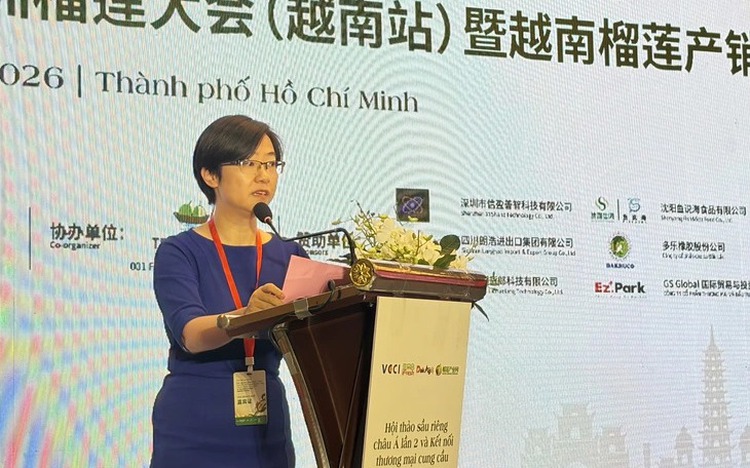
Cai Jianfei, founder of China's iFresh Asia Fruit, delivers remarks at the second Asian Durian Conference in Ho Chi Minh City, southern Vietnam, July 14, 2026. Photo: Nghi Vu / Tuoi Tre
They are among more than 500 delegates, including government officials, agricultural experts, and business representatives, attending the second Asian Durian Conference in Ho Chi Minh City on Tuesday.
The conference was jointly organized by the Ho Chi Minh City branch of the Vietnam Chamber of Commerce and Industry (VCCI-HCMC), China's iFresh Asia Fruit B2B platform, and Dakago Co., Ltd., a Vietnamese agricultural supply chain company.
The event also featured a Vietnam-China durian business matching program aimed at strengthening commercial ties between exporters and buyers, enhancing cross-border supply chain connectivity, increasing the value of Vietnamese durians, and expanding bilateral business cooperation.
The conference came as durians have become one of Vietnam's fastest-growing agricultural exports, with the country's durian export value surging from more than US$277 million in 2022 to a record $4 billion in 2025, an increase of over 14-fold in just three years.
Tran Ngoc Liem, director of VCCI-HCMC, said the industry's rapid growth not only presents significant opportunities but also poses growing challenges.
He said the conference was expected not merely to promote trade between Vietnamese and Chinese businesses but also to provide a platform for both sides to discuss technical requirements across the entire export chain, from growing areas to customs clearance.
Such discussions have taken on added importance since Vietnam introduced a nationwide durian traceability system on July 1, 2026, he added.
China remained by far the largest buyer of Vietnamese durians, importing $492 million worth of the fruit during the period, up 76.7 percent from a year earlier and accounting for 87.5 percent of Vietnam's total durian exports, according to the Voice of Vietnam.
Against this backdrop, Cai Jianfei, founder of iFresh Asia Fruit, underscored that the strong turnout of businesses from both countries reflected growing demand for closer cooperation.
Cai said her company invited representatives of more than 100 Chinese enterprises from major distribution channels, including Pagoda and Xianfeng Fruit, as well as retailers, wholesalers, importers, exporters, and distributors.
She also noted that China remains one of the world's most dynamic durian markets, with robust consumer demand.
However, the market is shifting from prioritizing supply toward placing greater emphasis on product quality and brand value.
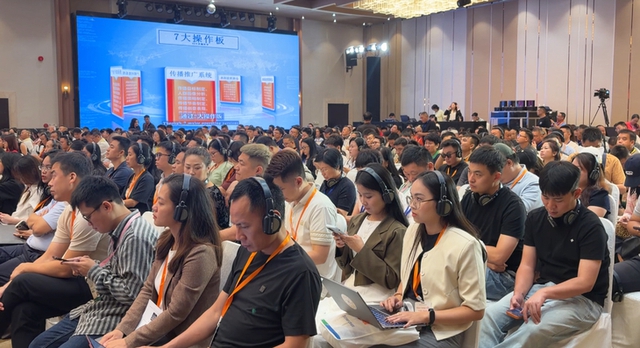
Delegates attend the second Asian Durian Conference and a Vietnam-China durian business matching program in Ho Chi Minh City, southern Vietnam, July 14, 2026. Photo: Nghi Vu / Tuoi Tre
That shift is expected to drive deeper cooperation between Vietnamese and Chinese businesses beyond traditional buyer-seller relationships across the entire durian value chain.
Many Chinese companies attending the conference also showcased solutions in crop protection, post-harvest technology, processing, cold storage and distribution, opening up opportunities for deeper cooperation across the durian supply chain.
Sharing market insights, Yang Li'an, founder of Zhongshan Xianhe Biotechnology Co., Ltd., said about 80 percent of losses in the durian trade stem from quality issues such as cracked husks, poor flesh quality, uneven ripening, and pesticide residues, with only about 20 percent attributable to price fluctuations.
He said most of these quality-related problems can be addressed through improved post-harvest technology, while effective quality control at the growing-area level is key to improving export performance and product value.
Nguyen Thi My Duy, director of 001 Fruits Co., Ltd., a Vietnamese company based in Dong Thap Province, said demand from China remains strong, but increasingly stringent market requirements mean Vietnam's durian industry needs to accelerate its transition from informal cross-border trade to official exports while meeting higher quality standards.
She added that increasingly stringent requirements for quality, traceability, and post-harvest technology are creating opportunities for Vietnamese businesses to participate more deeply in the supply chain through processing, cold storage, logistics, and related support services, helping increase the value of Vietnamese durians.








Max: 1500 characters
There are no comments yet. Be the first to comment.