


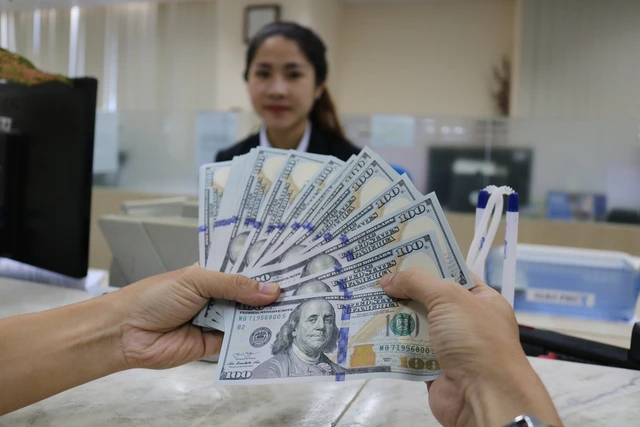
This illustrative image shows a U.S. dollar transaction at a bank in Vietnam. Photo: Ngoc Phuong / Tuoi Tre
Inflows sent through banks and money transfer companies dropped 16.9 percent from a year earlier to just over US$2.004 billion in the quarter, the branch said.
The amount also represented a 15.6-percent decline from the fourth quarter of 2025, extending a downward trend that began late last year.
The branch noted that remittances had been on a steady decline from the final months of 2025 into early 2026.
In the fourth quarter of 2025, inflows through credit institutions and economic organizations in the city reached nearly $2.38 billion, down 13.3 percent from the previous quarter.
Tran Thi Ngoc Lien, deputy director of the branch, said the decline was driven by a combination of global economic and financial pressures.
She pointed to a slow and uneven recovery of the world economy that has affected the incomes of overseas Vietnamese.
High inflation and rising living costs in many countries have also reduced their capacity to send money home.
Tight monetary policies in major economies have further constrained production and business activities, indirectly affecting wages and the cash flow available for remittances.
Ongoing military conflicts in the Middle East have added to global volatility by pushing up energy prices and sustaining inflationary pressure.
In some Middle Eastern countries where Vietnamese workers are present, localized disruptions in economic activity have also impacted employment and earnings, reducing remittance capacity.
However, the branch noted that the region does not account for a significant share of total inflows, meaning its impact is indirect rather than a key driver of the overall decline.
Domestically, Vietnam's macroeconomic environment remains stable, but some investment channels have not been attractive enough to encourage stronger remittance inflows.
In addition, the relatively narrow interest rate gap between the Vietnamese dong and the U.S. dollar has also influenced remittance decisions.
Seasonal factors have also contributed to the downturn, as remittances typically peak toward year-end each year for holiday and Lunar New Year (Tet) spending before easing in the first quarter of the following year.
Looking ahead, Lien said flows are unlikely to show a clear upward trend in the near term as they remain closely tied to global and domestic economic conditions.
She noted that remittances often recover modestly in subsequent quarters after the early-year low, as employment and economic activity among overseas workers stabilize following the holiday period.
However, conflicts in the Middle East and other parts of the world remain complex, continuing to affect energy prices, inflation and market sentiment, thereby weighing on the global economy and, in turn, the income and savings of overseas Vietnamese, which could further dampen remittance flows.
Data from the central bank also showed that in neighboring Dong Nai Province, remittances reached more than $36.4 million in the first quarter of this year, mainly through credit institutions, down 15.7 percent from the fourth quarter of 2025.
- REFERENCE MORE









Max: 1500 characters
There are no comments yet. Be the first to comment.