


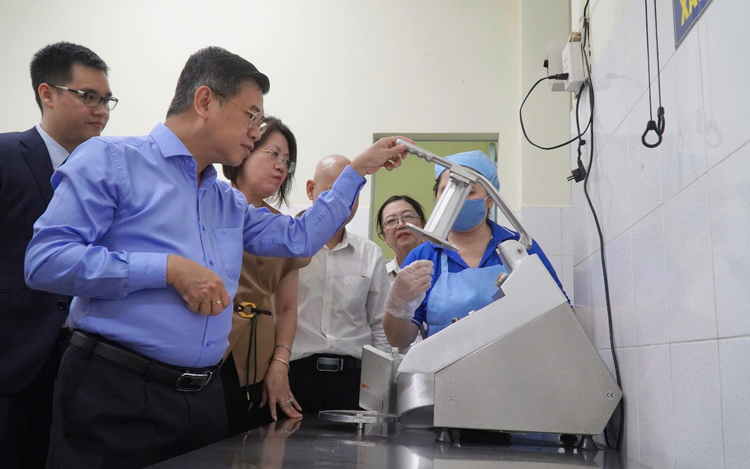
Nguyen Van Dung, vice-chairman of the Ho Chi Minh City People’s Council, checks a peeling machine at Kindergarten 19/5 in Binh Dong Ward. Photo: Quynh Tram / Tuoi Tre
The initiative is planned to reach every school across the city.
Under the program, parents can trace the origin of ingredients used in school meals by scanning a QR code.
All information related to food served in school cafeterias is digitized and integrated into an electronic platform.
Scanning a QR code, parents can access details about each ingredient, including its origin, supplier, and other relevant information associated with their child’s meal.
The People’s Committee of Binh Dong Ward, in cooperation with the municipal department, launched the initiative at school kitchens on Friday.
The ward had previously piloted the initiative in four kindergartens.
Tan My Ward launched the ‘Green Tick of Responsibility’ model on July 9 to build a safe food supply chain for school kitchens, making it the first ward in the city to implement the initiative.
The initiative has attracted 12 supermarket chains, more than 449 food suppliers, and over 5,460 approved products, laying the foundation for a broader food traceability network across Ho Chi Minh City’s education system.
Speaking at the launch ceremony, Phan Thao Ly, principal of Kindergarten 19/5, said parent engagement has increased significantly since the school began updating food information daily through its electronic communication platform and website.
Even during the summer break, when only about 195 students attended the school’s boarding program, each post featuring the daily menu received more than 300 views, she said.
Parents have also become more proactive in providing feedback on menus, meal quality, and children’s food preferences.
Beyond improving communication with families, the model strengthens schools’ ability to monitor food safety.
Ly shared that every food shipment undergoes a visual quality inspection before staff scan the QR code to verify supplier information and supporting documentation prior to food preparation.
Dao Ha Trung, chairman of the Ho Chi Minh City High Technology Association, said the initiative uses blockchain technology to store data in a transparent, publicly accessible, and tamper-resistant format.
The system allows parents to independently verify food sourcing and supply chain information, helping improve food safety oversight, while strengthening trust between schools and families.
Greater transparency enables teachers to focus more on teaching and caring for students, he said.
Vu Yen Oanh, vice-chairwoman of the Binh Dong Ward People’s Committee, said the ‘Green Tick of Responsibility’ initiative is intended to become more than a symbolic campaign, serving instead as a practical safeguard for students’ health.
Oanh called on school administrators, childcare providers, and independent preschool operators to review their boarding kitchen procedures.
Public schools have been instructed to implement the model immediately, while private schools and childcare groups are encouraged to participate.
Relevant agencies will continue providing guidance, inspections, and oversight during implementation.
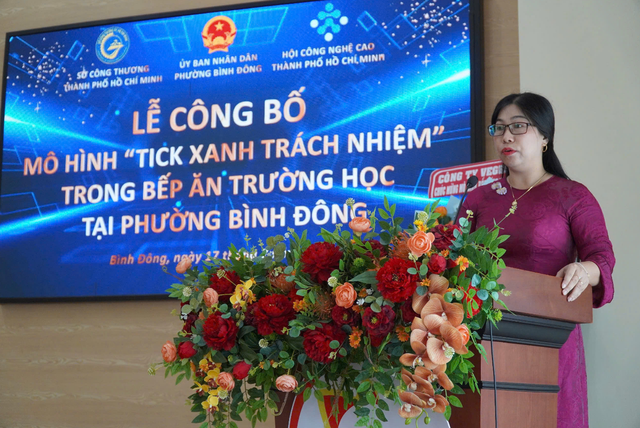
Phan Thao Ly, principal of Kindergarten 19/5 in Binh Dong Ward, Ho Chi Minh City, introduces the ‘Green Tick of Responsibility' model. Photo: Quynh Tram / Tuoi Tre
Encouraging businesses to meet higher standards
Nguyen Nguyen Phuong, deputy head of the Ho Chi Minh City Department of Industry and Trade, cited inspection data collected between mid-April and mid-May as saying that authorities identified and fined some 10 percent of inspected establishments for food safety violations.
During that period, 3,687 facilities were penalized, with total fines exceeding VND22 billion (US$840,000).
The figures demonstrate that food safety cannot rely solely on inspections, given limited enforcement resources, Phuong said.
Instead, an effective system should encourage businesses to voluntarily uphold safety standards, while enabling consumers to participate in monitoring.
Making supply chain information publicly available allows consumers to identify products that meet safety requirements, creating stronger incentives for businesses to invest in higher-quality production and expanding market opportunities for certified agricultural and food products.
At the launch event, all participating non-public educational institutions and food suppliers signed commitments to comply with food hygiene and safety regulations.








Max: 1500 characters
There are no comments yet. Be the first to comment.