


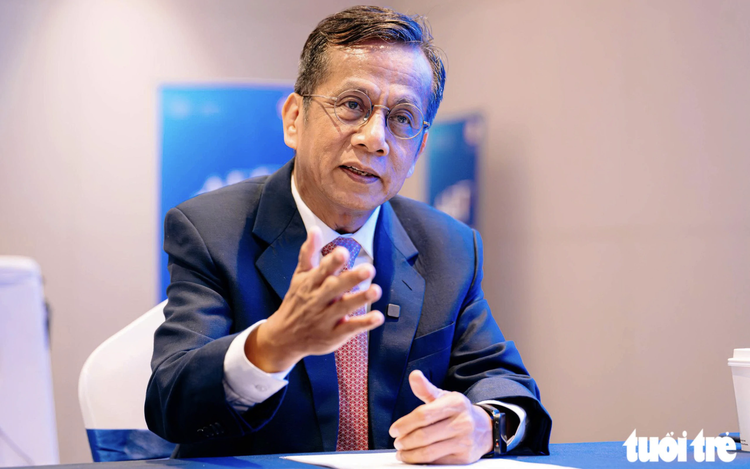
Philippine Secretary of Economy, Planning and Development Arsenio M. Balisacan speaks to Tuoi Tre (Youth) online newspaper on the sidelines of the Autumn Economic Forum 2026, held in Ho Chi Minh City. Photo: Thanh Hiep / Tuoi Tre
As the first speaker at the high-level plenary session of the Autumn Economic Forum 2026, held in Ho Chi Minh City on the morning of October 28, Balisacan set out an urgent challenge for economies: how to stay open while becoming more resilient.
“Openness creates opportunities. Productivity turns opportunities into growth. Resilience makes growth sustainable,” he said.
Just a few hours later, sitting down for an exclusive interview with Tuoi Tre on the sidelines of the event, Balisacan brought that message closer to home, using the example of two megacities: Ho Chi Minh City and Manila.
The two cities, like the two countries, need not be rivals, he said, stressing that the growth of one opens up more opportunities for the other.
Megacities as ‘magnets’ for growth
Megacities like Metro Manila and Ho Chi Minh City act as magnets, drawing businesses, innovation projects and talent, Balisacan said.
Bringing these resources together allows local economies to operate more efficiently, he explained.
Goods are produced at lower cost, while there are more products.
Also, labor productivity and capital efficiency improve.
“In economics, we call that agglomeration economies, meaning the process of bringing all forces together to make productivity grow faster. That is the role of megacities,” he said.
Metro Manila and Ho Chi Minh City each account for a large share of their country’s total output, so their growth should be encouraged, he said.
He also warned, however, that megacities can be a double-edged sword.
“If you don’t manage them well, they aggravate existing problems like pollution, traffic congestion, housing problems, and high cost of living,” he said.
Drawing on the speeches by Vietnamese Prime Minister Le Minh Hung and other speakers at the session, Balisacan said Ho Chi Minh City is being planned for the long term so that it will remain vibrant, productive and livable.
“I think that’s what every city must aspire for: even as it attracts a lot of businesses, talent and people, the city becomes livable and is still people-centered.”
Achieving this requires extensive urban planning and close coordination among stakeholders, particularly between local authorities and central agencies.
He cited the Philippines’ own experience as an example.
“Metro Manila is made up of several different local authorities," he said.
“Considerable coordination among these local authorities is needed to ensure the metropolitan area functions efficiently, remains liveable and provides the services people need, particularly transport, housing, electricity and water.
“All these elements must be coordinated in an integrated manner.”
Ho Chi Minh City is "in a much better position," he said, because it is less dense than Metro Manila and still has plenty of room to plan better.
Ho Chi Minh City has about 2,038 people per square kilometer, compared with 22,561 in Metro Manila.
The city is also planning more mass transit systems to connect different parts of the megacity, and especially to link it with regions beyond the metropolis.
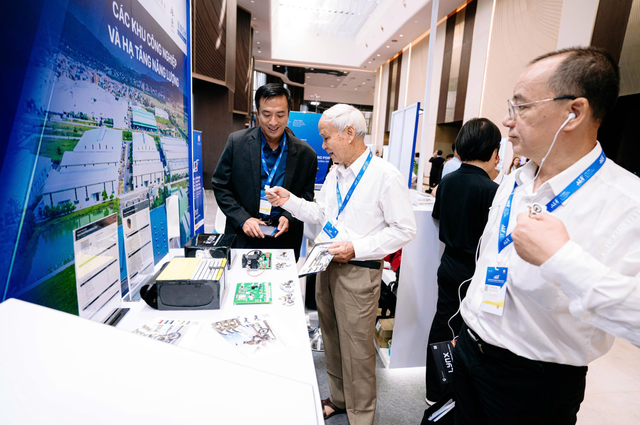
A booth showcases battery energy storage technology products at the Autumn Economic Forum 2026, Ho Chi Minh City. Photo: Thanh Hiep / Tuoi Tre
Vietnam’s growth windens doors for the Philippines
Balisacan was impressed by Vietnam’s target of achieving double-digit economic growth during the 2026-30 period, as outlined at the forum.
He believes such growth would also benefit countries like the Philippines.
“When Vietnam achieves double-digit growth, Philippine companies will have more opportunities to invest in Vietnam," he said.
“Similarly, that growth will generate positive spillovers for countries such as the Philippines in the form of investment.
“When the Philippines also pursues rapid growth, both countries benefit from each other.
“Growth is good for both nations.”
At the city level, Balisacan noted that Manila and Ho Chi Minh City share a common ambition: attracting as many opportunities as possible, from investors and talented professionals to innovation and new technologies.
There are a lot of opportunities for both megacities, even though within the region they may compete for talent.
“But I think competition should not be the one that dominates the discussion," he remarked.
“It’s really the cooperation and partnership that can happen, because there are lessons that can be learned from each other.”
The two megacities are at different stages of development and face different constraints, so their problems are not the same, he said.
“The constraints, issues and challenges facing the two cities are quite different,” he observed.
Nevertheless, there are lessons that can be learned from Ho Chi Minh City on how to develop a well-functioning, livable metropolis.
At the same time, Ho Chi Minh City can learn from Manila’s experience to improve its future planning.
“So I see the experiences and the development of these two metropolises as complementary rather than competitive,” he said.
Balisacan also identified several areas where the two sides complement each other.
Vietnam has considerable strengths in mathematics, science and engineering, and its education system, especially basic education, is well recognized internationally, offering lessons that the Philippines could learn from, he noted.
He also believes Vietnam is ahead of the Philippines in manufacturing.
“Now even VinFast vehicles are running in Metro Manila," Balisacan said.
“There are so many VinFast taxis already there.
“And I understand that VinFast is planning to establish a plant in the Philippines to manufacture vehicles, which is expected to bring a lot of benefits to both countries.”
The Philippines, for its part, is known for trade in services, with an extensive business process management sector.
Filipino workers are highly employable, he said, and many of them work in Vietnam, including as teachers.
Some Philippine conglomerates are also expanding in Vietnam such as Ayala in water and Universal Robina in food manufacturing.
“And of course our Jollibee is everywhere in Vietnam,” he said.

Humanoid robots along Nguyen Hue Pedestrian Street in downtown Ho Chi Minh City during the 2026 Green Growth Products & Services Exhibition. Photo: Supplied
Vietnam’s future vision goes hand in hand with the Philippines
In a dialogue with World Economic Forum (WEF) Managing Director Stephan Mergenthaler at the Autumn Economic Forum 2026 on the same day, Prime Minister Hung said the region and the world are entering a period of volatility and profound transformation, requiring all parties to work together to rebuild and strengthen strategic trust.
The Vietnamese government leader affirmed that Vietnam would take a more proactive and responsible role in addressing shared regional and global challenges, contributing to peace, cooperation and development on the basis of respect for international law and the United Nations Charter.
He also called on partners to share responsibility and jointly shape the future.
Balisacan praised the vision outlined by the prime minister at the forum as it extended beyond Vietnam to encompass the wider region and the world.
The prime minister’s views reflect well the view of ASEAN as a whole, as well as the spirit of the Philippines’ 2026 ASEAN chairmanship theme, ‘Navigating Our Future, Together,’ he said.
He said that was also the future the Philippines wants for the region, particularly with respect to the rule of law, where issues are resolved in accordance with mutually accepted legal standards.


Max: 1500 characters
There are no comments yet. Be the first to comment.