


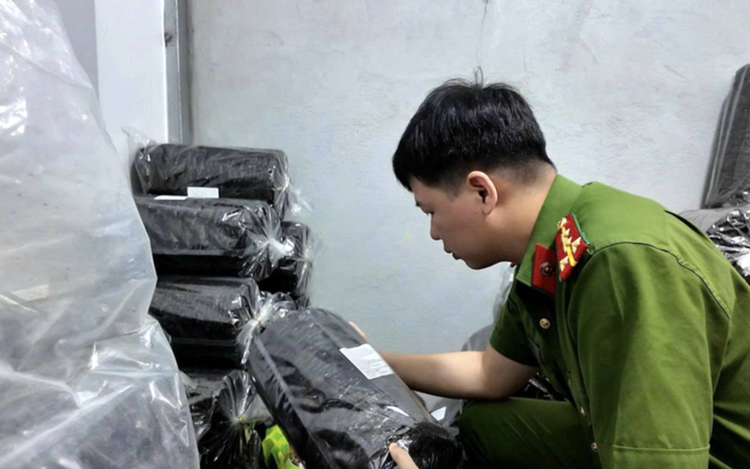
Police raid a warehouse linked to suspected origin-labeling fraud in Da Nang City, central Vietnam. Photo: H.B.
In simultaneous raids on the headquarters and warehouse of Dana Food Company in Hoa Khanh Ward, officers uncovered thousands of Chinese-origin dried seaweed products that were falsely labeled as Vietnamese-made goods.
The case was among a series of major crackdowns carried out in recent months by Da Nang City’s Steering Committee 389, which is responsible for combating smuggling, trade fraud and counterfeit goods.
According to the committee, although the situation involving smuggling, commercial fraud, counterfeit products, intellectual property violations and illegal cross-border transportation of goods has become less complicated recently, authorities continue to tighten control over the area.
As a major transit hub in central Vietnam, Da Nang remains vulnerable to illegal trade activities, including smuggling, drug-related crimes and the unauthorized transportation of goods across borders.
Among the recent cases investigated by authorities, the fraudulent labeling of Chinese-origin dried seaweed as Vietnamese products has attracted significant public attention.
The economic police division of the municipal Department of Public Security had previously deployed two teams to conduct simultaneous searches of Dana Food Company’s headquarters and warehouse at 5 and 29 Nguyen Minh Chan Street, Hoa Khanh Ward.
The company was owned by Nguyen Tan Hien, 27, and his wife, Do Thi Thuy Trang, 26.
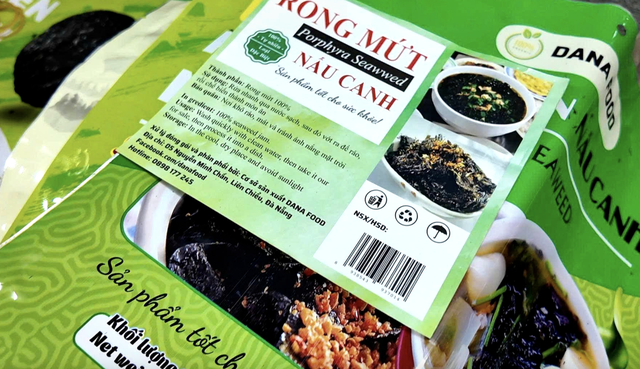
Dried seaweed with falsified origins seized by Da Nang police. Photo: H.B.
Investigators found several signs of violations, including unusually low prices for Dana Food-branded dried seaweed products compared with similar goods on the market.
The company had also registered and publicly announced that its Dana Food seaweed products were of Vietnamese origin, while in reality they had been imported from China.
During the inspection, officers seized more than 7,000 dried seaweed products identified as counterfeit goods, along with tens of thousands of packaging materials and raw materials used in the production of fake products.
Based on the collected evidence and documents, the investigative police agency initiated criminal proceedings and detained Hien.
Authorities also imposed a travel restriction measure on Trang, while continuing to investigate and expand the case.
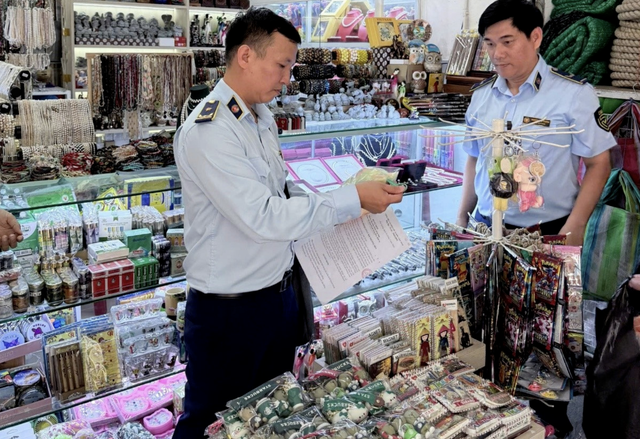
Law enforcement officers inspect warehouses and stores in Da Nang, central Vietnam. Photo: Market Surveillance Agency
Sophisticated methods used to evade authorities
According to law enforcement agencies, businesses involved in fraudulent activities often employ sophisticated methods to avoid detection and inspection.
One common tactic is to imitate protected products by copying their names, labels and packaging designs, then making minor changes to certain details.
These counterfeit products are manufactured with inferior quality but are designed to make consumers believe they are purchasing genuine goods.
Another method involves the use of modified vehicles.
Some offenders purchase enclosed trucks that are not legally transferred to their names and often carry license plates from other provinces.
They then install secret compartments inside the vehicles, dividing the cargo area into separate sections.
The hidden compartments are used to transport smuggled or prohibited goods.
Authorities have also identified cases in which individuals establish companies that operate only briefly or have no genuine business activities.
These companies are created primarily to buy and sell invoices, open corporate bank accounts and legitimize illegal financial flows linked to criminal activities, including fraud and overseas online gambling operations.
After a period of operation, offenders dissolve the companies or stop conducting business under their registered licenses in an attempt to erase evidence and hinder investigations.
Also, many smugglers have taken advantage of postal services, express delivery channels, personal luggage, gifts and duty-free allowances, as well as relaxed import-export policies, to transport compact, high-value goods illegally.
Authorities have recently detected numerous cases in which offenders exploited e-commerce platforms such as Shopee, TikTok Shop, Lazada and Tiki, along with social media platforms including Facebook and Zalo, and livestreaming tools to advertise and sell smuggled goods, counterfeit products, prohibited items, intellectual property-infringing goods, low-quality products and items with unclear origins.
In the first six months of 2026, agencies under Da Nang’s Steering Committee 389 detected and handled 1,384 violations.
The total value of confiscated illegal goods exceeded VND3 billion (US$115,000).
Law enforcement agencies also initiated criminal proceedings in 64 cases involving 95 suspects.








Max: 1500 characters
There are no comments yet. Be the first to comment.