


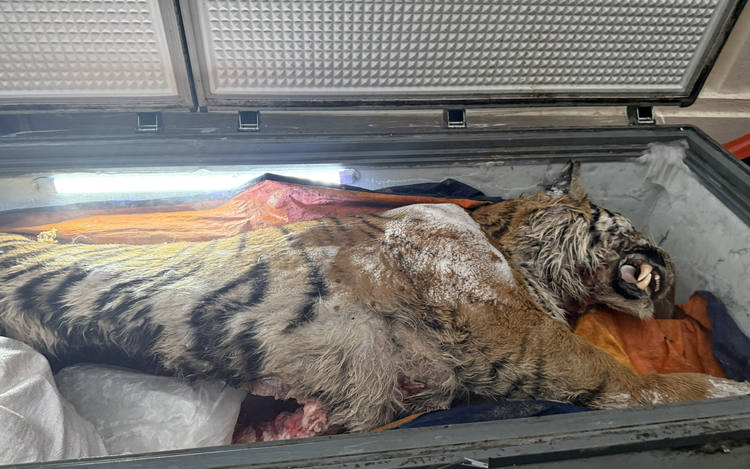
A frozen tiger carcass found in an underground bunker at the residence of Hoang Dinh Dat in Thanh Hoa Province, north-central Vietnam, who was accused of illegally producing tiger bone paste. Photo: Thanh Hoa Department of Public Security
The provincial investigation police agency said on Friday it had launched criminal proceedings against Hoang Dinh Dat, 52, and Nguyen Doan Son, 31, for allegedly violating ‘regulations on protection of endangered, precious, and rare animals’ under Article 244 of Vietnam’s Penal Code.
According to investigators, Dat, who resides in Xuan Lap Commune, regularly purchased wild animals, including tigers, and processed them into bone paste for illicit gain.
Acting on intelligence, officers raided his home and uncovered a concealed underground bunker allegedly used to store frozen tiger carcasses.
The bunker was secured with a reinforced iron door and equipped with a surveillance camera system.
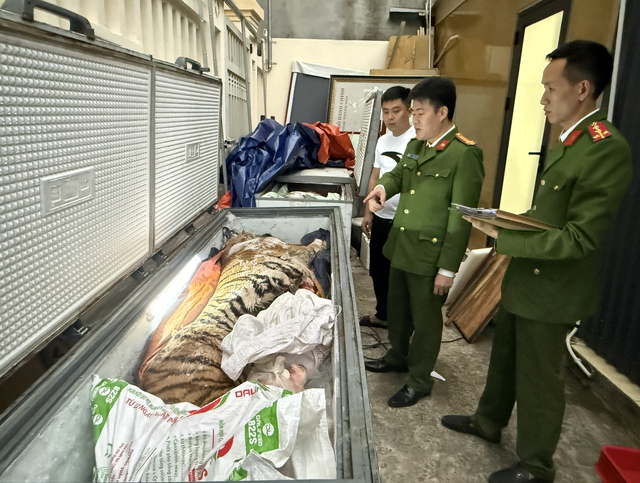
Police officers in Thanh Hoa Province, north-central Vietnam examine tiger carcasses discovered at the residence of Hoang Dinh Dat, who allegedly produced tiger bone paste for illegal profit. Photo: Thanh Hoa Department of Public Security
Inside, police found two frozen tiger carcasses weighing nearly 400 kilograms in total, with their internal organs removed, along with equipment believed to have been used to cook tiger bone paste.
During questioning, Dat admitted that he had contacted Son via the Zalo social media platform to buy the two carcasses for nearly VND2 billion (US$77,700).
Investigators later summoned Son, who resides in Thieu Trung Commune.
He confessed to purchasing the carcasses from a Lao national in neighboring Ha Tinh Province, transporting them to Thanh Hoa, and reselling them to Dat for profit.
Authorities said the investigation is ongoing as they work to trace the origin of the tiger carcasses and clarify other aspects of the wildlife trafficking and processing operation.

Two police officers in Thanh Hoa Province, north-central Vietnam question Nguyen Doan Son over his alleged violations of Vietnam’s regulations on the protection of endangered and rare wildlife species. Photo: Thanh Hoa Department of Public Security
Endangered wild animals are strictly protected in Vietnam under the Convention on International Trade in Endangered Species of Wild Fauna and Flora (CITES), to which the country has been party since 1994.
Pursuant to Vietnam’s Penal Code, transporting, trading, capturing or killing wild animals or parts thereof is a criminal offense punishable by six months to 12 years in prison.








Max: 1500 characters
There are no comments yet. Be the first to comment.