
140-year-old Czech trail system comes to Vietnam’s Phong Nha-Ke Bang park
Phong Nha-Ke Bang National Park in north-central Vietnam is piloting the Czech That Trail, a hiking trail-marking system developed over nearly 140 years in the Czech Republic.
The network, recognized by its distinctive four-colour markings, is expected to help visitors explore the park’s natural wonders more safely while supporting conservation efforts.
The system has also been adopted in several countries around the world, including Germany, Poland and Brazil, offering a proven approach to guiding hikers through natural landscapes.
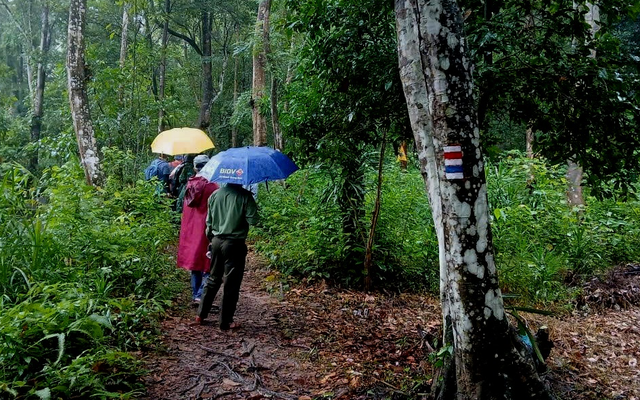
Tree trunks marked with horizontal stripes. Photo: T.G.
Simple trail markings guide visitors through forest
Pham Hong Thai, director of the Phong Nha-Ke Bang National Park management board, said the park had introduced the Czech trail-marking system on a trial basis in its botanical garden.
The area features trails with varied terrain and difficulty levels, providing visitors with a range of options suited to their physical fitness and interests.
“Clear trail markings and signposts will help visitors identify their routes, follow designated trails, and avoid entering areas where access is prohibited,” Thai said.
Instead of relying on large signboards or sophisticated electronic equipment, the system uses simple painted markings to guide hikers through natural environments.
Its distinctive feature is a horizontal colored marking, with the central stripe indicating the trail’s color.
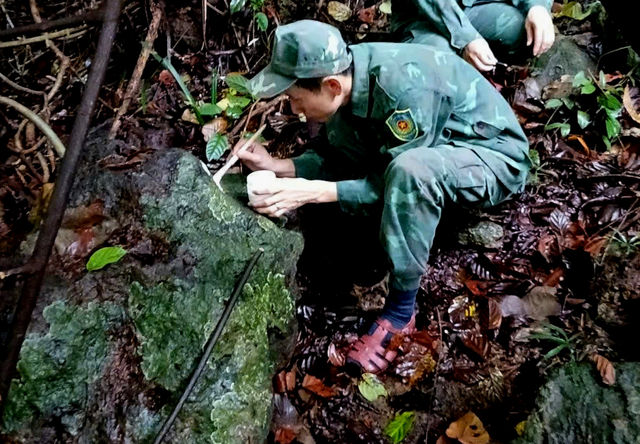
A rock painted with stripes. Photo: T.G.
The markings are painted on easily visible surfaces, such as tree trunks and rock faces.
Four colors, including red, blue, green and yellow, are used to distinguish different types of trails.
Red marks identify main routes, including long trails leading to mountain summits.
Blue markings indicate important routes connecting different areas.
Green markings denote shorter trails, connecting paths to larger routes and trails passing through local communities, while yellow markings identify connecting routes, shortcuts, and secondary paths.
The distance between successive markings does not exceed 250 meters.
At bends, junctions and trail intersections, arrows in the corresponding color indicate the direction hikers should follow before making a turn.
Thanks to its standardized and intuitive design, the system allows visitors to navigate trails without relying entirely on smartphones, GPS devices or an Internet connection.
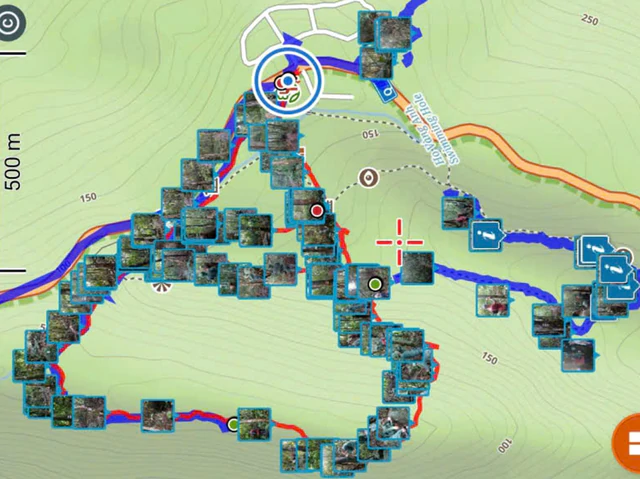
A map of the two routes marked using the Czech trail system in the botanical garden at Phong Nha-Ke Bang National Park. Photo: T.G.
Toward safer, more sustainable trekking routes
The Czech Republic’s hiking trail network has existed for nearly 140 years and now features more than 44,000 kilometers of marked routes, according to Pavel Prilepek, chairman of the Czech Tourist Club.
The network connects mountains, forests, valleys, nature reserves, and historic attractions.
“Behind these seemingly simple painted markings is a system organized according to established standards, requiring consistency in design, placement and maintenance,” said Prilepek.
“Markers must be positioned strategically so hikers can easily spot the next one, particularly in places where they might otherwise become confused.”
In mid-October, experts from the club, together with a supporting team, completed trail marking within the operational area of the botanical garden at Phong Nha-Ke Bang.
The work covered two hiking routes within a total area of 77.1 hectares.
One route is five kilometers long, while the other stretches for three kilometers.

The initiative to introduce the system at Phong Nha-Ke Bang was jointly developed by the Czech Tourist Club, with support from the Embassy of the Czech Republic in Hanoi and the Czech Center Hanoi.
The initiative aims to improve visitor safety, enhance the experience of exploring nature, and ensure that tourism activities respect conservation principles.
The system is also expected to assist national park staff in guiding visitors, monitoring tourist activities, and managing access to designated areas.
Prilepek said that bringing the system to Phong Nha-Ke Bang is about more than simply introducing a European trail-marking method to Vietnam.
More importantly, it represents a step toward organizing nature-based exploration in a clearer, safer, and more responsible way.
When implemented consistently alongside effective management, maintenance, and conservation measures, these small painted markers in the forest could help establish more professional trekking routes, allowing visitors to explore the natural environment independently while remaining within designated boundaries.
Tieu Bac - Quoc Nam / Tuoi Tre News
Link nội dung: https://news.tuoitre.vn/140-year-old-czech-trail-system-comes-to-vietnams-phong-nha-ke-bang-park-103261028154139498.htm