
2 Vietnamese doctors aid ill Lithuanian passenger on Beijing-bound flight, help avoid emergency landing
Two Vietnamese doctors helped stabilize a Lithuanian passenger suffering severe abdominal pain on an Air China flight from Ho Chi Minh City to Beijing early Tuesday, allowing the aircraft to continue its journey without an emergency landing.
Dr. Phan Hai Thanh, deputy director of Hue Central International Hospital, recounted the incident during a phone conversation with Tuoi Tre (Youth) online newspaper from Beijing later on the same day.
Thanh said he and Dr. La Van Phu, head of the General Surgery Department at Can Tho General Hospital, were traveling with a Vietnamese medical delegation to attend an international medical conference in Beijing when the flight crew called for medical assistance.
The passenger, a Lithuanian man, was stretched out on his seat, suffering from severe abdominal pain, with his worried wife beside him.
A young woman who introduced herself as an intensive care unit (ICU) nurse working in the United States also stepped forward to help.
After identifying themselves as doctors, Thanh and Phu asked the chief flight attendant to bring the aircraft's medical kit so they could examine the passenger.
The man was instructed to lie on his back while the doctors checked his pulse, blood pressure and temperature and examined his abdomen.
Their initial assessment found that his vital signs were stable, with no signs of an acute surgical emergency.
The two doctors suspected that he was experiencing left-sided renal colic.
The main challenge was that the aircraft's medical kit contained only oral medication, with no injectable painkillers.
After considering their options, the doctors decided to give him oral pain medication brought along by the Vietnamese medical delegation and continued to monitor his condition.
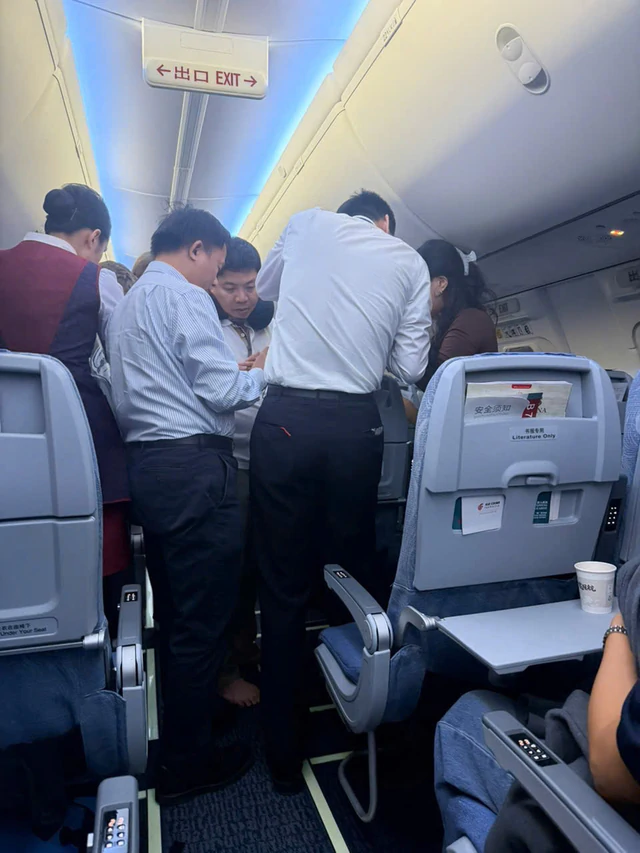
Two Vietnamese doctors and others are seen providing emergency medical assistance to a Lithuanian man suffering severe abdominal pain aboard an Air China flight from Ho Chi Minh City to Beijing, China, on November 17, 2026. Photo: Dr. Phan Hai Thanh
However, his pain did not subside immediately. His wife repeatedly asked how serious his condition was and considered requesting an emergency landing. The flight crew also weighed this option.
The doctors explained that their examination had revealed no immediate life-threatening signs, but that he needed to be monitored and reassessed after 15 to 30 minutes before they could decide on the next course of action.
While waiting for the medication to take effect, the two doctors stayed with him and reassured him and his wife.
About 30 minutes after taking the medication, his pain began to ease, and he became more alert and comfortable.
By the time the aircraft landed in Beijing, his condition had improved considerably and he was able to walk normally.
He and his wife repeatedly thanked the Vietnamese doctors and others who had helped him.
Thanks to the cooperation of the two doctors, the ICU nurse and the flight crew, the aircraft completed its journey without an emergency landing.
After the incident, the flight attendants documented the examination and treatment. The two Vietnamese doctors signed to confirm the medical procedures they had performed and accept responsibility for their professional work.
Thanh told Tuoi Tre he was glad the passenger had recovered and that the flight had not needed to change its schedule because of the medical emergency.
"We discussed the emergency case very carefully because the medical decisions we had to make at that moment were extremely important," he said.
Phu also expressed his happiness at being able to help the passenger in a post on his personal Facebook page.
This was the second time Phu had provided emergency medical assistance to a passenger on an international flight.
More than a year ago, he helped a French passenger who experienced a health problem aboard a Vietnam Airlines flight from Ho Chi Minh City to Paris.
Although the two incidents were different, both left Phu with unforgettable memories of a doctor's professional responsibility.
For both doctors, the real reward wasn't the thanks they received, but watching the patient's pain subside, his wife's anxiety ease, and a wave of relief wash over the cabin.
Vinh Tho - Nhat Linh / Tuoi Tre News