
3 pre-Champa kilns dating back nearly 2,000 years unearthed in central Vietnam
An emergency excavation at Chau Sa Ancient Citadel in Quang Ngai Province, central Vietnam has uncovered three roof tile kilns dating back to around the second and third centuries.
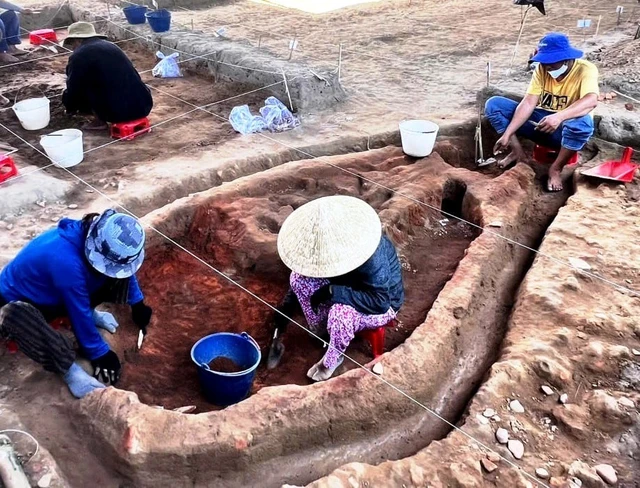
An ancient roof tile kiln used by the pre-Champa people unearthed at Chau Sa Ancient Citadel in Quang Ngai Province, central Vietnam. Photo: Tran Mai / Tuoi Tre
The finding provides further evidence that the site was once a major construction material production center of the pre-Champa people.
Key link in understanding Chau Sa Ancient Citadel
Dr. Doan Ngoc Khoi, deputy director of the Quang Ngai General Museum and head of the month-long emergency excavation in Tinh Khe Commune, said on Monday that archaeologists had opened two excavation pits covering a total area of about 100 square meters within the ancient citadel.
The excavation uncovered three ancient kilns along with numerous fragments of roof tiles, pottery, charcoal, and traces of ancient human habitation.
According to Dr. Khoi, the kilns are all oval-shaped, measuring approximately 3.5 meters long and one meter wide, and have been dated to around the second and third centuries.
Samples of charcoal, pottery, and tiles recovered are being analyzed using scientific dating methods to determine their age more precisely.
"The emergency excavation is the result of years of research at Chau Sa Ancient Citadel,” Khoi said.
“This is a crucial link for continuing research and gaining a deeper understanding of the site's historical value.”
Notably, this is not the first kiln discovered at the site. The Quang Ngai General Museum had previously uncovered a similar ancient kiln.
With the three newly excavated kilns, a total of four kilns have now been identified within the ancient citadel.
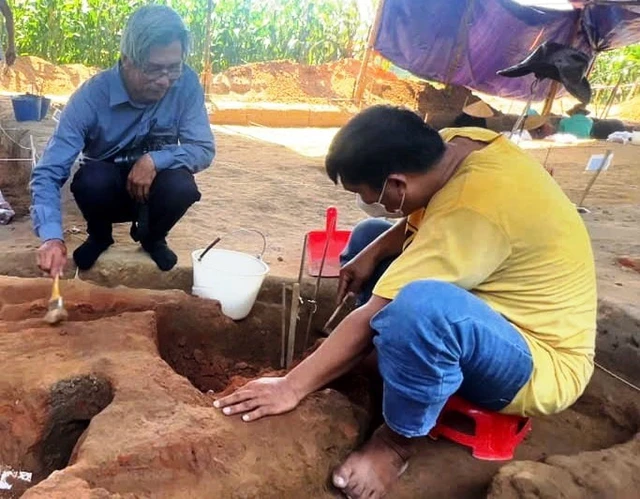
Dr. Doan Ngoc Khoi (left), deputy director of the Quang Ngai General Museum, says the discovery of the ancient kilns is of great significance to research on Chau Sa Ancient Citadel. Photo: Tran Mai / Tuoi Tre
Shedding light on pre-Champa construction techniques
The growing number of kilns found suggests that Chau Sa was once home to an extensive roof tile production complex operated by the pre-Champa people, rather than isolated kiln sites.
Archaeologists believe the latest discovery not only helps clarify how ancient inhabitants produced construction materials but also provides additional evidence of the cultural transition from the Sa Huynh culture, which dates from 1,000 BC until the late second century AD, to the establishments of early urban centers in central Vietnam.
Chau Sa Ancient Citadel is located on the northern bank of the Tra Khuc River, spanning present-day Tinh Khe Commune and Truong Quang Trong Ward.
Built before the 10th century, the citadel consists of inner and outer walls and occupies a strategic location connecting the Tra Khuc River with the Dai and Sa Ky estuaries, serving both trade and defense purposes.
After Dai Viet took control of the region in 1471, Emperor Le Thanh Tong selected Chau Sa Citadel as the headquarters of the Quang Nam administrative authority, which governed the territory stretching from present-day Quang Nam to Phu Yen.
The site was recognized as a national historical relic in 1994.
However, most of the land within the citadel remains in agricultural use by local residents.
According to experts, the continued use of traditional hand tools instead of heavy machinery for farming has helped preserve many archaeological layers beneath the ground in remarkably intact condition over the centuries.
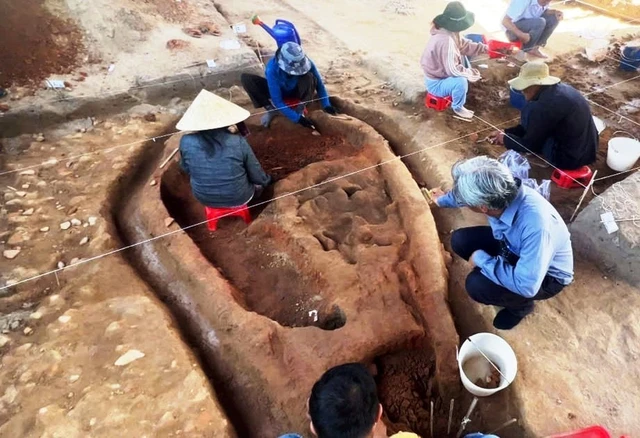
The three newly discovered kilns are expected to provide valuable insights into the Chau Sa Ancient Citadel. Photo: Tran Mai / Tuoi Tre
Based on the latest excavation, Khoi proposed expanding research to determine the full extent of the kiln complex while combining conservation efforts with heritage promotion.
Rather than reburying the excavated remains after research, as has traditionally been done, he suggested that authorities construct protective shelters, visitor walkways, and partially reconstruct the ancient kilns to support research, history education, and cultural tourism.
Tran Mai - Dong Nguyen / Tuoi Tre News
Link nội dung: https://news.tuoitre.vn/3-pre-champa-kilns-dating-back-nearly-2000-years-unearthed-in-central-vietnam-103260721233903394.htm