
All 15 million residents in Ho Chi Minh City to be screened free for major diseases
Ho Chi Minh City’s citywide public health initiative in 2026 will offer free medical examinations and disease screenings to its entire population of more than 15 million people, set to prioritize early detection of high-risk conditions, including cardiovascular disease, diabetes, and several common cancers.
The municipal Department of Health was assigned to implement citywide free health check-ups in 2026, without dividing the roll-out into phases, an official said during the fifth conference for the 2025-30 term held by the municipal Party Committee last week.
This task must be carried out in accordance with Resolution 72 of the Politburo on a number of breakthrough solutions for strengthening the protection, care, and improvement of public health.
The city’s Party Committee on Wednesday also held a policy workshop gathering opinions on a plan to implement the initiative during the 2026-30 period.
At the workshop, the municipal department suggested prioritizing screenings and check-ups for disease groups that can be implemented on a large scale, and have a high burden of illness, and applying a targeted testing approach rather than spending the budget on mass testing.
Nguyen Anh Dung, deputy director of the municipal department, said that Ho Chi Minh City has a dense population, rapid urban mobility, and diverse demographics, resulting in an increasing demand for healthcare.
Meanwhile, the disease profile is evolving, with a double burden of infectious diseases and a growing prevalence of non-communicable conditions, particularly among the elderly.
As such, the city’s healthcare system should focus both on treating ill patients and paying attention to the comprehensive healthcare management, with early detection and screening playing a key role.
The initiative is set to cover diseases that meet strict criteria: strong scientific evidence, feasibility for large-scale implementation, and availability of follow-up diagnosis and treatment.
Priority will be given to interventions that are cost-effective and suitable for primary healthcare settings.
In the initial phase, especially in 2026, the city will finalize clinical guidelines, establish financial mechanisms, roll out basic health check packages, and begin building electronic health records for residents.
In 2027, a network of participating healthcare facilities will be established across crowded residential areas, industrial zones, schools, and social institutions.
In 2028, the program will stabilize and expand evidence-based screening initiatives for hypertension, diabetes and cardiovascular risk, cervical cancer, breast cancer, colorectal cancer, viral hepatitis, and tuberculosis.
From 2030 onward, the city aims to operate a fully digital, automated system capable of proactively inviting residents to participate in screenings.
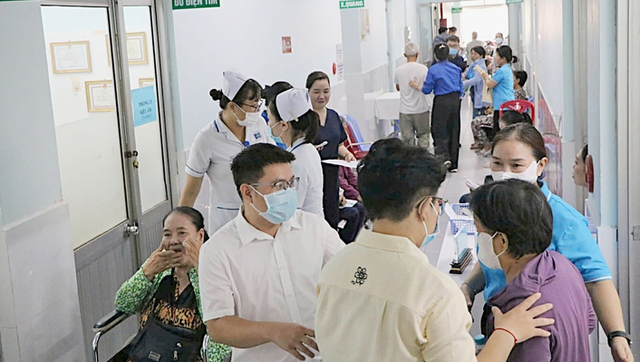
Ho Chi Minh City offers free medical check-ups to all residents in the city. Photo: Thu Hien / Tuoi Tre
Immediate priorities
The deputy director of the department identified several conditions suitable for immediate large-scale screening.
These include hypertension and diabetes among high-risk individuals, particularly those over 40, as well as cervical cancer.
Additional targeted conditions will be breast and colorectal cancers among people aged 50 to 70, tuberculosis, hepatitis B and C, and illnesses related to mental health, vision, and dental care.
The city’s budget will not be used for prostate-specific antigen (PSA) screening, hearing tests or intraocular pressure measurements unless medically indicated.
Early detection could transform outcomes
Diep Bao Tuan, director of the Ho Chi Minh City Oncology Hospital, noted that the most common cancers among men include liver, lung, stomach, colorectal, and prostate cancers, while women are most affected by breast, lung, colorectal, stomach, and liver cancers.
Cancer screening is intended to detect abnormal or malignant cells before symptoms appear, enabling more effective treatment and reducing mortality.
High-risk groups include individuals with personal or family histories of cancer, genetic mutations, and exposure to carcinogens such as tobacco smoke or chemicals and older age.
Breast cancer screening, in particular, is considered essential for women of all ages, with risk increasing over time.
Ultrasound plays a critical role due to its affordability, accessibility, and suitability for primary care facilities.
Technology, AI to drive access
The Ho Chi Minh City Department of Science and Technology, in collaboration with the municipal Department of Health and the Ho Chi Minh City Public Health Association, on Wednesday held the ‘Smart Healthcare 2026 - Startup Connection Day’ program.
Speaking at the event, Nguyen Van Vinh Chau, deputy director of the municipal Department of Health, said the city aims for 100 percent of residents to have electronic health records by 2030.
These records, described as a ‘health passport' throughout a person’s lifetime, will provide doctors with comprehensive data for accurate treatment decisions while enabling citizens to actively monitor their own health.
The association also revealed it is awaiting approval to deploy testing technologies capable of detecting cancer-causing human papillomavirus strains and conducting breast cancer screening directly at local health facilities in a bid to bring early screening services closer to the community.
In addition, technologies such as the Truscreen device are set to be introduced to detect precancerous and cervical cancer cells 10-20 years before disease progression, offering greater opportunities for early intervention and reducing the burden of treatment.
Tieu Bac - Thu Hien - Huynh Anh / Tuoi Tre News
Link nội dung: https://news.tuoitre.vn/all-15-million-residents-in-ho-chi-minh-city-to-be-screened-free-for-major-diseases-103260409170646792.htm