
Ancient rock formations in Da Nang reveal millions of years of geological history
Ban Than, a coastal landmark in Da Nang City’s Tam Hai Commune, draws visitors with its striking black rock formations formed hundreds of millions of years ago, offering a glimpse into the region’s rich geological past.
Tam Hai, an island commune in southern Da Nang, formerly part of Quang Nam Province’s Nui Thanh District, covers about 15 square kilometers.
Surrounded by the sea on three sides and bordered by a river on the fourth, the commune is accessible only by ferry or boat.
Ban Than-Hon Mang-Hon Dua, a cluster of coastal attractions, has been recognized as a national heritage site by Vietnam’s Ministry of Culture, Sports, and Tourism.
Ban Than is a rocky shoreline on Tam Hai Island Commune, while Hon Mang and Hon Dua are two nearby islets.
The Ban Than rock formation stretches for about 2km along the coast.
According to local residents, the name ‘Ban Than,’ which translates roughly as ‘coal table,’ comes from the area’s broad, flat black rock slabs, resembling giant tables carved by nature.
The formations contrast with the surrounding sea, white sandy beaches, coconut groves, and sedimentary rock outcrops.
The site features more than 2km of stacked black rock cliffs, with layers tilted, overlapping, and fractured into a variety of formations that geologists regard as a distinctive geological heritage.
Geologists say the rocks are not volcanic in origin but are ancient bedrock dating back as far as 400 million years.
The formations are believed to have emerged above sea level during a major tectonic event.
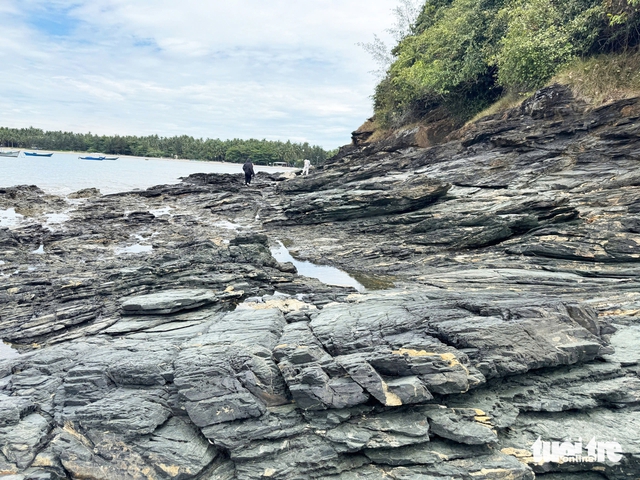
Black rock slabs at Ban Than date back as far as 400 million years. Photo: Le Trung / Tuoi Tre
The area is considered an important geological heritage site, preserving evidence of ancient life, stratigraphy, landforms, tectonic structures, karst features, rock formations, and paleoenvironmental history.
The Ban Than mountain range and the nearby Hon Mang and Hon Dua islets are home to metamorphic rock outcrops belonging to the Kham Duc-Nui Vu complex.
The site is dominated by amphibolite schist, with smaller occurrences of quartz-biotite schist interbedded with granite and quartz intrusions, while folded rock structures are common throughout the area.
The rock layers dip southwest at an angle of about 30 degrees.
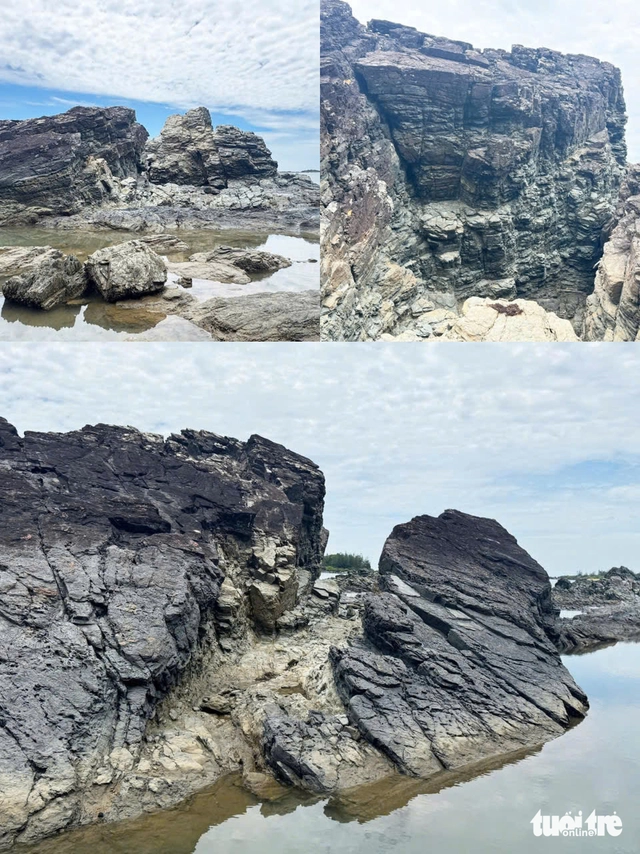
Leading geologists say the rocks at Ban Than are ancient bedrock up to 400 million years old that was uplifted above sea level during a major tectonic event.
Geologists say the formations originated from a diverse assemblage of oceanic crust, or ophiolite, including deep-marine sediments, basaltic volcanic rocks, and ultramafic-mafic igneous rocks, before undergoing multiple episodes of deformation and metamorphism over millions of years.
Repeated tectonic deformation compressed, folded, and fractured the rocks, creating the ridges, sea arches, and other striking formations that were later sculpted by weathering and wave erosion.
The schist formations are exposed across a wide area and have been sharply sculpted by wind and waves, allowing visitors and researchers to clearly observe their lithology as well as the structural changes caused by metamorphism and subsequent geological processes.
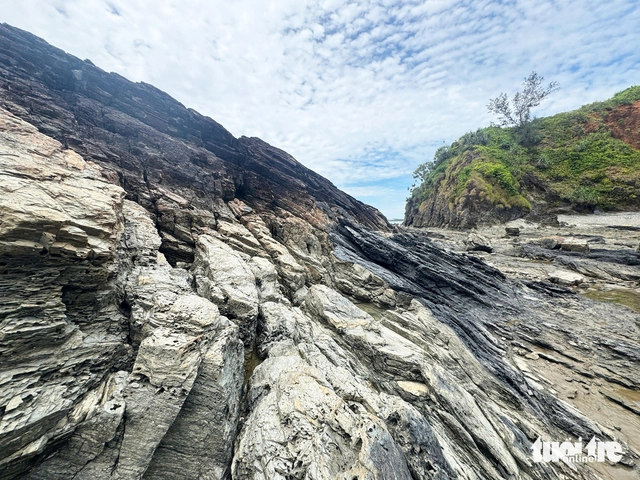
Black cliffs overlook the sea at Ban Than in Da Nang City, central Vietnam. Photo: Le Trung / Tuoi Tre
Geologists say the site serves as a natural open-air museum of metamorphic rocks, making it valuable for tourism, education, and geological research.
Tam Hai, including Ban Than, Hon Mang, and Hon Dua, is regarded as one of southern Da Nang’s key tourism destinations.
The area features striking dark rock formations alongside long sandy beaches, clear blue waters, coconut groves, and abundant seafood.
Visitor Nguyen Thi Thanh Lan said Ban Than’s towering black rock formations and coastal scenery left her impressed.
“Walking among the rocks, taking photos, and enjoying the clear blue sea gives me a memorable experience," she said.
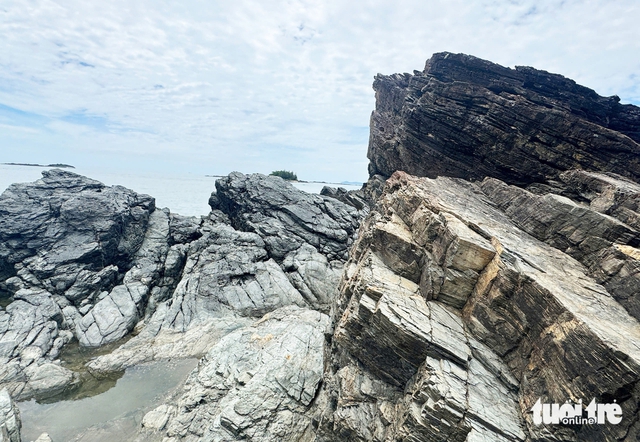
Amphibolite schist is the dominant rock type at Ban Than.
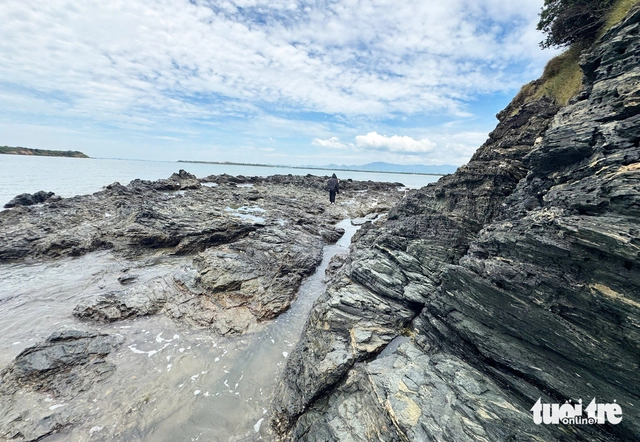
Black rock formations lie along the shoreline.
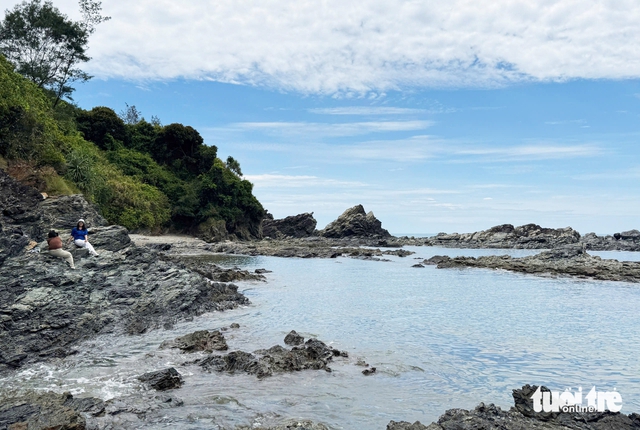
The coastline at Ban Than features ancient black rock formations and clear blue waters.
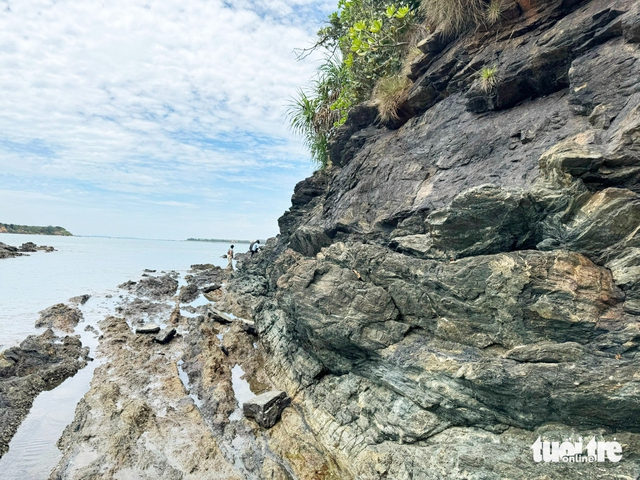
Visitors explore Ban Than’s rocky landscape.
Van Giang - Le Trung / Tuoi Tre News
Link nội dung: https://news.tuoitre.vn/ancient-rock-formations-in-da-nang-reveal-millions-of-years-of-geological-history-103260714143701039.htm