
Apartment buildings in Vietnam required to include dedicated areas for EVs
Vietnam’s Ministry of Construction has issued a new regulation requiring both newly built and existing apartment buildings to provide dedicated areas for electric vehicles (EVs), including parking, charging and battery-swapping areas, as the country accelerates its transition toward greener transportation.
The ministry recently issued Circular 31, amending the national technical standards for apartment buildings.
The regulation will take effect on December 15, 2026.
Under the new rules, all newly constructed apartment buildings must include separate parking areas for electric bicycles, motorcycles and cars.
They must also provide charging and battery-swapping facilities that meet stricter fire safety requirements.
For existing apartment buildings, the ministry requires owners or authorized management entities to complete reviews of their properties within six months of the circular taking effect.
Buildings that do not comply with the new standards must undergo repairs or renovations to meet the requirements.
Le Hoang Chau, chairman of the Ho Chi Minh City Real Estate Association (HoREA), said the regulation is necessary as the number of electric vehicle users continues to grow in major cities due to the ongoing green transition.
He said requiring apartment buildings to provide parking, charging and battery-swapping spaces is appropriate and reflects current transportation trends.
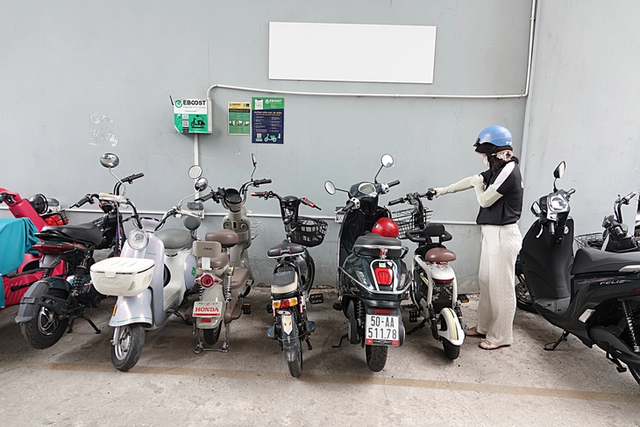
A covered outdoor electric vehicle charging station at an apartment complex in Hanh Thong Ward, Ho Chi Minh City. Photo: T.T.D. / Tuoi Tre
Many residents have welcomed the new regulation.
A resident of Tay Thanh Apartment Building in Ho Chi Minh City said providing dedicated charging stations and parking areas for EVs is both reasonable and necessary.
He recalled receiving what he described as a harsh notice when his building management board stopped accepting EVs in the communal parking area because the electrical system lacked sufficient capacity to support charging demand.
According to him, the original fire prevention and firefighting design for the building did not include facilities for EVs.
As a result, he had to pay to charge and park his EV overnight at a nearby café, costing VND150,000 (US$5.7) per month.
Le Mai Phuong, a resident of an apartment complex in Hanoi, said the new regulation would help protect the interests of residents who use EVs.
She said developers and building operators should be responsible for upgrading parking facilities in existing apartment buildings to accommodate EVs, allowing residents to avoid additional parking fees at external lots.
Nguyen Duc Tien, a resident of an apartment building in Hanoi’s Trung Hoa-Nhan Chinh area, said the requirement is essential for ensuring fire safety while protecting the rights of EV owners.
He added that the regulation could also encourage greater adoption of EVs in line with the government’s green transition strategy.
Existing apartment buildings face challenges
Despite broad support for the policy, experts have warned that compliance could be difficult for older apartment buildings.
Nguyen Tien Dung, chairman of the Ho Chi Minh City Building Operation and Management Association, said Circular 31 provides much-needed technical standards for the design and installation of charging stations and EV parking facilities.
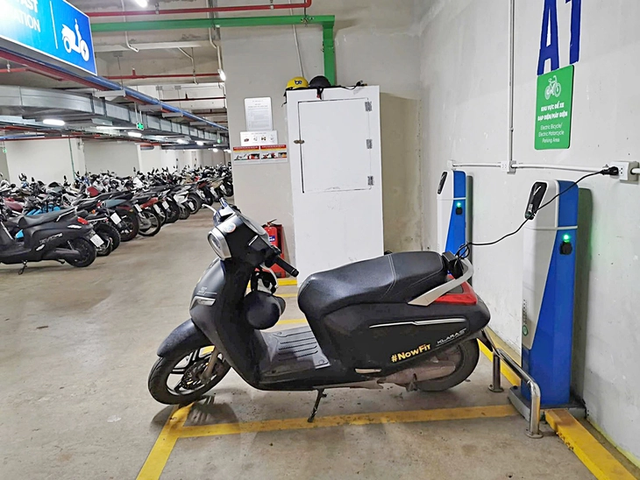
An electric motorcycle charging station at an apartment building in Hanoi. Photo: B. Ngoc / Tuoi Tre
However, he suggested the standards should be applied flexibly because each building has different infrastructure conditions.
“The main challenge is not parking space but the capacity of electrical systems and fire safety infrastructure, which were not originally designed for EVs,” Dung said.
Nguyen Quoc Khanh, vice-chairman of the Vietnam Association of Realtors, noted that electrical systems in many existing apartment buildings were installed underground and designed without dedicated charging areas.
He said only a limited number of buildings could realistically install independent power supplies or develop charging facilities in surrounding open spaces.
Improvised solutions, he warned, could create new safety risks.
A representative of a real estate and construction company developing apartment projects in Ho Chi Minh City and Tay Ninh Province suggested that public charging hubs located near residential buildings, a model used in several countries, could help ease pressure on existing apartment complexes.
The representative also said the requirement for older apartment buildings to complete inspections and renovations within six months of December 15, 2026 would place enormous pressure on both budgets and timelines.
Architect Dao Ngoc Nghiem, vice-chairman of the Vietnam Urban Planning and Development Association, said adding dedicated EV parking requirements to the national apartment building standards is necessary and must be strictly enforced.
He noted that major cities such as Hanoi and Ho Chi Minh City are developing plans to gradually limit gasoline-powered vehicles and encourage the use of more environmentally friendly transportation, including electric cars and motorcycles.
According to Nghiem, dedicated parking facilities are essential to support that transition.
Chau of HoREA acknowledged that the new requirements would increase development costs for apartment projects.
For new projects that have not yet been sold, the additional expenses associated with parking areas, charging facilities, and related infrastructure are likely to be reflected in apartment prices.
For projects that have already been sold but not yet handed over to buyers, developers will have to absorb the extra costs themselves.
For existing apartment buildings that have already been transferred to residents, decisions on renovation expenses will need to be made through apartment residents’ meetings, he said.
Khanh said the requirements are technically feasible for newly built apartment complexes and would provide valuable amenities for residents.
However, dedicated charging areas require additional infrastructure and strict fire prevention measures, resulting in significant investment costs.
“These expenses will ultimately be included in housing prices, and residents will be the ones who pay for them,” he said.
New fire safety requirements
Under Circular 31, EV parking areas must be prioritized in the following order: outdoor spaces, ground level, semi-basements, and then basement level one.
Parking areas must provide adequate evacuation routes, ventilation systems, fire protection measures, and structural load-bearing capacity.
If EV parking is located in a semi-basement or basement, developers must implement measures to evacuate or isolate vehicles in the event of a fire.
Charging areas must be divided into separate fire compartments.
The maximum area of a fire compartment for electric car charging or mixed charging facilities is limited to 1,500 square meters above ground and 1,200 square meters in semi-basements or basements.
For electric motorcycle and electric bicycle charging facilities, the limits are 500 square meters above ground and 300 square meters underground.
Authorities also require apartment buildings to establish separate charging zones, maintain automatic fire alarm systems, provide firefighting equipment, and ensure adequate smoke extraction and ventilation systems.
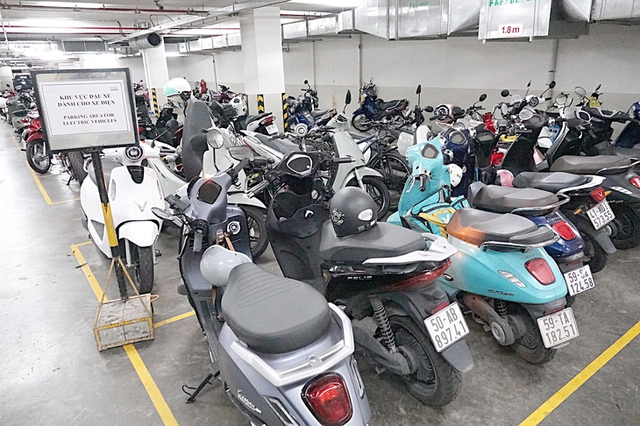
The management board of a high-end apartment building in Khanh Hoi Ward, Ho Chi Minh City allows electric vehicles to park in the basement but does not permit charging. Photo: T.T.D. / Tuoi Tre
According to a fire prevention and rescue officer in Ho Chi Minh City, apartment building operators must establish dedicated charging areas for EVs to ensure fire safety when charging vehicles in basements.
These areas should maintain safe distances from emergency exits, technical rooms, and locations where flammable materials are stored.
Charging stations must not be installed in locations that obstruct traffic flow or emergency evacuation routes.
Electrical systems serving charging stations must be specially designed, appropriately rated for capacity, and equipped with adequate protective devices.
To meet fire safety requirements, charging areas must be fitted with effective automatic fire alarm systems as well as suitable firefighting and rescue equipment.
Smoke extraction and ventilation systems in basement parking areas must also be properly maintained. In addition, building operators are required to establish procedures for handling EV fire incidents and conduct regular drills to improve emergency response capabilities.
Regarding operational management, apartment buildings should issue regulations governing the use of charging stations, including rules on charging times, designated locations, and charging procedures.
Unauthorized connection of vehicles to household electrical outlets in basements, as well as the use of non-standard cables, sockets, or adapters, is strictly prohibited.
EV users should park in approved spaces, switch off their vehicles before connecting them to chargers, follow the charging procedures recommended by manufacturers, and refrain from tampering with vehicle batteries or electrical systems.
According to recommendations from the Fire Prevention, Firefighting and Rescue Police Department under the Ministry of Public Security, EVs powered by lithium-ion batteries pose potential fire and explosion risks if they are used, charged, or stored improperly.
Tuoi Tre News
Link nội dung: https://news.tuoitre.vn/apartment-buildings-in-vietnam-required-to-include-dedicated-areas-for-evs-103260624163228388.htm