
As temperatures rise, companies ‘flying blind’ on heat stress risk
As the northern hemisphere endures another summer of record-breaking temperatures, heat stress in the workplace is finally getting its moment in the sun. After years of companies being left to adopt ad hoc measures, industry groups are beginning to provide tailored guidance on this increasingly urgent welfare issue.

A construction worker drinks water amid a heatwave in Bordeaux, France, May 28, 2026. REUTERS/Alice Sacco
Yet a more fundamental problem persists: in many parts of the world, regulations around what constitutes "excessive" heat – and what steps employers are expected to take – remain vague or incomplete. The result is that many companies are still, in practice, having to improvise their response.
"Most brands at present are completely flying blind," says Lucy Siers, a research scholar at NYU Stern's Center for Business and Human Rights. "They have no visibility into the reality on the ground, and this disconnect enables them to wipe their hands of any responsibility to act."
The American Apparel and Footwear Association (AAFA) and the U.S.-based human resources professional body HRCI have both recently issued protocols on how best to manage extreme heat, while the garment sector-focused International Accord is preparing similar advice.
Kaveh Zahedi, assistant director-general and director of the Office of Climate Change, Biodiversity and Environment at the United Nations' Food and Agriculture Organization (FAO), says temperatures now regularly reach the high 40s (degrees Celsius) in some parts of the world. Climate change is having a "debilitating toll on farmers, especially small-scale farmers and their families, who are pushed further into poverty with every day of extreme heat."

A Deliveroo delivery worker cools his head with a bottle of water next to his bike as a heatwave hits a large part of France, June 18, 2026. REUTERS/Abdul Saboor
Heat stress is also acute in other outdoor-oriented sectors, such as fisheries, construction and delivery services, as well as in manual industries where workers operate in enclosed environments with poor ventilation, heavy equipment or a lack of climate control.
Across all industries, excessive heat is calculated to annually cause almost 19,000 deaths and around 22.85 million occupational injuries, according to the International Labour Organization. Extended exposure can also lead to serious long-term health effects, including organ damage, while new research links extreme heat to negative pregnancy outcomes.
Heat stress also carries profound economic costs. Zahedi cites a recent report by the WHO and the World Meteorological Organization that finds productivity falls by 2% to 3% for every degree above 20C. "Heat stress is already showing up in lost work hours, rising health burdens and smaller harvests, and it will get harder in the months ahead if El Niño adds another layer of heat," the FAO spokesperson states.
These impacts are beginning to ripple through supply chains. Research by the Energy & Climate Intelligence Unit suggests that 13% of UK food imports could be at risk due to heat-related production declines in key markets such as India, Brazil and South Africa. Similar effects are being observed in the garment industry.

A worker mans a conveyor where dyed and washed garments are flattened, steamed and ironed at a textile factory in Andhra Pradesh, India. REUTERS/Samuel Rajkumar
Based on field research in Indian clothing factories, a recent report by NYU Stern finds evidence of higher absenteeism, reduced productivity, higher defect rates in products and delivery delays. "Because the heat is now becoming so intolerable, we're seeing direct impacts on productivity and efficiency," says Siers. "And that is starting to impact overall supply chain resilience."
In some countries, regulators have begun to respond. In the United Arab Emirates, Saudi Arabia and Oman, for instance, outdoor work is banned for a three-hour stretch during the hottest part of the summer day. But such measures remain uneven globally, and in many jurisdictions, employers lack clear benchmarks for action.
Part of this regulatory confusion derives from a lack of consensus over how best to measure workplace heat conditions. Not only do metrics vary widely – with land surface temperature, air temperature, heat index, wet bulb globe temperature and thermal comfort indices all potential options – but the equipment for measuring them also differs.
Overall, existing regulations are "not very helpful", says Veronique Camerer, head of policy and accountability at the International Accord. "There's a wide diversity of approaches to decide, for instance, what the triggering temperature threshold should be, to then determine the administrative controls that need to be put in place."
Establishing an official, standardised temperature threshold for triggering employer action is a first-order imperative, she argues. Such clarity would give employers and brands an impetus to act, if only out of regulatory compliance.

A heavily pregnant woman collects muskmelons during a heatwave, at a farm on the outskirts of Jacobabad, Pakistan. REUTERS/Akhtar Soomro
In India's garment sector, for example, 65% of buyers at present request no data whatsoever from their suppliers about temperature or humidity conditions.
So, what actions should businesses be taking? While advice varies depending on factors such as workplace location and heat type, most heat stress protocols include the same baseline measures. These typically include workplace heat monitoring, mandatory rest breaks, worker reporting mechanisms, and the provision of water, electrolytes, shade (for outdoor workers) and ventilation (for indoor workers). Training workers on heat safety protocols and ensuring they are not penalised for reduced productivity due to excessive heat are also widely recommended.
Less clear is with whom ultimate responsibility lies for addressing the problem. Most small businesses faced with heat stress "are doing something", says Siers. Yet, without stronger incentives, few have the motivation or resources to go beyond the bare minimum. "They say, 'We need the brands to signal to us that they care about this, that this is something that they consider a threat to their supply-chain resilience'."
Some actors are stepping up. In the U.S., fast food brands McDonald's, Burger King and Subway, along with Walmart, Trader Joe's and Whole Foods Market, are supporting the Fair Food Program, a cross-sector initiative that introduced an enforceable heat stress standard in 2021. Likewise, the International Accord, which now includes heat stress as one of its foundational safety pillars, counts more than 300 brand participants.
As AAFA's executive vice president Nate Herman notes, an effective response to heat stress requires brands, suppliers and worker groups to act together. Without support from upstream commercial actors, suppliers may be "disproportionately" affected by additional compliance costs, particularly in low- and middle-income countries, where the majority of workplace heat exposure occurs.
In its guidance, AAFA calls on members to adopt a position of "shared accountability", including more responsible purchasing practices, reasonable lead times and appropriate pricing structures. Ensuring that workers' voices are heard is also critical. As those experiencing extreme heat firsthand, they are often best placed to identify practical solutions.
It is a point echoed by Amy Dufrane, chief executive at HRCI, who advocates for corporate HR teams to engage more directly with working conditions on the ground, including at supplier facilities.
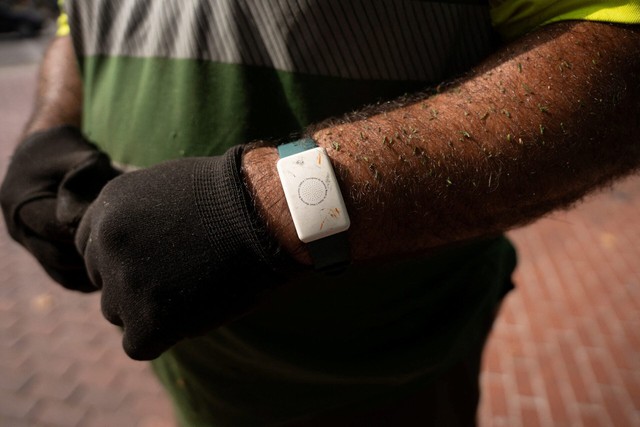
Antonio Reina, a worker wears a heat-monitoring bracelet. A year after one of its street cleaners died during a heatwave, the city of Barcelona has begun to use heat-monitoring bracelets for its outdoor workers to help prevent heat-related incidents in Barcelona, Spain, July 1, 2026. REUTERS/ Bruna Casas
HR functions, she suggests, should also play a central role in designing and updating heat action plans.
Arguably, the responsibility of employers and buyers extends beyond the workplace. In many low-income settings, workers live in homes that offer little protection from extreme heat.
In Bangladesh, the non-profit Practical Action is working with municipalities to improve the heat resilience of the homes of waste and sanitation workers. In cities such as Khulna, Satkhira and Faridpur, low-cost measures such as insulated roofing and PVC sheets are helping reduce indoor temperatures.
"Just some basic insulation in the roof can reduce the temperature inside by several degrees," says Tamanna Rahman, the organisation's climate resilience lead. "It's not expensive. This is definitely where business entities should start investing more."
Such initiatives point to a wider gap in how heat stress is prioritised. At present, it receives limited attention in many national climate adaptation plans, despite its growing impacts on workers and economies.
Until clearer standards are established – and enforced – heat stress is likely to remain a growing but unevenly managed risk across global supply chains.
Reuters
Link nội dung: https://news.tuoitre.vn/as-temperatures-rise-companies-flying-blind-on-heat-stress-risk-103260707112910438.htm