
Blind man’s uncanny skill at catching mud eels in southern Vietnam
Tran Thai Hoang, 53, from Vietnam’s southernmost province of Ca Mau, has been blind since childhood, but his hands rarely miss what lies beneath the mud. A single sweep is often enough for him to sense a mud eel hiding below.
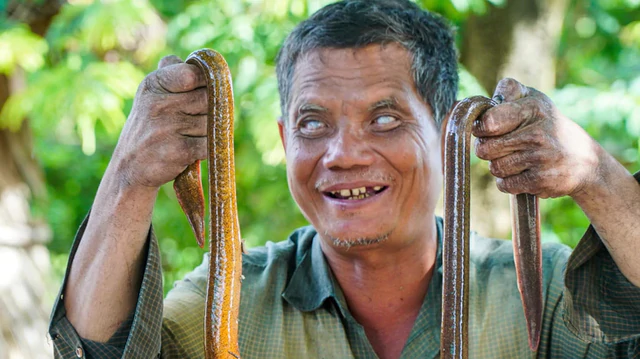
Completely blind, Hoang can still catch mud eels with remarkable skill. Photo: Thanh Huyen / Tuoi Tre
In Nam Can Commune, Hoang is widely known as “Blind Hoang,” a man who makes a living catching mud eels, locally known as lich, by hand.
Besides his knack for finding the elusive animals, locals are also amazed by his extraordinary memory for roads and directions.
Finding his way without sight
Without sight, Hoang has learned to navigate shrimp farms and winding rural roads through touch, sound and memory.
He could move swiftly through a shrimp farm of more than five hectares, even where experienced sighted hunters might struggle.
“Mud eels live deep in the mud and dig burrows that are extremely difficult to locate,” a local resident said.
“Even a sighted person without experience would struggle. Hoang, however, only needs to feel through the mud to find the burrow and work out where to block the eel’s escape.”
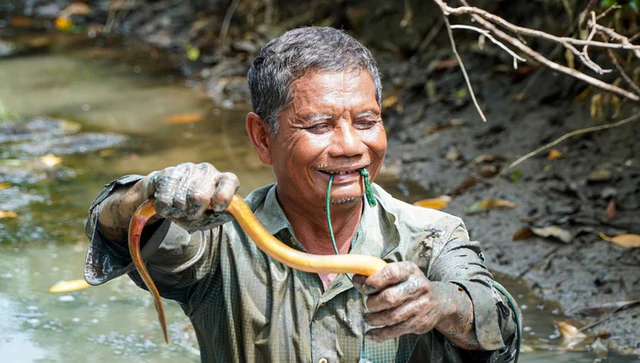
Using only his bare hands, Hoang can pull mud eels from deep in the mud. Photo: Thanh Huyen / Tuoi Tre
What impressed others even more was Hoang’s sense of direction.
He can remember routes stretching more than 20 kilometers along winding rural roads and guide a motorbike driver through each turn from memory.
“When I sit on the back, I pay attention to the bridges we cross, how long we travel and when we turn left or right,” Hoang said. “After a few trips, I remember the way.”
Out on the shrimp farms, Hoang relies on a different set of cues. He follows the embankments and listens to the wind, nearby voices and dogs barking to guide him through surroundings that can change from day to day.
Wading through hardship
A severe fever accompanied by a rash left Hoang permanently blind when he was four years old.
Growing up in the former Tra Vinh Province, he learned to feel his way to the river, where he practiced catching crabs and fish before eventually taking up mud eel hunting.
At 14, after hearing radio stories about Ca Mau and its abundant natural resources, he packed his belongings and took a bus south in search of a living.
A shrimp farmer in Nam Can later let him stay and help look after the farm, marking the start of Hoang’s life earning a living around the waterways.
He married at 32 and later had two children. But more than a decade later, his wife left, taking their children with her.
“When my wife and children left, I was very sad. The emptiness was hard to fill,” Hoang recalled.
“To ease the sadness, I went out to shrimp farms and canals every day to catch mud eels, from early morning until late at night. Sometimes I would still be wading through the mud in heavy rain.”
For Hoang, blindness even has one unusual advantage.
“Other people have to stop when it gets dark,” he said.
“For me, day and night are the same. I just keep feeling my way around and catching them.”
Hoang said catching mud eels is not simply about strength. Hunters must understand how the animals live and build their burrows.
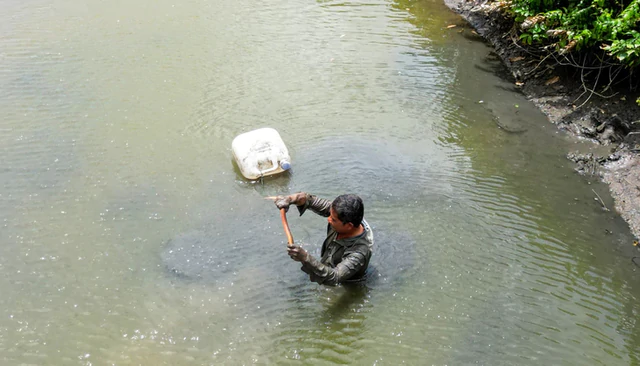
Hoang’s only “tools” are a plastic container and a piece of rope. Photo: Thanh Huyen / Tuoi Tre
Their burrows do not run straight down but slope into the ground and often branch into several passages. Sighted hunters can look for cloudy water flowing from a burrow to work out where an eel may be hiding.
Hoang relies entirely on his hands to feel the shape of the mud and trace the burrow beneath it.
Mud eels feed on small shrimp and fish in aquaculture farms, so farm owners are usually happy to let people catch them.
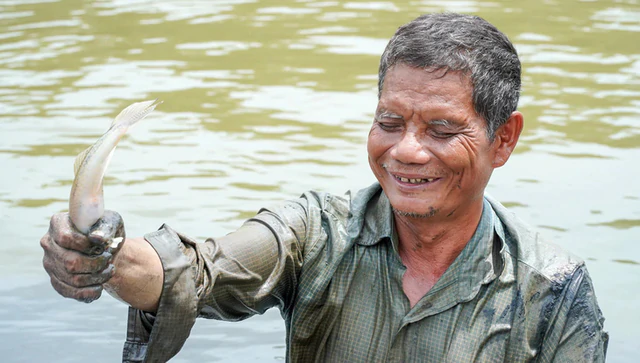
Sometimes, he even catches large gobies with his bare hands. Photo: Thanh Huyen / Tuoi Tre
On one recent outing, Hoang spent more than four hours in the water and caught seven kilograms of large mud eels, with around seven to eight animals per kilogram.
At about VND160,000 (US$6) per kilogram, the catch was worth more than VND1 million ($38).
Hoang hoisted the container of mud eels onto his shoulder, smiling broadly, his face darkened by years of working outdoors.
For him, the money earned from hours in the mud is not just a means of making a living, but also proof that he can support himself without depending on others.
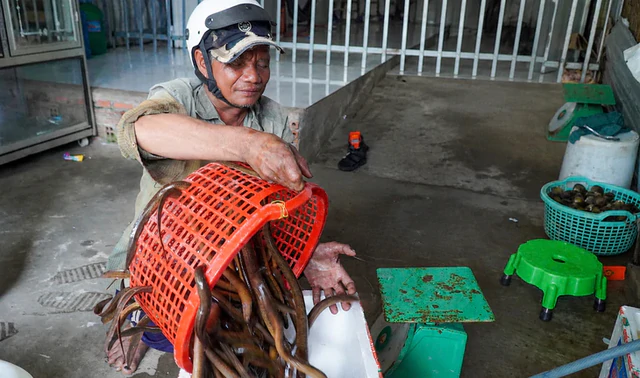
After four hours wading through the shrimp farm, Hoang caught seven kilograms of mud eels worth more than $38. Photo: Thanh Huyen / Tuoi Tre
Why hand-caught mud eels fetch higher prices
Mud eels have long, slippery bodies resembling common eels, with dark yellow coloring.
They are commonly found in brackish water, estuarine mudflats and shrimp or crab farms, where they burrow deep beneath mud and plant roots, making them difficult to catch.
Local residents often use hooks to catch larger numbers, but hooked mud eels can die quickly and are difficult to keep alive.
The traditional hand-catching method used by experienced hunters such as Hoang requires them to probe the burrow, trace its passages and block the animal’s escape route.
Mud eels caught this way tend to remain healthy and survive longer, making them more sought after by traders.
Depending on size, they sell for VND160,000-250,000 ($6-9.5) per kilogram.
Ngoc Nguyen - Thanh Huyen / Tuoi Tre News
Link nội dung: https://news.tuoitre.vn/blind-mans-uncanny-skill-at-catching-mud-eels-in-southern-vietnam-103260905142236537.htm