
Can India ignite a durian boom for Vietnam? Industry data vs. on-the-ground realities
India’s recent decision to greenlight imports of fresh Vietnamese durian has injected a fresh wave of optimism into Vietnam’s agricultural sector, unlocking direct access to a burgeoning consumer base of over 1.4 billion people.
Yet, while market intelligence points to a rapidly expanding appetite for exotic fruits across the subcontinent, trade experts on the ground are urging caution, warning that structural hurdles will likely temper early expectations.
The market access gives Vietnam a vital avenue to diversify its agricultural trade away from single-country dependency, as reported by Tuoi Tre (Youth) online newspaper.
Still, a crucial question hangs over the industry: can India deliver the same explosive growth that turned China into a multi-billion-dollar durian juggernaut for Vietnamese growers?
A billion-dollar frontier
On paper, the growth trajectory of India’s tropical fruit sector looks undeniable.
According to a market intelligence report authored by analyst Hannah Blake at Deep Market Insights, the Indian durian industry was valued at $1.27 billion in 2025 and is projected to surpass $2.19 billion by 2034, expanding at a steady annual rate of 6.2 percent. India currently accounts for roughly 4.5 percent of global durian demand.
Much of this momentum is fueled by an expanding urban middle class, growing exposure to international flavors, and an evolving retail infrastructure that includes specialty grocers, cold-chain logistics, and e-commerce platforms.
While fresh durian historically held the lion’s share of sales, researchers expect frozen formats and processed applications—such as durian-based desserts, bakery items, and smoothies—to post the fastest growth over the coming decade.
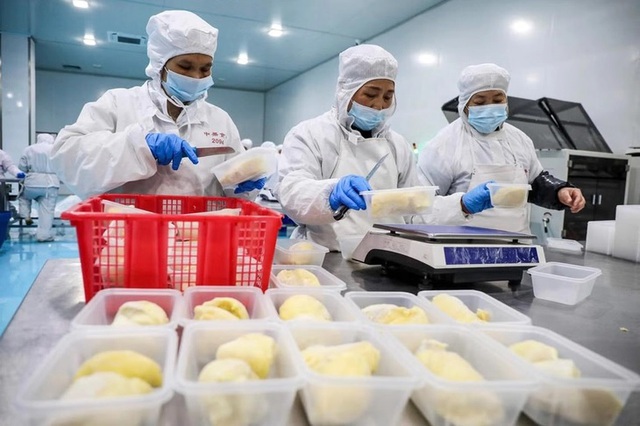
Beyond pricing, consumer familiarity poses a softer but equally challenging obstacle for Vietnamese durian in India. Photo: TTO
The reality on the ground
Despite these encouraging macroeconomic trends, converting raw market potential into steady export revenue will not happen overnight.
Speaking with Tuoi Tre, Dang Phuc Nguyen, general secretary of the Vietnam Fruit and Vegetable Association, welcomed India’s regulatory approval as a significant milestone, but emphasized that two formidable barriers stand in the way of rapid expansion: steep tariffs and an unfamiliar consumer palate.
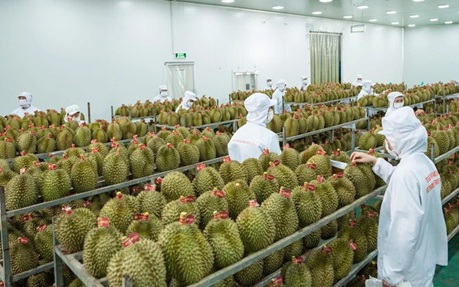
High import duties have long restricted the Indian durian trade.
Thai suppliers, who previously dominated the small Indian market, focused predominantly on frozen or dried products alongside limited air-freighted shipments sold at premium prices in affluent urban centers like Mumbai and New Delhi.
Today, while many imported fruits in India face duties as high as 60 to 70 percent, durian carries a tax rate of around 43 percent, heavily squeezing retail margins.
Nguyen noted that Vietnamese exporters will only gain a true competitive foothold if they can eventually secure zero-percent tariff treatment under the ASEAN–India Free Trade Agreement.
Beyond pricing, consumer familiarity poses a softer but equally challenging obstacle. When Vietnam gained official access to China, Chinese consumers were already deeply familiar with durian after decades of marketing and supply from Thailand and Malaysia.
In contrast, durian remains a novelty to the vast majority of Indian shoppers, many of whom are unaccustomed to its distinctively strong aroma and complex flavor profile.
Given these lingering obstacles, Nguyen believes that initial trade volume will be modest, predicting export turnover to reach a maximum of $50 million to $100 million in the early years—a far cry from a full-blown boom.
A pragmatic path forward
On the regulatory front, officials offer a encouraging silver lining. Representatives from Vietnam’s Department of Crop Production and Plant Protection confirmed that India has waived requirements for additional phytosanitary declarations on official certificates, streamlining the baseline shipping process.
To make meaningful inroads, industry leaders agree that Vietnamese exporters must play a long game.
Rather than flooding the market with fresh fruit, companies are advised to lead with processed, dried, or frozen durian products, which offer longer shelf life and serve as a gentler entry point for first-time consumers.
Initial distribution will likely remain focused on high-end supermarkets, hotel networks, and online delivery apps in major metropolitan areas, allowing exporters to build brand awareness while local supply chains mature.
Hai Minh - Chi Tue / Tuoi Tre News
Link nội dung: https://news.tuoitre.vn/can-india-ignite-a-durian-boom-for-vietnam-industry-data-vs-on-the-ground-realities-103260804094830813.htm