
Children cannot be left to social media: What Australia’s experience means for Vietnam
Australia’s decision to ban children under 16 from holding social media accounts is rooted in a simple principle: young people deserve the same protections online that they receive in the physical world.
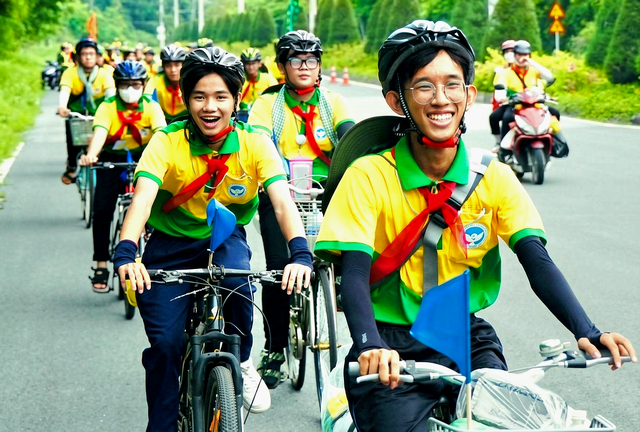
Students in Ho Chi Minh City take part in a cycling field trip to learn about the history, traditions, and culture of different regions in Vietnam. Photo: T. Hiep / Tuoi Tre
In an interview with Tuoi Tre (Youth) newspaper, Australian Ambassador to Vietnam Gillian Bird said the legislation reflects Australia’s growing concern over the effects of unrestricted social media access on children and teenagers, as governments worldwide struggle to balance technological innovation with safety.
“Australia’s world-leading social media minimum age legislation came into effect in December last year, reflecting our government’s strong commitment to protecting children and young people in the digital age,” Bird said.
The ambassador said Australia’s move followed mounting evidence that children under 16 are especially vulnerable to the harmful effects of social media platforms designed to maximize engagement.
“There is a growing evidence-base that indicates an association between social media use and harm to young people and children,” she said, citing personalized algorithmic content, endless scrolling feeds, ‘likes,’ and disappearing content such as ‘stories’ as features linked to problematic use.
According to Bird, these systems can contribute to “social isolation, sleep interference, poor mental and physical health, and exposure to inappropriate and harmful content.”
The legislation is intended to help end what has been described as the “era of unregulated access” for children online.
“Just as society accepts age restrictions for certain films, venues or products, we believe similar child-safety principles should exist online,” Bird said.
Ending ‘era of unregulated access’
Under Australia's new law, major social media platforms are legally responsible for preventing children under 16 from holding accounts.
The obligation falls primarily on technology companies rather than parents or children.
Australia’s independent eSafety Commissioner oversees compliance and requires platforms to take “reasonable steps” to prevent underage access, including detecting and removing underage accounts and preventing re-registration attempts.
Platforms including Facebook, Instagram, Threads, Snapchat, TikTok, and YouTube have been classified as age-restricted under the legislation.
However, children can still access messaging services and platforms focused on education or health support.
Bird stressed that families and schools remain essential to the effort, even though enforcement does not rely solely on parental supervision.
“Parents and carers are encouraged to use practical tools such as guides from the eSafety Commissioner and family technology agreements to establish healthy boundaries around technology use,” she said.
Australian schools are also increasingly emphasizing digital and algorithmic literacy, teaching students to critically understand how online systems shape behavior and influence what users see.
“The aim is to ensure that young people understand online risks and are better prepared to navigate the digital world safely when they eventually reach the permitted age for having social media accounts,” Bird said.

Australian Ambassador to Vietnam Gillian Bird
Teaching children to navigate digital world
Australia’s approach, she added, is not simply about restricting access.
“It is equally focused on encouraging healthier and more positive alternatives for young people,” she said.
One major initiative is the Australian Government’s AUD200 million (US$142.43 million) “Play Our Way” program, aimed at increasing participation in sports, especially among women and girls.
The program funds community facilities for activities such as football and netball to encourage physical activity and social interaction offline.
At the same time, Australia is investing in digital literacy and online safety education designed to prepare children for eventual participation in digital spaces “safely, critically, and responsibly.”
“The broader objective is to encourage balance, ensuring that technology remains a positive tool in young people’s lives rather than becoming their primary source of social connection or entertainment,” Bird said.
Although the legislation is still new, Bird said early responses from families have been encouraging.
“Parents have described feeling more supported when setting boundaries around screen time and online behavior,” she said.
The ambassador acknowledged that the reform will take time to fully take hold across society, comparing it to earlier public safety measures such as mandatory seatbelt laws.
“Australia views this reform in a similar way to other major public safety measures introduced over time,” she said.
The government has not yet collected long-term data on whether children are spending more time outdoors or reducing screen time significantly, but Bird said authorities are working to provide “attractive alternatives to excessive social media use and encourage healthier lifestyles for young Australians.”
Australia also recognizes that no technological system can completely eliminate attempts to bypass restrictions, including through tools such as VPNs.
“This is not about chasing perfection but establishing a new norm for social media use,” Bird said.
The government’s strategy instead focuses on making platforms accountable for enforcing age restrictions.
Companies that fail to take sufficient measures may face enforcement action from the eSafety Commissioner.
 Australian Ambassador to Vietnam Gillian Bird
Transparency requirements are another key element.
Social media companies can be legally required to explain what measures they are taking to prevent underage access.
“We understand that online safety is an evolving challenge that requires ongoing adaptation,” Bird said.
As Vietnam debates calls for similar restrictions, Bird said Australia’s experience offers several lessons.
One is that online safety rules should mirror protections already accepted offline.
“Just as age checks are required for certain films or physical venues, similar principles can also apply in online spaces where children may otherwise be exposed to harmful experiences and material,” she said.
Bird also highlighted the importance of privacy protections within Australia’s legislation, including limits on how platforms can use information collected for age verification and requirements that such information be destroyed after use.
Another lesson, she said, is the need for accessibility and inclusion.
“Australia has worked to provide digital safety resources in multiple languages, including Vietnamese, so that linguistically diverse communities are not left behind,” Bird said.
She underlined that effective policies require cooperation between regulators, educators, families, and young people themselves.
Australia has also invested heavily in helping children build what some experts describe as “psychological armor” -- the resilience and critical thinking needed to make safer choices online independently.
“Young people are being taught how algorithms shape the content they see online, including the risks of ‘echo chambers’ and addictive content cycles,” Bird said.
“By understanding how digital systems influence behavior, young people are better equipped to take greater control over their own online experiences.”
Bird said Australia hopes to continue exchanging experiences with Vietnam and other regional partners as countries search for ways to better protect children online.
“Building a safer, healthier digital future for children and young people will help build a better future for all of us,” she said.
Thanh Hien - Bao Anh / Tuoi Tre News
Link nội dung: https://news.tuoitre.vn/children-cannot-be-left-to-social-media-what-australias-experience-means-for-vietnam-103260528151846232.htm