
China not pursuing trade surplus with Vietnam: Chinese ambassador
China does not view a trade surplus with Vietnam as a strategic objective, underscoring a willingness to expand imports of high-quality Vietnamese goods as part of efforts to rebalance bilateral trade, Chinese Ambassador to Vietnam He Wei told a press briefing in Hanoi on Tuesday.
“China does not pursue a trade surplus with Vietnam,” he said.
“Our government is actively working to address the persistent trade imbalance and is encouraging greater access for Vietnamese exports to the Chinese market."
The ambassador emphasized that both sides recognize the imbalance as unsustainable and are working to address it.
He noted that China itself experienced significant trade deficits during earlier stages of its development and has drawn lessons from that period.
A country facing a trade deficit is an almost unavoidable stage in the course of development, but Vietnam’s trade deficit with China has brought in more investment, factories, and local jobs, the ambassador said.
China is preparing to implement its 15th five-year plan, which will open its doors to high-quality global goods.
As the world’s largest economy by purchasing power parity, China offers significant opportunities for Vietnam to expand its exports.
“China is willing to welcome more high-quality Vietnamese goods,” He said.
Vietnam is China’s largest trading partner in ASEAN and its fourth-largest globally among individual countries, according to Vietnam’s Ministry of Foreign Affairs.
Bilateral trade reached US$256.4 billion in 2025, up 24.8 percent year on year.
Vietnam exported $70.4 billion worth of goods to China, up 14.8 percent, while imports from China totaled $186 billion, up 29 percent year on year.
In the first two months of 2026, China remained Vietnam’s largest trading partner, with total trade reaching $66.7 billion, a year-on-year increase of 30.2 percent.
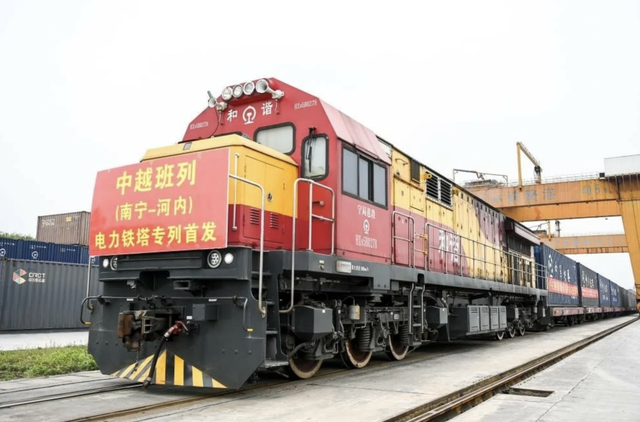
A Vietnam-China train departs for Hanoi, Vietnam from Nanning International Railway Port in Guangxi, China. Photo: Xinhua
Landmark milestone in bilateral ties
The briefing reviewed the outcomes of the recent state visit to China by Vietnam’s Party chief and State President To Lam from April 14 to 17.
According to the ambassador, the trip marked a historic milestone in bilateral relations, highlighted by what he described as three ‘firsts.’
It was the first overseas visit by Vietnam’s highest-ranking leader after the National Assembly consolidated the senior leadership apparatus.
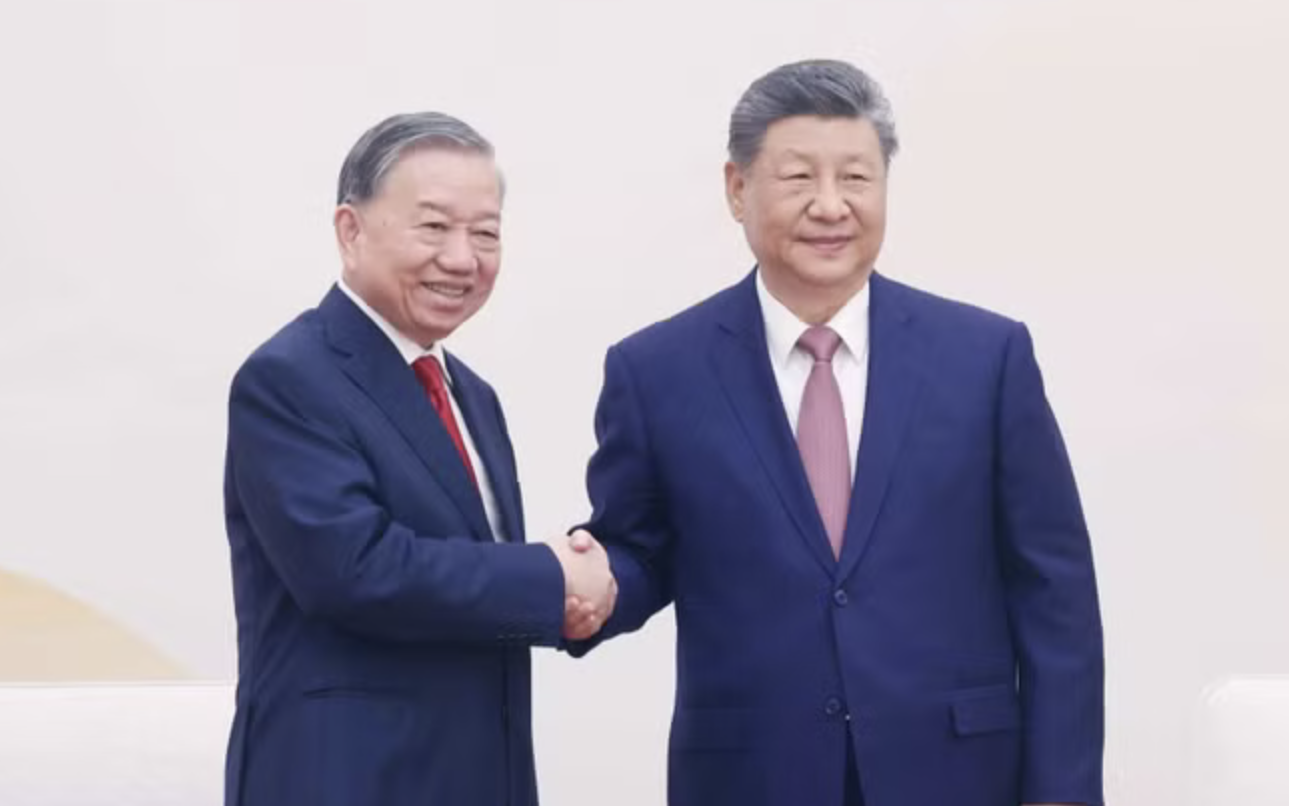
The trip also marked the first time a foreign head of state had visited the Xiong’an New Area, a flagship urban development envisioned as a model for China’s future growth.
Additionally, it was the first time a visiting foreign leader had traveled more than 2,500 kilometers across China via high-speed rail during an official visit, a journey lasting over 10 hours and spanning five provinces.
The visit yielded significant outcomes as political trust was further deepened, clearly reflecting the distinctive nature of China-Vietnam relations, He said.
Besides, practical cooperation was accelerated, as evidenced in the joint statement.
In addition, multilateral coordination was further strengthened, contributing positive momentum to peace and stability in the region and beyond.
He also shared a personal moment from the trip, recalling how Party General Secretary and State President To Lam Lam and his spouse stood by the window of the departing train for an extended time, waving farewell as they left China.
The gesture, widely shared on social media in both countries, resonated as a simple yet powerful symbol of neighborly friendship.
Since Chinese Party Secretary General and President Xi Jinping’s visit to Vietnam in April 2025, bilateral ties have seen what the ambassador described as a period of strong forward momentum.
Practical cooperation has reached unprecedented levels, including the deeper penetration of Vietnamese agricultural products into the Chinese market, reaching individual households.
Vietnamese fruits and cashew nuts were even featured at official banquets during the recent visit.
Looking ahead, railway cooperation has emerged as a central pillar of future collaboration.
The ambassador described it as a ‘strategic breakthrough’ area, noting that Party chief and State President Lam showed keen interest in China’s high-speed rail system during his travels.
The Vietnamese leader raised numerous questions about the technology and highly valued China’s high-speed rail development.
"We can sense that the Vietnamese leader has high expectations for the development of railway cooperation between the two countries,” the Chinese ambassador said.
He added that the cooperation in the railway sector not only improves physical connectivity but also serves as a foundation for building a shared future community between the two countries.
During the visit, both top leaders witnessed the handover of feasibility study results for the Lao Cai-Hanoi-Hai Phong railway project, funded by Chinese aid.
Progress is also being made on additional routes linking Lang Son to Hanoi and Mong Cai to Ha Long and Hai Phong.
In the future, these standard-gauge railways will help strengthen connectivity, facilitating trade and travel while enabling Vietnam to deeply access the Chinese market with 1.4 billion people.
In addition, the three rail lines could help transform Vietnam from a sea-oriented country into one that is also connected overland to the European market via the Eurasian continent, enhancing its position in global supply chains.
Tieu Bac - Duy Linh / Tuoi Tre News
Link nội dung: https://news.tuoitre.vn/china-not-pursuing-trade-surplus-with-vietnam-chinese-ambassador-103260422112250056.htm