
Coffee industry’s future lies with Robusta: Vietnamese coffee expert
Despite building his career around Arabica as a certified Arabica Q Grader, Vietnamese coffee expert Vo Phap believes Robusta is poised to shape the future of the global coffee industry, citing its resilience, quality improvements, and growing market potential.
Phap’s coffee journey began behind the bar at Ho Chi Minh City’s Caravelle Hotel, where he worked as a bartender.
Today, he is widely recognized as one of Vietnam’s leading coffee experts.
In 2010, Phap won the prestigious Lavazza Barista Champions, an international barista competition, before joining Italian coffee brand Illy as a trainer.
He later earned the coveted Q Arabica Grader certification, one of the coffee industry’s highest credentials, awarded to professionals qualified to evaluate and score coffee quality under internationally recognized standards.
He also completed advanced professional training in coffee processing.
In 2016, Phap founded Saigon Roastery Coffee, creating a space that serves both as a café showcasing his own roasted coffees and as a training center for aspiring baristas.
The venue has earned high praise from international visitors on TripAdvisor.
Contrary to the assumption that the above-mentioned view of Phap is influenced by Vietnam’s status as the world’s largest exporter of Robusta coffee, he said his prediction is rooted in long-term shifts in both consumer behavior and climate.
Phap believes Robusta will increasingly dominate the global coffee industry as modern lifestyles drive demand for beverages with higher caffeine content.
As work becomes more demanding, particularly in the age of artificial intelligence, people are relying more on drinks to help them stay alert, he said.
While Arabica has long been prized for its delicate aroma and slight acidity, it contains significantly less caffeine than Robusta, the variety known for its stronger flavor and higher caffeine content.
Drawing on years of experience in the coffee industry, Phap argues that caffeine will become an increasingly important factor shaping consumer preferences.
Climate change is another reason behind his outlook.
Arabica is notoriously sensitive to fluctuations in temperature and growing conditions, making it more vulnerable to unpredictable weather.
Robusta, by contrast, is hardier and better adapted to hotter climates and harsher environmental conditions, giving it a long-term advantage as global temperatures continue to rise.
Conventional Robusta has long been associated with bitterness, a lack of acidity, and a less pronounced aroma, characteristics that have traditionally made Arabica the preferred choice among specialty coffee enthusiasts.
But he argued that this perception no longer applies to Fine Robusta, a higher-quality segment produced under stricter cultivation and processing standards.
According to Phap, many coffee professionals around the world are beginning to embrace espresso made without any Arabica in the blend, a shift he sees as evidence of Fine Robusta’s growing recognition within the specialty coffee industry.
He also believes Fine Robusta offers a distinctly Vietnamese drinking experience when paired with sweetened condensed milk, creating a flavor profile that is both unique and deeply rooted in the country’s coffee culture.
Although green Robusta beans command lower prices than green Arabica beans, premium finished products made from the two varieties, Fine Robusta and Special Arabica, can fetch comparable prices.
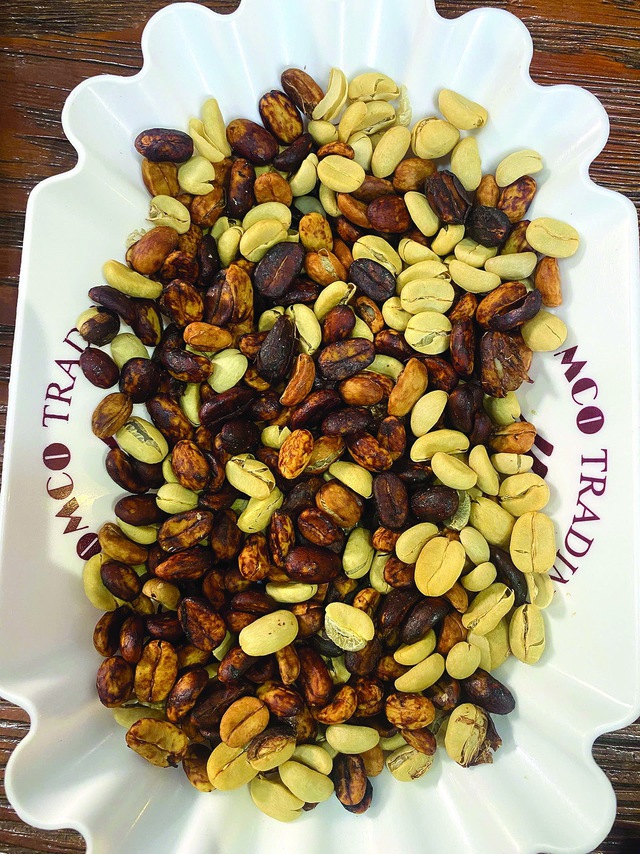
Robusta beans after primary processing. The lighter beans are washed, while the darker ones are naturally processed and more fermented, helping reduce bitterness. Photo: Bao Duy
Phap attributes such price parity to the labor-intensive processing required to produce Fine Robusta.
Unlike conventional Robusta, Fine Robusta undergoes highly controlled post-harvest processing to reduce bitterness and develop a sweeter, more complex flavor profile.
Producers capitalize on the bean’s naturally high sugar content by harvesting cherries at an overripe stage and carefully managing fermentation.
Some Vietnamese Robusta varieties, whose coffee cherries turn purple when ripe, can reach sugar levels of as much as 32-34 percent, Phap said.
The drying stage is equally demanding. The beans must be spread no more than two layers thick on raised drying beds at least 70 centimeters above the ground to ensure proper airflow.
While sunlight is essential, the beans are dried under greenhouse conditions rather than in direct sunlight to maintain consistent quality.
The labor-intensive process requires substantial investment and highly skilled processors, helping explain why Fine Robusta can command prices comparable to specialty Arabica despite the lower cost of its raw beans.
Phap believes Vietnam has only begun to unlock the potential of Fine Robusta.
Commercial production took off only after the COVID-19 pandemic, and as more processors acquire the expertise and infrastructure needed to produce high-quality Fine Robusta, he expects the premium segment to expand.
That, in turn, could raise the value of Vietnam’s signature coffee while making Fine Robusta more accessible to consumers over time.
Vietnam is the world’s largest producer of Robusta coffee, but many experts say it has yet to fully capitalize on that advantage.
Much of the country’s Robusta is still exported as a raw commodity, limiting the value captured by Vietnamese growers.
They argue that greater investment in post-harvest processing and roasting could transform Robusta from a volume-driven crop into a premium product, allowing Vietnam to move further up the value chain and earn higher returns from the coffee it already produces.
Van Giang - Huy Tho / Tuoi Tre News
Link nội dung: https://news.tuoitre.vn/coffee-industrys-future-lies-with-robusta-vietnamese-coffee-expert-103260701160622942.htm