
Conditions of poisoned children in Da Nang improve thanks to WHO-supplied botulism antidote
Three children in Da Nang City, central Vietnam have shown signs of recovery after receiving a rare botulism antidote supplied by the World Health Organization (WHO) following food poisoning, health officials said.
The Da Nang Department of Health received five vials of Botulism Antitoxin Heptavalent from the WHO as emergency assistance late on Wednesday and immediately delivered them to the hospitals treating the affected children.
Two of the patients are being treated at Da Nang Hospital for Women and Children, while the third is under care at Quang Nam Northern Mountainous Regional General Hospital.
The antidote was administered overnight.
By the following morning, Da Nang Hospital for Women and Children reported that the two children under its care had become more alert, were able to respond when spoken to, and were gradually regaining movement in their limbs.
Doctors said they will continue closely monitoring their respiratory function in the coming days.
Dr. Nguyen Thi Phuc, a technical officer at the WHO office in Vietnam, said the organization was pleased to learn that the children’s conditions had improved following treatment.
She attributed the outcome to close cooperation among the Ministry of Health, local health authorities, hospitals, and related agencies.
According to the health department, the drug is extremely rare and costly, priced at around US$8,000 per vial, and is not currently available in Vietnam.
Local health authorities sought urgent support from the WHO after three pediatric patients were hospitalized in critical condition.
Phuc said the WHO activated its emergency response mechanism immediately after receiving an official request from the Da Nang Department of Health regarding the critically ill children.
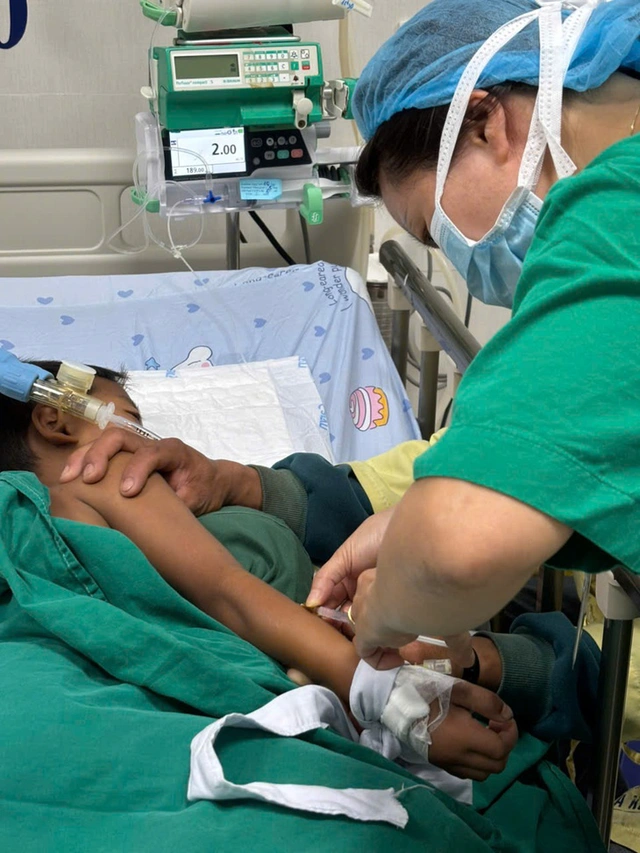
A child with botulism poisoning receives treatment at Da Nang Hospital for Women and Children in Da Nang, central Vietnam. Photo: Supplied
The antidote was transported from Geneva via Istanbul to Hanoi before being rushed to Da Nang for treatment.
Dr. Tran Dinh Vinh, director of Da Nang Hospital for Women and Children, said the hospital had earlier been alerted to three children with botulism poisoning after eating fermented fish.
Two of the children were transferred to the hospital with respiratory failure and limb weakness, including one who required mechanical ventilation.
Vinh said the hospital has sufficient intensive care capacity, but the availability of the specific antitoxin is crucial for treating botulism poisoning.
Tran Thanh Thuy, director of the Da Nang Department of Health, said city leaders had been informed about the poisoning incident and thanked the WHO for its timely support.
Authorities are reviewing related cases and examining how the contaminated food was prepared, while the Nha Trang Pasteur Institute in Khanh Hoa Province is studying potential risks linked to fermented food processing to develop prevention recommendations.
Health officials are also stepping up public warnings about botulism poisoning, particularly risks associated with homemade fermented or pickled foods.
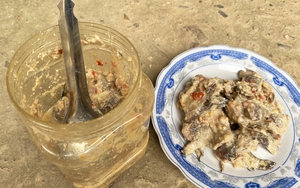
Vietnam has recorded several botulism poisoning incidents in recent years.
In 2020, dozens of people fell ill after eating vegetarian pate while the country had no stock of the antidote, prompting the WHO to urgently supply 10 vials of antitoxin from Switzerland.
In 2023, the organization again provided six vials, which were flown to Ho Chi Minh City to treat three patients.
A doctor in the intensive care unit of a major hospital in Ho Chi Minh City told Tuoi Tre (Youth) newspaper that rare medicines such as botulism antitoxin play a decisive role in treating severe poisoning and can determine a patient’s chance of survival.
However, access to such drugs remains difficult in Vietnam because the country has yet to establish a national stockpile of rare medicines.
Since 2023, the Drug Administration of Vietnam under the Ministry of Health has been planning to establish three to six centers to store rare and limited supply medicines, with the stockpile expected to include around 15 to 20 drugs such as botulinum antitoxin.
However, three years later the proposed centers remain on paper as authorities continue working to finalize regulations on the drug list and health insurance coverage.
Vinh Tho - Chau Sa / Tuoi Tre News