
Degraded collective housing in Hanoi: When concrete fades but memory endures
As Hanoi evolves, and modern high-rises replace ramshackle apartment blocks, many residents of the city’s tumbledown collective housing estates still find themselves tethered to memories that refuse to fade.
Over the past three decades, the renovation of these aging complexes has been discussed repeatedly.
Yet the renovated housing projects have accounted for only a minimal proportion of the overall plan.
As of the end of 2024, just over one percent of the redevelopment plan had been completed.
Nearly 250,000 people continue to live in around 1,580 dilapidated collective housing blocks and apartment buildings, most of them located in the heart of the city such as Dong Da, Ba Dinh, and Hai Ba Trung.
Once hailed as a pioneering housing solution, these collective housing areas now stand at a crossroads.
Are they part of the city’s urban heritage, or have they become emblems of urban decay?
In a lecture on the transformation of human settlement patterns in Hanoi, delivered at an international workshop between Phuong Dong University in Hanoi and Germany’s University of Kassel many years ago, Associate Professor and architect Nguyen Hong Thuc highlighted this evolution in the capital.
She argued that the street-market lifestyle is intrinsic to Vietnamese culture, fulfilling daily needs while nurturing cultural exchange.
More importantly, the transformation of these estates demonstrates that living culture can reshape architectural form itself.
Collective housing was not a spontaneous architectural experiment, but it emerged from a distinctly 20th-century vision: to provide standardized accommodation for state employees in a centrally planned economy, and to organize urban life around principles of collectivity, equality, and frugality.
Four- or five-story blocks, with shared staircases and communal courtyards, reflected a design philosophy in which function prevailed over aesthetics and community was prioritized over individuality.
For decades, the model functioned relatively well.
These collective housing blocks were not merely residential units but also social ecosystems.
Children played in shared courtyards, while neighbors exchanged bowls of soup across balconies.
Everyday encounters fostered durable bonds.
For generations of Hanoians, memories of collective housing are intertwined with hardship, solidarity, and a distinctly communal way of life.
From this well of memory arises an increasingly persistent argument: should these estates be regarded as a form of urban heritage?
Not heritage in the classical sense of ancient monuments, but as repositories of collective memory and markers of a unique phase in social and urban development.
Yet the current legal framework has yet to make room for the form of heritage such as collective housing.
Vietnam’s Law on Cultural Heritage emphasizes historical and cultural value but provides no clear criteria regarding the age of modern architecture.
Most collective housing blocks are 40 to 60 years old – old enough to deteriorate, but not old enough to qualify automatically for preservation.
Urban decay or social adaptation?
Architectural evaluation tools under the Law on Architecture and related decrees focus heavily on technical and aesthetic standards rather than social value or lived memory.
As a result, collective housing estates occupy a grey zone: structurally unsafe to preserve unchanged, yet insufficiently recognized as heritage to warrant protection.
Six buildings classified at the most dangerous level have already been identified for urgent evacuation.
But even when collapse is a real threat, achieving consensus among residents remains complex.
Relocation is not simply a matter of square meters, it involves livelihoods, social networks, and a sense of belonging.
Complicating matters further, most of these estates were once located on the outskirts of the city but now sit in prime inner-city locations.
The interests of residents, investors, and urban planners are difficult to reconcile swiftly.
From a planning perspective, many experts view the degraded collective housing blocks as clear manifestations of urban decline: outdated infrastructure, overcrowding beyond design capacity, encroached public spaces, and distorted cityscapes.
The ubiquitous ‘tiger cages,’ or iron-barred enclosures installed on balconies and windows to prevent burglary, are not merely aesthetic blemishes but signs of prolonged governance gaps.
Yet to reduce collective housing to a technical problem is to overlook a parallel story of social resilience.
When living spaces no longer met their needs, residents adapted.
Balconies were expanded, ground floors converted into small shops, corridors transformed into micro-marketplaces.
Over time, many estates evolved into miniatures of ‘streets and markets,’ reflecting the deep-rooted Vietnamese attachment to commerce and street life.
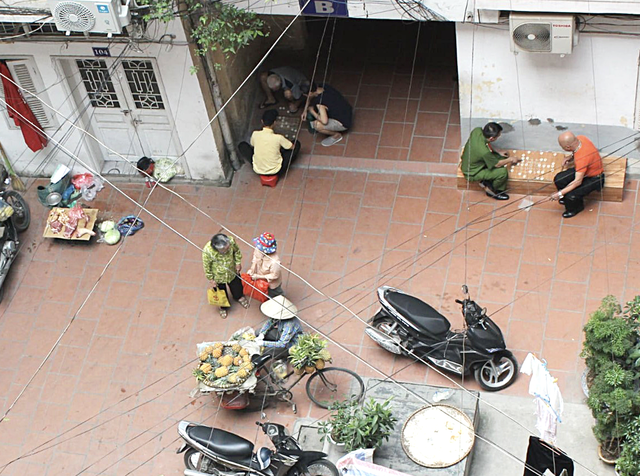
The courtyard of a collective housing estate in Hanoi becomes a space for a market, chess games, and parking. Photo: Thien Dieu / Tuoi Tre
What will the city choose to remember?
Ultimately, the central question is not whether to demolish or preserve, but how the city defines its own future.
If all collective housing blocks are razed and replaced with high-rise buildings, Hanoi may solve pressing problems of safety and density.
However, it may also erase irreplaceable layers of memory – spaces that once nurtured a distinctive form of urban life.
Conversely, preserving them sentimentally while ignoring structural risks would turn heritage into a burden.
Between these extremes, many experts advocate a selective, tiered approach.
Not every estate needs to be saved, but neither should all be wiped from the map.
Some areas with particular historical value, strong community structures or strategic urban positions could undergo adaptive renovation – upgrading infrastructure while retaining spatial forms and social life.
Such an approach requires more than administrative decrees.
It demands genuine participation from residents, who best understand both the value and the limitations of their homes.
It also calls for a planning mindset that regards urban memory as a resource rather than an obstacle.
The old collective housing blocks of Hanoi are not simply relics of nostalgia, nor merely technical challenges awaiting resolution.
They are a test of the city’s ability to converse with its past as it steps into the future.
No city can preserve everything. But what it chooses to retain reveals the identity it wishes to carry forward.
Amid the weathered concrete of these aging estates, Hanoi faces a decision not only about space, but about memory, community, and the story it will tell future generations about itself.
Tieu Bac - Tam Le / Tuoi Tre News
Link nội dung: https://news.tuoitre.vn/degraded-collective-housing-in-hanoi-when-concrete-fades-but-memory-endures-103260302152802411.htm