
Drivers torn between safety and 'cut-in' fears as Vietnam cracks down on expressway tailgating
As Vietnam begins deploying smart cameras to slap automated fines on tailgaters across its primary expressways, the aggressive crackdown has sparked a fierce debate among motorists -- trapped between praising a long-overdue safety campaign and fearing the legal trap of aggressive drivers cutting into their required gap.
Starting Thursday, authorities officially began penalizing tailgating violations along the key corridor stretching from Hanoi to Thanh Hoa, which encompasses the Phap Van - Cau Gie - Cao Bo - Mai Son - National Highway 45 - Nghi Son expressway sections.
This campaign represents a major step in the country's efforts to curb expressway accidents, over 30 percent of which officials attribute directly to vehicles following too closely.
High-tech surveillance meets tighter legal enforcement
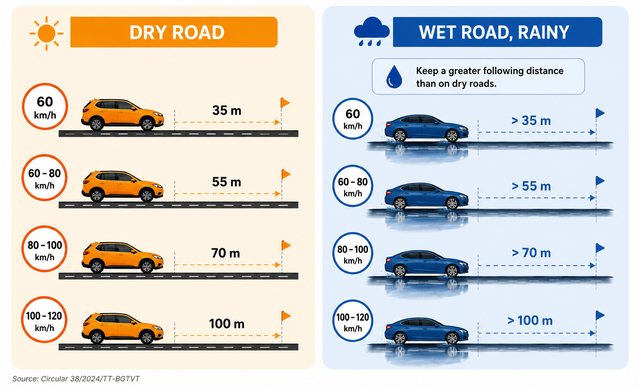
Under Circular 38/2024/TT-BGTVT, which originally took effect on January 1, 2025, drivers on Vietnamese expressways must adhere to strict metric distance requirements tailored to their travel speed.
Financial penalties for violators are governed by Decree 238/2026. Specifically, failing to maintain a safe distance when no collision occurs carries a fine of VND 4–6 million (US$157–235) and a two-point deduction from the driver's license. If the violation results in an accident, the fine escalates to VND 20–22 million (US$785–863), along with a ten-point license deduction.
According to authorities, the legal mandate to maintain safe distances is not new to Vietnamese road laws, but consistent enforcement is.
In the past, technical limitations made it difficult to verify and penalize tailgating unless an accident occurred.
Now, a network of high-resolution surveillance cameras, dashcam footage submitted by the public, and mobile patrols allow the traffic police department to issue automated fines.
Graphic: Tuoi Tre News
Under normal, dry road conditions, the regulations mandate a sliding scale of minimum safe distances based on speed brackets.
For vehicles traveling at 60 km/h, the minimum safe distance is 35 meters.
This requirement increases to 55 meters for speeds between 60 km/h and 80 km/h.
Drivers traveling between 80 km/h and 100 km/h must keep a gap of at least 70 meters, while those traveling at the maximum highway speeds of 100 km/h to 120 km/h are required to maintain a distance of 100 meters.
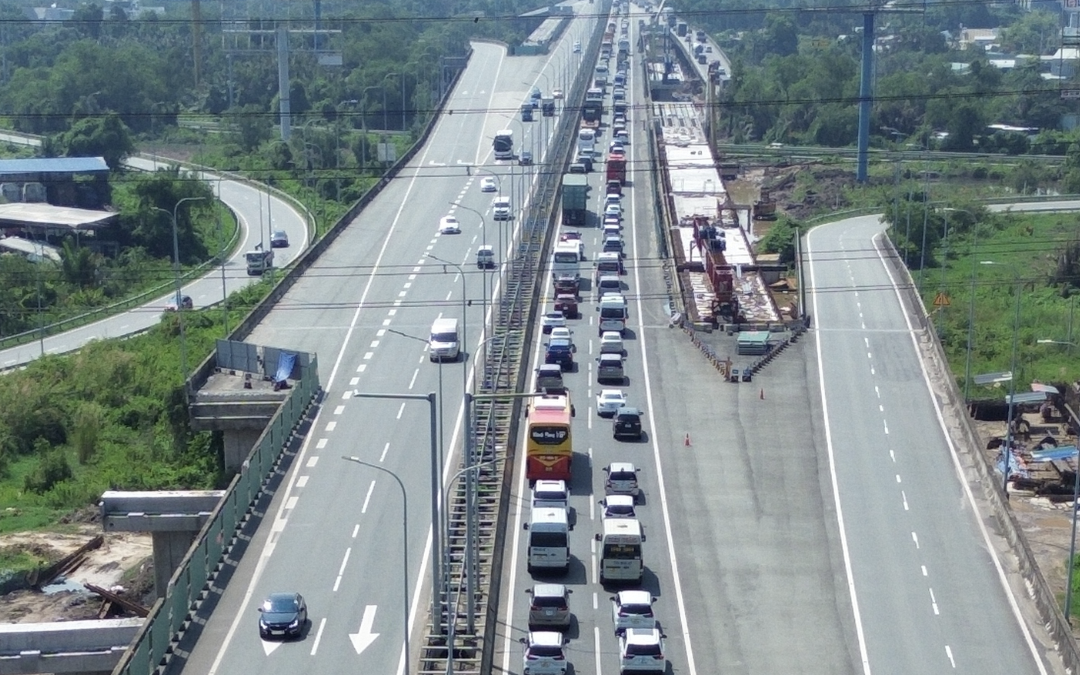
If traffic density rises or congestion occurs, dropping speeds below 60 km/h, drivers are expected to actively adjust and maintain a safe gap based on the actual flow of traffic.
Conversely, in adverse conditions such as rain, fog, or slippery surfaces, drivers are legally required to extend their following distance beyond the statutory minimums.
The metric approach adopted by Vietnam aligns closely with neighboring China, which also mandates a minimum 100-meter gap for speeds exceeding 100 km/h, and Japan, where guidelines recommend a 100-meter gap at 100 km/h.
This contrasts with many Western countries, such as France and the United Kingdom, where drivers are instructed to follow time-based rules, typically maintaining a two-to-three-second buffer behind the preceding vehicle.
Public anxiety over the "fill-in-the-blank" habit
While many Vietnamese drivers have welcomed the campaign as a necessary measure to prevent horrific multi-vehicle pileups, the strict metric requirements have also triggered widespread anxiety.
The most prevalent concern among motorists is the notorious 'fill-in-the-blank' behavior.
On crowded expressways, drivers worry that leaving the legally mandated 55-meter or 100-meter gap will simply invite aggressive motorists to cut in front of them, instantly turning a law-abiding driver into a technical violator.
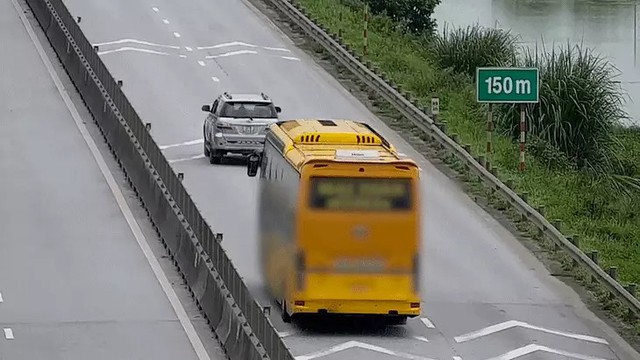
The yellow passenger bus has been penalized for failing to maintain a safe distance from the vehicle ahead on the expressway. Photo: Traffic Police Department
Adding to this anxiety is the acute stress of trying to estimate precise metric distances on the move.
Some drivers point out that, without advanced vehicle technologies like Adaptive Cruise Control (ACC) or Advanced Driver Assistance Systems (ADAS), measuring a precise 55-meter or 70-meter gap by eye while traveling at high speeds is nearly impossible.
Others report that constantly straining to calculate distances distracts them from the road and causes severe mental fatigue.
Concerns are also rising over the perceived inflexibility of automated surveillance systems, with some motorists fearing that artificial intelligence (AI) cameras will flag them for being minorly off-target, such as maintaining 54 meters instead of 55 meters.
Authorities address driver fears
In response to these anxieties, traffic police officials have clarified that the primary objective is to eliminate dangerous, deliberate tailgating -- where vehicles run bumper-to-bumper at high speeds to force a lane change -- rather than punishing victims of sudden cut-ins.
Authorities have assured the public that traffic officers and AI-enabled cameras will analyze context-heavy video sequences to differentiate between actual tailgating violations and instances where another vehicle abruptly cuts into a driver's zone.
To help drivers estimate distances without advanced vehicle technologies like ACC, safety experts suggest looking for roadside markers and painted ground lines, which are spaced at 50-meter intervals on major expressways.
Experienced drivers also recommend using the 'three-second rule' -- measuring the time it takes to reach a fixed roadside object after the car ahead has passed it -- as a practical method to ensure a safe following gap.
Following the upcoming National Day holiday (September 2), the enforcement campaign is scheduled to expand across other major sections of the North-South Expressway, including routes stretching from Ho Chi Minh City to Khanh Hoa, as well as segments between Dak Lak and Quang Tri.
Son Luong / Tuoi Tre News