
Drone disruption at Tan Son Nhat Airport: How much did it cost carriers?
Thousands of passengers were affected by delays and flight diversions after unauthorized drones disrupted operations at Tan Son Nhat International Airport in Ho Chi Minh City on Tuesday, with the incident estimated to have cost airlines up to US$2 million.
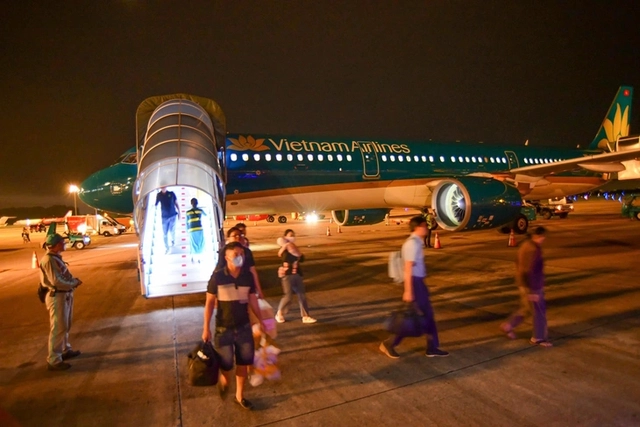
Airlines suffered millions of dollars in losses following the drone intrusion at Tan Son Nhat International Airport. Photo: Quang Dinh / Tuoi Tre
Drone intrusion triggers millions of dollars in airline losses
The two-hour disruption at Tan Son Nhat International Airport is estimated to have cost airlines millions of dollars, as dozens of flights were delayed, diverted, or forced to remain in holding patterns.
According to representatives of the airport, the incident occurred during peak operating hours, when Vietnam's busiest airport typically handles 44-46 takeoffs and landings per hour.
Flight operations were suspended twice after an unauthorized drone was detected in restricted airspace.
The first suspension lasted from 6:28 pm to 7:16 pm, while the second ran from 7:40 pm to 8:34 pm..
The 102-minute disruption forced aircraft to either circle while awaiting clearance to land or divert to alternate airports, disrupting aircraft rotations and triggering delays across airline networks.
Airport data showed that 56 flights were directly affected, generating a cumulative 5,285 minutes of delays.
Of those, 24 flights were diverted to alternate airports, including Can Tho and Cam Ranh, 18 were required to remain in holding patterns, and 14 were delayed before departure.
Some flights experienced lengthy delays.
Vietnam Airlines flight VN1267 from Vinh to Ho Chi Minh City, for example, arrived nearly two hours behind schedule.
While Tan Son Nhat Airport recorded 56 directly affected flights, aviation authorities and related agencies estimated that the actual impact may have extended to 70-100 flights through knock-on disruptions.
Vietnam Airlines said 11 of its flights were diverted and around 30 others were directly affected, with aircraft required to remain in holding patterns for between 20 and 80 minutes.
The carrier added that the need to reorganize aircraft assignments, crew schedules, and flight operations created ripple effects for dozens of services on Wednesday.
Its network-wide on-time performance on Tuesday fell by six percentage points.
Vietjet also reported disruptions to multiple flights, particularly evening services, forcing the airline to adjust aircraft schedules, rearrange crew assignments, and assist passengers stranded at airports.
Diversions accounted for large share of airline losses
Flight diversions were the costliest consequence of the drone disruption at Tan Son Nhat, helping push total airline losses from the incident to an estimated VND37.7-52 billion ($1.45-2 million), according to aviation experts.
An aviation commerce expert told Tuoi Tre (Youth) that airline operating costs are typically calculated by “block hour,” the period from when an aircraft leaves its parking stand until it reaches its parking position at the destination airport.
Based on the expert’s estimates, operating a narrow-body aircraft such as an Airbus A320 or A321 costs about $8,000 per hour, while a wide-body aircraft can cost up to $13,000 per hour.
The figure includes fuel, maintenance, aircraft leasing or depreciation, crew expenses, and other operating costs.
When aircraft are forced to remain in holding patterns, engines continue running and fuel consumption rises.
If fuel reserves approach mandatory safety limits, flight crews and airline operations centers may decide to divert to an alternate airport.
On Tuesday evening, three flights made emergency landings for refueling, while 24 others were diverted to alternate airports.
The expert said diversions typically generate the highest costs because airlines must absorb additional fuel burn, landing fees, ground handling charges, refueling expenses, and passenger support costs.
Aircraft may also need to operate extra flights to return to their intended destinations or continue scheduled services.
The 24 diverted flights are estimated to have generated losses of about VND24.7 billion ($950,000), compared with VND5.3 billion ($204,000) for the 18 flights placed in holding patterns and VND7.7 billion ($296,000) for the 14 flights delayed on the ground.
The affected flights are estimated to have consumed an additional 179 metric tons of fuel worth about $207,000.
Direct operational losses, including fuel, aircraft utilization, crew costs, airport charges, and ground services, were estimated at around VND12 billion ($462,000).
When passenger delays, missed connections, airport assistance, potential compensation claims, and broader commercial impacts are included, total losses could reach VND37.7 billion ($1.45 million).
If knock-on disruptions across airline networks are also taken into account, the figure could approach VND52 billion ($2 million).
With airlines estimating an average of 200 passengers per flight, roughly 11,200 passenger journeys may have been affected by the incident.
Ngoc Nguyen - Cong Trung / Tuoi Tre News
Link nội dung: https://news.tuoitre.vn/drone-disruption-at-tan-son-nhat-airport-how-much-did-it-cost-carriers-103260813143208368.htm