
Efforts underway to identify 17 sets of remains believed to belong to war martyrs in Da Nang
Authorities in Da Nang City, central Vietnam, are reviewing newly submitted historical records, wartime aerial photographs and witness accounts that could help identify 17 sets of human remains believed to be those of Vietnamese war martyrs, which were recovered decades ago from a suspected wartime mass grave in the former Quang Nam Province.
A veteran who served in Military Region 5 provided documents pointing to the remains to the Da Nang High Command.
At his home on Pham Quang Anh Street in Da Nang, the veteran, Nguyen Tien Dai, spread out field survey records, maps and aerial photographs preserved by U.S. veterans who served in the Quang Nam-Da Nang battlefield between 1965 and 1966.
According to Dai, cross-checking these materials has consistently pointed to the conclusion that 17 Vietnamese soldiers were likely killed and buried in a mass grave in Hiep Duc.
Dai compiled the information after years of comparing historical records while searching for the burial place of his uncle, martyr Vo Xuan Thuy from Bac Ninh Province, who was killed on the Quang Nam-Da Nang battlefield during the war.
According to Dai, his family's decades-long search was hindered because his uncle's name had been mistakenly recorded as Vu Xuan Thuy instead of Vo Xuan Thuy on official documents.
As a former Military Region 5 soldier, Dai said he felt responsible for finding his uncle's resting place.
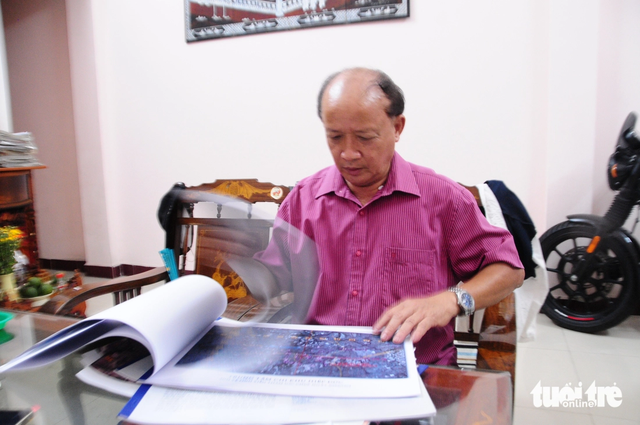
Nguyen Tien Dai displays aerial photographs provided by U.S. veterans. Photo: B.D. / Tuoi Tre
After nearly 20 years of tracing archival records, cemeteries and former military units, he discovered that his uncle's file had been kept at the former Quang Nam High Command under the incorrect name.
By comparing multiple sources, he determined that his uncle was buried at Dien Phuoc Martyrs' Cemetery, now in Da Nang, although the headstone still bears the incorrect name.
"That journey helped me understand the longing of families whose loved ones have never returned home. I wanted to share my experience so that other families might have more hope," Dai said.
Several years ago, Dai began sharing his search on Facebook, where he connected with U.S. veterans Bob Connor and Richard W. Magner, both of whom had served in Vietnam.
Their exchanges gradually developed into a joint effort to search for information about missing Vietnamese war martyrs.
Dai said Connor and Magner had preserved extensive wartime records after the war and hoped to help both Vietnam and the United States locate those still missing on former battlefields.
Following clues from aerial photographs
While researching battles fought in Hiep Duc during 1965-66, Dai found references in historical documents suggesting that mass graves of Vietnamese soldiers might exist in the area.
He asked the U.S. veterans to help locate related records.
Soon afterward, Connor sent him a collection of aerial photographs taken by U.S. military aircraft over Hiep Duc during 1965-66. The images are archived at a U.S. university.
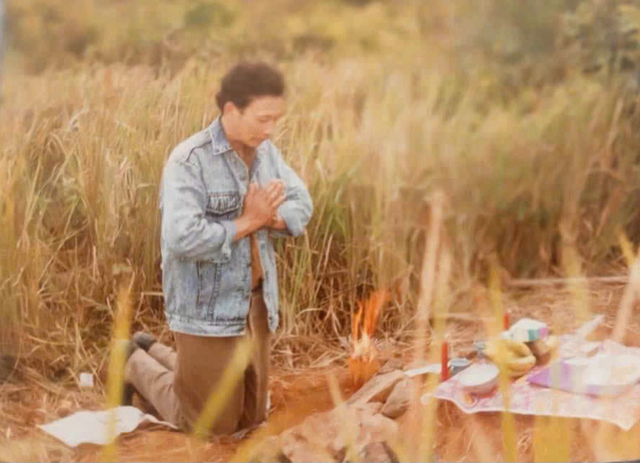
Vo Dinh The visits the graves of the 17 unidentified remains that he personally recovered and buried in 1980. Photo: Vo Dinh The
Dai then sought assistance from fellow veterans Le Thanh Hung, Dang Ngoc Nga and Mai Xuan Huong, along with architect Nguyen Xuan Thang of Da Nang, to analyze the photographs.
As more evidence emerged, Dai asked the U.S. veterans to locate additional aerial images of the same area taken at different times for comparison.
By comparing the photographs, they identified several clearings within dense forests that corresponded with U.S. military records documenting the locations and timing of battles.
Dai believes these sites may be linked to wartime mass graves.
Carrying maps, aerial photographs and coordinates, he traveled to Hiep Duc to interview local witnesses.
According to information he gathered, workers constructing a government office in 1980 uncovered an underground burial site containing 17 sets of human remains along with military artifacts.
At the time, however, authorities lacked the conditions needed to identify the victims.
The discovery prompted Dai to continue tracing the history of the 17 sets of remains and locate the person who had exhumed and cared for them for more than four decades.
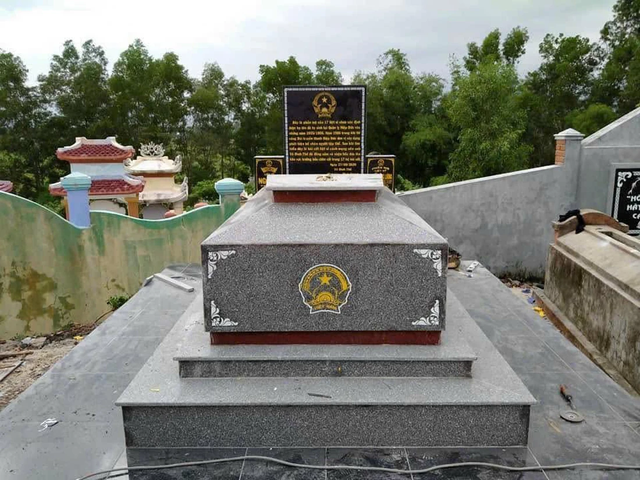
The remains are currently buried and cared for at Vo Dinh The's family cemetery. Photo: Vo Dinh The
Caring for 17 unidentified remains for more than 40 years
Following documents collected in Hiep Duc, Dai met Vo Dinh The, a businessman now living in Ho Chi Minh City who is originally from Duy Tan Commune, now part of Da Nang.
Local residents told Dai that The personally recovered, buried and has maintained the graves of the 17 suspected war martyrs for more than 40 years.
The recalled that in 1980, while serving at the Hiep Duc District Military Command, he witnessed construction workers uncover a mass grave during land clearance.
"The excavator uncovered a pit filled with human remains. No one dared to climb down. I went down myself and counted 17 skulls.
There were also many personal belongings of the soldiers. In two cases, identifying information had been preserved inside penicillin bottles," The told Tuoi Tre (Youth) online newspaper.
After reporting the discovery to authorities, The said that because identification was not possible at the time, he and a local resident collected all the remains, buried them near the discovery site and took responsibility for maintaining the graves.
Even after leaving the military and moving to Ho Chi Minh City, he continued returning to Hiep Duc to burn incense at the graves whenever he visited his hometown.
In 2019, when the burial site was cleared for construction, the remains could not yet be transferred to a martyrs' cemetery because verification procedures had not been completed.
The, therefore, hired workers to exhume all 17 sets of remains and rebury them in his family's cemetery in Duy Tan Commune, where they continue to be carefully maintained.
"For decades I have only wished that they could one day be identified and reunited with their families. I have kept all the artifacts and records collected during the reburial. Every year on July 27 (War Invalids and Martyrs' Day in Vietnam), I return to hold a memorial ceremony for them," The said.
According to Dai, the combination of aerial photographs, U.S. military records, witness accounts and information preserved by The has created an important body of evidence to support efforts to verify their identities.
He has handed over the entire dossier to the Da Nang High Command.
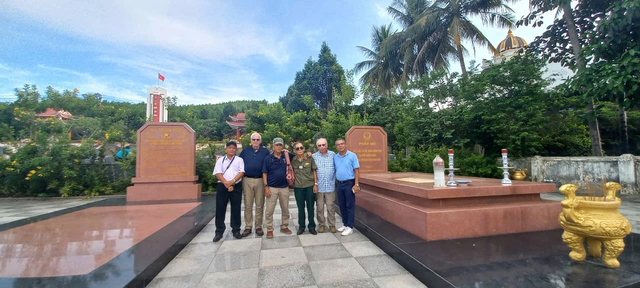
U.S. veterans return to Vietnam to work with Nguyen Tien Dai and his colleagues in the search for information about missing war martyrs. Photo: Nguyen Tien Dai
Lieutenant Colonel Nguyen Linh Thien from the Da Nang High Command confirmed that the command has received the documents and is reviewing them.
"Any information related to war martyrs is extremely valuable. We will continue examining historical records, conducting field verification and interviewing witnesses. If sufficient evidence is obtained, we will organize a scientific workshop and invite relevant experts to assess the findings before proceeding in accordance with regulations," Thien said.
If the findings are verified and DNA testing can be carried out, the remains that have been cared for for more than four decades may finally be identified.
More than 50 years after the war ended, tens of thousands of Vietnamese families are still searching for the burial places of relatives who died in combat. Many cemeteries contain rows of graves marked only with the words "Unidentified war martyr."
Provinces and cities across Vietnam are accelerating efforts under a 500-day nationwide campaign launched in early April to locate and identify war martyrs' remains.
Thanh Ha - Thai Ba Dung / Tuoi Tre News