
Electric bikes, solar power gain traction as heatwaves push up energy demand in Vietnam
Prolonged heatwaves in Vietnam are not only driving electricity demand sharply higher but also prompting households to rethink how they manage living costs, with electric bikes and rooftop solar power emerging as practical ways to optimize energy use and reduce expenses.
Tran Van Minh, a ride-hailing driver in Ho Chi Minh City, said his decision to switch from a gasoline vehicle to an electric bike initially stemmed from a very basic reason: cutting costs.
Cutting costs comes hand in hand with higher profits, according to Minh.
He previously spent around VND120,000 (US$4.56) per day on gasoline.
Since his switch to an electric vehicle, charging costs are only around VND30,000-40,000 ($1.14-1.52) per day and do not exceed VND50,000 ($1.9) even with heavy usage.
In addition to saving on fuel costs, electric vehicles break down less frequently and do not require engine oil changes.
For those with intensive usage, the difference in daily fuel expenses and regular oil changes can accumulate into a considerable amount of savings.
“If you work consistently, saving up to several million dong is feasible,” he said. [VND1 million = $38]
His colleague, Duong Cong Hoang, said his biggest initial concern was the battery.
Hoang, also a ride-hailing driver in Ho Chi Minh City, has been using the electric vehicle for over four years.
He said he had researched through books and consultations with the staff at the store, and learned that replacing the battery for an electric bike costs tens of millions of dong.
However, after using it, he realized that the costs spread over the span of six to eight years, or even 10 years, which would not be considered a loss.
According to Hoang, an electric bike’s battery often lasts six to eight years, or even longer with careful use.
Also, it does not fail immediately but gradually loses range over time.
Meanwhile, daily savings of around VND80,000-100,000 ($3.04-3.8) from reduced fuel and maintenance costs can add up to roughly VND2-2.5 million ($76-95) per month.
“If you work consistently, those savings are enough to cover the battery costs, not to mention the fact that electric bikes break down less and do not require periodic oil changes, which makes total costs not as big a barrier for drivers,” he added.
He also stressed that the total costs would not be a burden when considering all factors on the total scale.
Another notable point is that the operating costs of electric bikes are more stable than those of gasoline ones, as they are not affected by the fluctuations in fuel prices.
This helps riders, especially ride-hailing drivers, track their income more easily and plan their finances more proactively.
As urban areas gradually tighten emissions standards and promote green transport, electric bikes are no longer an emerging trend but they are becoming a practical solution.
Rooftop solar power payback period is shortening
As the trend of ‘electrifying life’ is becoming clear, the next issue is the electric costs. This is where rooftop solar power becomes the key piece of the puzzle.
A business owned by Nguyen Van Hoang in Ho Chi Minh City previously paid more than VND32 million ($1,216) for electricity a month due to the continuous operation of high-capacity air-conditioning systems.
After investing VND550 million ($2,090) in rooftop solar with battery storage, the electricity bill dropped to VND7.3 million ($277.4).
During the day, the system uses sunlight to power equipment and charge the battery.
At night, especially during peak-price hours, stored electricity is used instead of grid power.
“We are almost completely in control, everything is managed on a phone,” Hoang said, adding that the payback amount is expected in about two years.
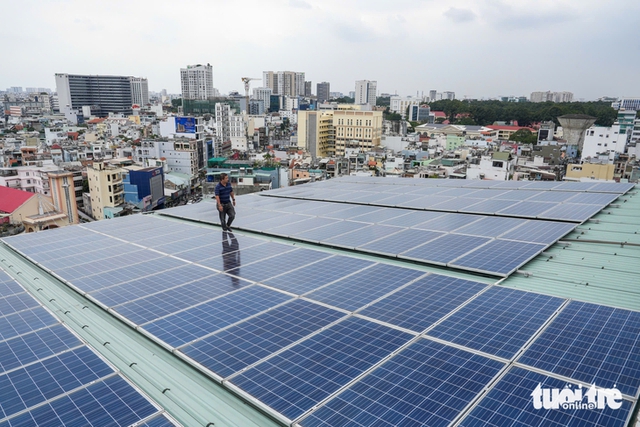
Rooftop solar power has proven its efficiency over time. Photo: Huu Hanh / Tuoi Tre
According to a representative from Ho Chi Minh City Power Corporation (EVNHCMC), the effectiveness of solar power has been proven after nearly a decade of operation.
If the market previously had many concerns about the panel durability, operational efficiency, and storage capacity, nearly 10 years of deployment have proven minimal performance degradation, provided systems are regularly maintained and hygiened.
As equipment prices decline, payback periods for rooftop solar systems have shortened significantly.
For systems without battery storage, payback periods can be around two years. Meanwhile, systems with storage take longer to recover costs but they allow users to control electricity supply at night and increase self-sufficiency.
In particular, in the event of grid disruptions, the system can continue operation for a certain period, ensuring that household activities and production are not disrupted.
This is the ‘dual benefit’ rooftop solar provides: reducing electricity costs for users, while helping with demand response for the urban electricity systems.
For battery storage, technology has improved significantly over the past five years, better meeting practical needs.
The Southern Power Corporation (EVNSPC) said it is actively supporting new registrations and providing detailed information on rooftop solar systems both directly and online.
It has expert teams advising on energy issues, energy audits, and solar installations for businesses and factories across provinces.
In addition, the power sector has developed a data and information system for rooftop solar installation on the website solar.evn.com.vn, where customers can refer to market prices, capacity, and registration procedures online.
As electricity demand continues to rise, electrical devices become more widespread and green transport expands, consumers are no longer just 'electricity users' but are becoming more proactive in creating and managing their own energy sources.
The issue is no longer about saving small expenses, but about optimizing total operating costs, from efficient energy use to the adoption of renewable energy for sustainability.
Green energy transition a key driver of sustainable growth
Ensuring energy security, stabilizing supply, and reducing emissions are becoming urgent requirements for Vietnam.
Amid volatility in global energy markets, gradually reducing dependence on fossil fuels, developing renewable energy, and building an appropriate transition roadmap are seen as key tasks to sustain economic growth.
In that context, the Ministry of Industry and Trade, the Ho Chi Minh City People’s Committee, and Tuoi Tre (Youth) newspaper are jointly organizing a seminar titled 'Green Energy Transition - A Key Driver of Sustainable Growth.'
The seminar is the opening event of the Green Vietnam 2026 program, initiated by Tuoi Tre and Packaging Recycling Organization Vietnam (PRO Vietnam), in coordination with the Department of Climate Change under the Ministry of Agriculture and Environment and the Ho Chi Minh City chapter of the Vietnam Youth Federation.
The event will take place from 1:30 pm to 5:30 pm on April 24 at Majestic Hotel at 1 Dong Khoi Street, Ben Nghe Ward, Ho Chi Minh City, with the participation of regulators, experts, research institutes, and the business community.
The agenda focuses on the green transition roadmap, emission reduction solutions, the development of new energy, policy mechanisms, and technology applications in the transition process.
Van Giang - Cong Trieu / Tuoi Tre News
Link nội dung: https://news.tuoitre.vn/electric-bikes-solar-power-gain-traction-as-heatwaves-push-up-energy-demand-in-vietnam-103260421122103733.htm