
Electric is new normal in Vietnam’s cities amid fuel cost rise
Vietnamese urban households and businesses are increasingly turning to electric stoves and vehicles as electricity costs become more competitive and the push for green living accelerates.
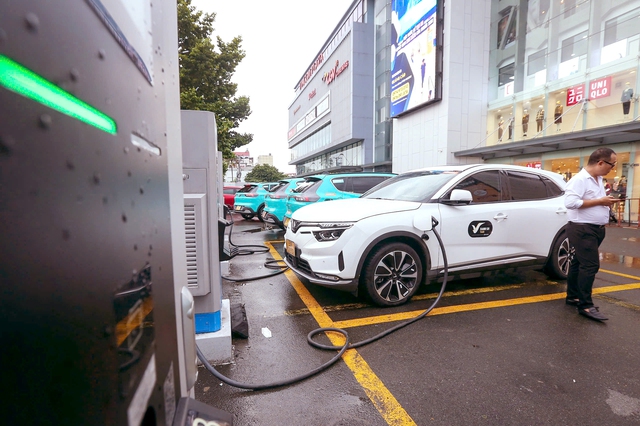
An electric vehicle charging station is located at a shopping mall in Hanh Thong Ward, Ho Chi Minh City. Photo: Quang Dinh / Tuoi Tre
Residents in Ho Chi Minh City and other provinces said safety and convenience are key reasons for switching from gas to electric cooking.
Kim Dung, from Ho Chi Minh City’s former Go Vap area, explained her family adopted an electric stove during a kitchen renovation a few years ago.
“At first, I just wanted to avoid fire hazards. Now it’s even more convenient because I don’t have to worry about rising gas prices,” she said.
Similarly, Hong Nguyen said that her family in Lam Dong Province, located in Vietnam’s Central Highlands, had long used electric stoves for safety reasons, and the owner of her current rental in Vinh Hoi Ward, Ho Chi Minh City requires tenants to avoid gas cooking.
Beyond household appliances, many urban residents are becoming familiar with electric-powered transportation.
Phuong Anh, 24, from Binh Trung Ward, Ho Chi Minh City said she prefers electric buses for their quiet rides and environmental benefits.
While she still uses a gasoline-powered motorbike for work, she plans to buy her first car as an electric vehicle.
“I don’t mind waiting for charging. I just want to avoid spending so much on fuel,” Phuong Anh said.
Experts believe electrification is a strategic move for Vietnam.
Nguyen Vinh Khuong, lecturer at RMIT University Vietnam, told Tuoi Tre (Youth) newspaper that households are shifting to electric appliances while companies adopt electric vehicles to meet sustainability goals.
He said that volatile oil prices, especially amid Middle East tensions, highlight electricity’s long-term stability, particularly as renewable energy grows.
Global oil prices have been volatile due to escalating conflict involving the U.S., Israel, and Iran in the Middle East since February 28 and concerns over supply disruptions through key shipping routes.
Research by Ember Futures, a UK-based energy research division, shows only 16 percent of final energy demand in climate-vulnerable countries, including Vietnam, is met by electricity.
Yet falling costs of solar power and electric two-wheelers are making electrification more accessible.
Daan Walter, a senior energy specialist at Ember Futures, said fossil fuels have long been viewed as the only path to economic development.
However, recent energy crises have demonstrated the vulnerability of that model, especially for emerging economies that spend billions of dollars annually on fuel imports.
Solar power costs have fallen sharply over the past decade, making renewable energy increasingly competitive.
In Vietnam, financing costs for solar projects have declined from around 12 percent to about 10 percent, now lower than the roughly 11-percent cost associated with gas-based energy generation.
Khuong said electrification represents a strategic pathway for reducing dependence on oil imports.
He suggested prioritizing sectors with high fossil fuel consumption and strong conversion potential, including urban transportation, light industry, and residential energy use.
“At this stage, investment in energy, particularly energy efficiency and electrification linked to clean power sources, is not just an environmental issue but a long-term competitive strategy for businesses and nations,” Khuong said.
Electricity demand growth has historically tracked closely with economic expansion.
Under Vietnam’s revised national power development plan, commercial electricity consumption is forecast to reach between 500.4 billion and 557.8 billion kilowatt-hours by 2030, representing annual growth of 10.3-12.5 percent to support double-digit GDP growth targets.
Thai Hoang Quynh, head of energy business development at Schneider Electric in Vietnam and Cambodia, said energy infrastructure is no longer merely technical support but has become a core economic platform.
“In the era of digitalization, artificial intelligence, and rapidly expanding energy demand models, infrastructure is not just supporting growth. It directly determines economic competitiveness,” he said.
Analysis from Zero Carbon Analytics showed that with solar generation of 25.9 terawatt-hours, Vietnam could save approximately US$594 million annually in fossil fuel import costs, assuming coal and gas prices remain stable.
Writing in Asian Power, Frédéric Godemel, executive vice-president for energy management at Schneider Electric, said technologies such as rooftop solar panels, battery storage systems, and smart energy management tools are becoming increasingly accessible.
These technologies allow households to shift from passive energy consumers to active participants, enabling them to store electricity, manage usage timing, and even sell excess power.
Such changes also reduce exposure to energy price volatility.
“More importantly, individuals become active contributors in the journey toward net-zero emissions,” Godemel said.
Minh Duy - Nghi Vu / Tuoi Tre News
Link nội dung: https://news.tuoitre.vn/electric-stoves-vehicles-gain-popularity-in-vietnams-cities-103260419143839579.htm