
English-language chemistry lessons turn Ho Chi Minh City students into green problem-solvers
From pitching ideas to tackling plastic pollution in a mock courtroom, students at a Ho Chi Minh City school are learning chemistry in English through hands-on activities that combine science, communication, and environmental awareness.
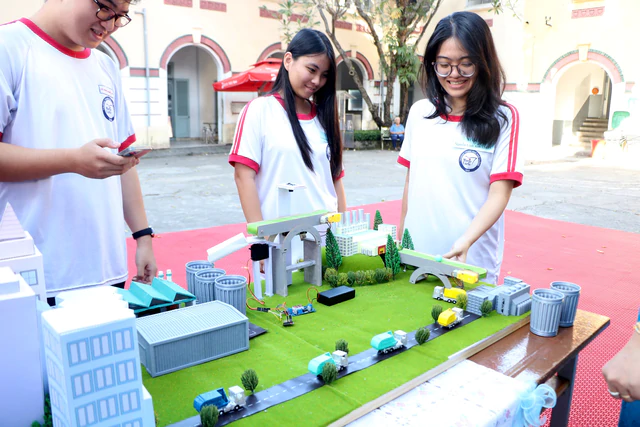
Students 3D-print a recycling center as part of their vision for a future city. Photo: Trong Nhan / Tuoi Tre
More than 120 grade-12 students at Marie Curie High School in Ho Chi Minh City took part in a demonstration lesson titled 'From Polymers to a Sustainable Future' on Wednesday morning, using English to debate plastic pollution and explore sustainable solutions through chemistry.
From STEM presentations to plastic pollution debates
The lesson opened with a question: "What would disappear if there were no polymers?" Students considered everyday items such as clothes, water bottles and phone cases before visiting the booths to learn about creative applications of polymers.
Students rotated between booths in three-minute sessions. Those presenting explained their products, described the materials used and answered questions in English, while visitors recorded what they learned in a digital worksheet called a 'polymer passport.'
At a booth featuring a model of a future city in 2050, students Nguyen Hoang An and Chu Bao Han presented their group's vision of an urban area that makes use of recycled materials.
As visitors arrived in successive groups, the students explained their ideas and the features incorporated into the model in English.
An said the group had spent considerable time practicing, reviewing chemistry concepts, and learning scientific terms in English. Beyond understanding the lesson, students also had to find ways to explain the concepts clearly to their audience.
Han said the unfamiliar format required careful preparation. The activity gave students an opportunity to learn specialized English vocabulary and use it to introduce their models and explain chemistry concepts.
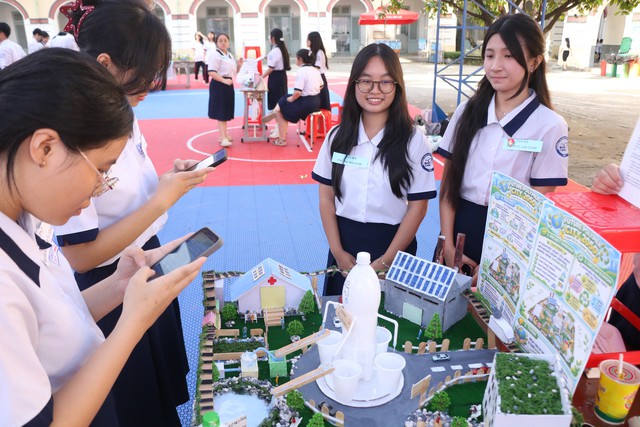
Bao Han's group presents its model of a future city in 2050 as classmates listen and complete their digital 'polymer passports.' Photo: Trong Nhan / Tuoi Tre
At the recycling booth, Do Hoang Nam introduced his group's 3D-printed factory model, featuring a conveyor belt that simulated the movement of plastic waste through the recycling process.
One student played a sorting worker, separating waste before it moved to the cleaning area. The group explained how plastic was shredded, melted, and turned into pellets for use in making new products.
Meanwhile, Nguyen Khanh Hung's group posed a question during its presentation: "Why throw away an entire object just because it has a crack?"
The group demonstrated how two-part epoxy and super glue could be used to repair broken items, including a plier handle, a picture frame, and a clothes hanger.
Their message was to prioritize repairing and reusing items before considering recycling.
After the exhibition, six students took on the role of investors in a simulated 'Shark Tank' activity, selecting the most promising ideas.
They assessed each project based on its chemistry, creativity and sustainability, then explained their choices.
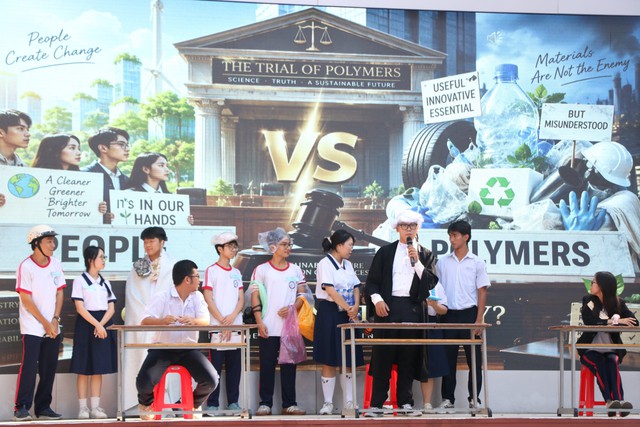
Students take part in a mock 'polymer trial,' debating whether polymers or humans are responsible for plastic pollution. Photo: Trong Nhan / Tuoi Tre
The lesson continued with a mock 'polymer trial,' in which students took on the roles of PET bottles, plastic bags, nylon fibers, adhesives and rubber, each making a case for its usefulness.
Prosecutors and defense lawyers then debated who was responsible for plastic pollution: polymers, humans or both. Students cast their votes by scanning a QR code at the end of the trial.
Trieu Khang, a member of the drama team, said that although he was familiar with English, performing a scientific story presented a different challenge.
He had to research scientific terminology carefully and pay particular attention to pronunciation while learning his lines.
"Using scientific terms in English was a fun challenge," he said.
Putting English into practice through creative activities
The special lesson was led by three chemistry teachers. Nguyen Thi Ngoc Tho guided and coordinated the class, while Lien Hong Nguyen and Nguyen Thanh Phong took on the roles of chemistry and environmental experts, posing questions to student groups.
Tho said the lesson was designed to encourage students to extend the useful life of polymers through products they made themselves.
The exhibition and role-playing activities created opportunities for students to explain their work in English.
Based on the lesson, she said one challenge of using English as a second language in schools was the uneven proficiency among students. While some spoke fluently, others were still hesitant
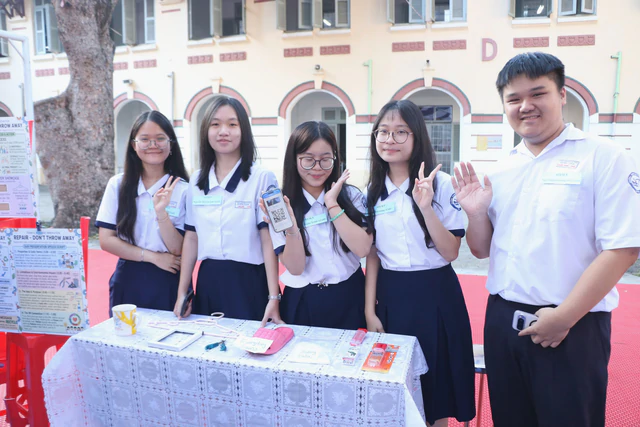
Students display everyday items made from recycled polymers at a STEM exhibition. Photo: Trong Nhan / Tuoi Tre
Teachers, too, need to learn how to teach in English accurately and clearly, Tho said.
"Above all, students need an environment where English is used regularly. They should be encouraged to speak up and gradually develop fluency, rather than staying silent for fear of making mistakes," she said.
Nguyen said STEM projects helped students illustrate scientific concepts and connect them to real-life situations.
Through the bilingual format, students learned about materials while practicing how to explain their knowledge in English.
Before the lesson, chemistry teachers worked with English teachers to review presentations, prepare vocabulary lists, and rehearse questions and answers.
Phong said it was the first time the three teachers had jointly organized a demonstration lesson in an exhibition format in a large space.
They had to choose clear and accessible language to help students understand the lesson and complete their tasks.
He praised the students' creativity, saying they had developed their own ideas beyond the original assignment.
By closely guiding students as they worked on their projects, Phong said he had also gained professional knowledge and new ideas for teaching future lessons.

Van Giang - Trong Nhan / Tuoi Tre News