
European freight truck makers brace for wave of low-cost Chinese rivals
ANTWERP/SODERTALJE, Sweden - Chinese electric freight trucks are rolling into Europe at pace this year, following the trail blazed by Chinese EVs and threatening to upend the market with better technology and lower prices.
Reuters has identified more than half a dozen Chinese manufacturers planning to launch European heavy truck sales in 2026.
They include EV giant BYD; Geely Holding (GEELY.UL) unit Farizon; China's top-selling electric truck brand Sany; Sinotruk; and startups Windrose and SuperPanther.
Founded in 2022, Windrose will build trucks in Europe and is exploring U.S. production with Xos, which makes delivery trucks for UPS and FedEx. That would put it in direct competition with Tesla's Semi big rig, which CEO Elon Musk recently said will start mass production this year, nine years after its 2017 unveiling.
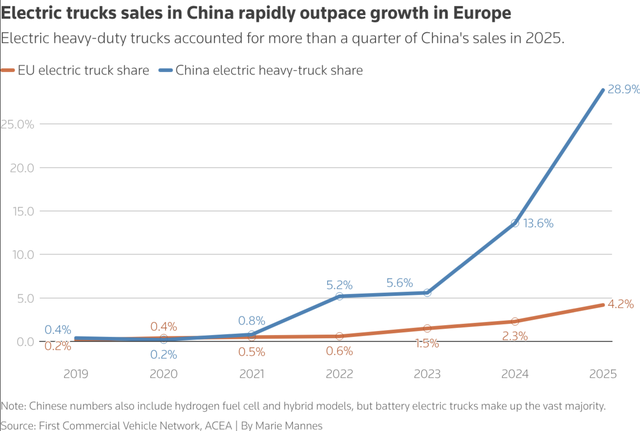
In Europe, the new arrivals aim to price their trucks up to 30% below the European average price of 320,000 euros ($380,000), managers at Chinese and European truckmakers told Reuters. Their cost advantages rely on their greater scale in China, where zero-emission heavy-duty trucks account for 29% of sales, as well as China's lower-cost electric vehicle and battery supply chain.
Electric freight trucks made up 4.2% of overall truck sales in the EU in 2025, up from 2.3% in 2024. Their growth has been slowed by price s that are about triple the 100,000-euro average for a diesel truck, according to industry experts.
Europe's truck-fleet owners are loyal to trusted brands, one advantage for European truck brands including Daimler Trucks, Volvo Group, Iveco, and Volkswagen unit Traton, which owns the MAN and Scania brands. These incumbents dominate Europe's market and control large portions of the global market outside China.
But fleet owners are also cost-conscious, raising fears among legacy truck makers that the influx of lower-priced Chinese rivals could quickly build electric-truck market share.
"We have one or two years to get ahead of this," says Chris Heron, secretary general of trade association E-Mobility Europe. "Or the Chinese will eat our lunch."
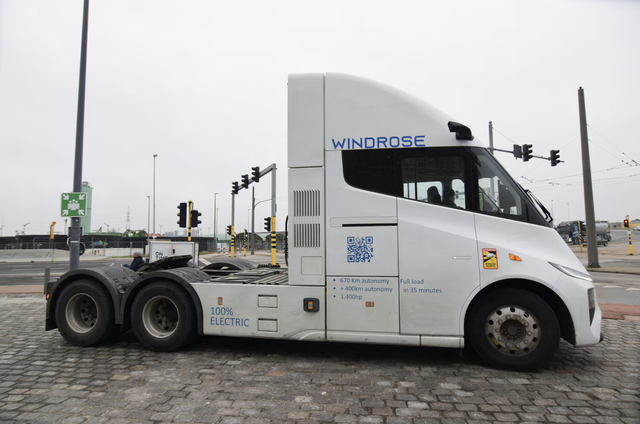
The Global E700, a heavy-duty electric truck developed by Chinese startup Windrose, will start sales in Europe this year in Antwerp, Belgium, January 29, 2026. Photo: Reuters
Europeans Seek Government Help
Traditional truckmakers are taking the competitive threat seriously.
Chinese rivals "are speedy, innovative, decisive and committed," said Volvo Group's CEO Martin Lundstedt. "Full respect – and the race is on."
Behind the scenes, industry groups like the European Automobile Manufacturers Association (ACEA) and E-Mobility are pushing the European Commission for policies to boost demand for their electric trucks before Chinese brands gain a European foothold. They seek lower highway tolls, zero-emissions freight mandates for major truck-fleet customers and other ways to boost demand.
"We need a significant acceleration of ZET (zero-emission truck) adoption in Europe," said Thomas Fabian, ACEA's chief commercial vehicle officer.
European climate groups like Transport & Environment (T&E) also support efforts to boost demand.
The Commission proposed easing 2030 carbon-emissions standards for truckmakers as part of a December automotive package and backs a number of measures to boost electric demand, including lower tolls. The Commission is also considering linking electric-truck subsidies to European production and mandating fleet electrification over time, a spokesperson said.
Underscoring the potential demand, the Dutch government in January offered a generous electric-truck subsidy programme totalling $95 million that was oversubscribed in a single day.
"That tells you it's also about price," said Stef Cornelis, T&E's director of electric fleets and trucks.
Chinese Technology Three Years Ahead
Phil Dunne, a managing director at consultancy Grant Thornton Stax, said Europe's truckmakers banked on Chinese manufacturers taking much longer to develop models for Europe. The industry's typical development cycle is seven years.
"The speed at which the Chinese have arrived with great products has surprised everyone," Dunne said.
It took startup Windrose three years to develop its Global E700 electric truck and get regulatory approval to sell it in China, Europe and the United States. Its first model allows the driver to sit in the middle, eliminating the need to produce different trucks for left- or right-hand-drive markets.
Legacy truckmakers often develop different models tailored to different regions, with separate R&D teams.
Windrose "only had enough money to develop one truck," said CEO Wen Han.
The company spent $99 million on development and will charge 250,000 euros ($295,250.00) for the truck in Europe when it goes on sale this year, more than double what it fetches in China's more competitive market, Han said.
Belgian logistics firm Gilbert de Clercq is awaiting delivery of a Windrose truck, CEO Filip de Clercq told Reuters. The company was attracted by the E700 price, along with its 670-kilometre (416 miles) driving range and 35-minute charging time - more than twice as fast as most European electric trucks today.
"China's competitive advantage is their technology is about three years ahead of Europe's," de Clercq said.
Plans For European Factories, Service Centres
Chinese truckmakers are taking steps to ease European truck-fleet managers' wariness about buying pricey trucks from unfamiliar Chinese companies. Xiaomi-backed SuperPanther and Sany have signed deals with Germany's Alltrucks, which runs a network of about 650 service centres across Europe.
BYD will make its trucks at its bus factory in Hungary. Steyr Automotive will build SuperPanther's trucks under contract at an Austrian factory that previously made MAN trucks. "Having our trucks assembled in Europe is a very good storyline for us," said SuperPanther's head of sales Frank Schulz.
In a sign of European truckmakers' recognition of Chinese technology, Scania last October invested 2 billion euros to open a factory about 150 km northwest of Shanghai that makes diesel trucks now and will add electric models later.
Scania has also aggressively hired R&D talent in China to better compete against Chinese rivals both there and globally.
"That is their biggest advantage... how they scale quickly from innovation to a really industrial state," Scania CEO Christian Levin said on a tour of the company's electric truck factory in Sodertalje, Sweden. "That's something that we as Europeans need to learn."
($1 = 9.0371 Swedish crowns)
($1 = 0.8467 euros)
Reuters
Link nội dung: https://news.tuoitre.vn/european-freight-truck-makers-brace-for-wave-of-low-cost-chinese-rivals-103260310165433303.htm