
Expanding bicycle lanes in Ho Chi Minh City requires careful planning: experts
Ho Chi Minh City’s recent launch of a dedicated bicycle lane along Mai Chi Tho Boulevard has drawn significant public attention.
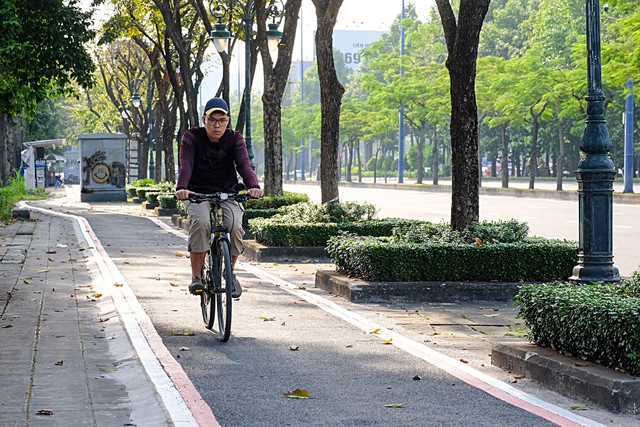
A resident cycles along a dedicated bicycle lane on Mai Chi Tho Boulevard in Ho Chi Minh City, January 8, 2026. Photo: Phuong Nhi / Tuoi Tre
Vo Khanh Hung, deputy director of the Ho Chi Minh City Department of Construction, said the city will consider extending bicycle lanes along the remaining sections of Mai Chi Tho Boulevard, before studying the model’s expansion to connect with other major streets.
These include Nguyen Van Cu, Tran Hung Dao, Le Loi, Nguyen Hue, Ham Nghi, Ton Duc Thang, Dong Khoi, Cong Xa Paris, Le Duan, Pham Ngoc Thach, Ben Van Don, Hoang Sa, Truong Sa, Dien Bien Phu, Vo Van Kiet, Nguyen Thi Minh Khai, Nguyen Huu Canh, Dinh Tien Hoang, and Vo Nguyen Giap, among others.
Synchronized management and organization needed
Meanwhile, experts say that scaling up bicycle lanes is not simply a matter of “painting extra lines on the road,” but requires a systematic, long-term approach tailored to the city’s dense urban fabric.
According to those experts, Mai Chi Tho’s strengths are also what make it an exception, conditions that few inner-city roads in Ho Chi Minh City can match.
Dr. Nguyen Bao Thanh, an urban planning and construction expert at Van Lang University, said Mai Chi Tho has unusually favorable conditions for bicycle lanes.
Its wide cross-section, existing sidewalks, and green medians allow bicycles to be physically separated from motor vehicles.
Implementation costs are also relatively modest, mainly involving road surface adjustments and repainting.
“However, bringing this model into the city center, where space is also needed for pedestrians, would face many obstacles,” Thanh said.
“Central roads are typically narrow, while carriageways and sidewalks already have to accommodate bus stops, parking for private vehicles, and other functions,” Thanh added.
“The issue is not adding a lane, but re-allocating street space.”
Thanh noted that improper use of sidewalks remains widespread in central areas.
Any available space is quickly taken over for parking or commercial activities, making it difficult to maintain stable, dedicated space for bicycles.
Without synchronized management and organization of public space, expanding bicycle lanes would be unlikely to deliver real benefits.
Another issue, Thanh added, is that bicycles are not yet treated as a mandatory component in street design standards.
While green and sustainable transport is frequently mentioned in planning documents, bicycle lanes rarely feature in actual urban design.
“If the city is serious about expanding this model over the next five to ten years, bicycle lanes must be recognized as a compulsory element in planning and road design standards, especially in new urban areas,” he said.
“We cannot wait until roads are completed and then try to ‘cut out’ space for bicycles.”
Thanh also noted that on several central roads, such as Tran Hung Dao, Pasteur, and Nguyen Van Cu, there are already curbside lanes about two to three meters wide for two- and three-wheeled vehicles, separated by green medians.
These sections, he said, could be cautiously and selectively studied for the introduction of priority bicycle lanes.
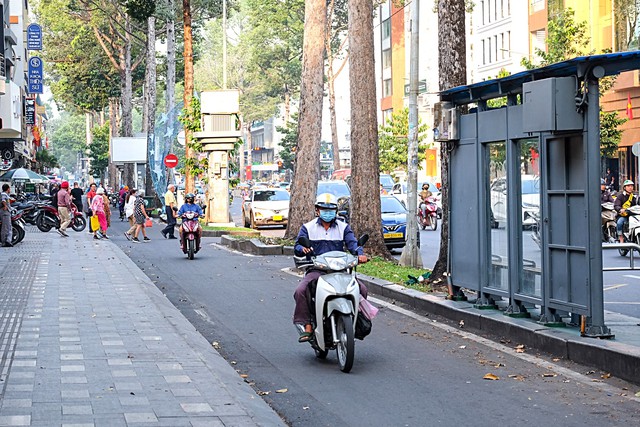
Tran Hung Dao Street has a curbside lane about two to three meters wide, separated from motor traffic by a green median, and is seen as a section that could be studied for the introduction of priority bicycle lanes. Photo: Phuong Nhi / Tuoi Tre
Residents’ travel habits matter
Pundits also say that before scaling up, the city must carefully assess potential barriers, the biggest of which is not technical, but the travel habit of residents.
Ho Chi Minh City remains heavily dependent on motorbikes.
Reducing space for motorbikes to prioritize bicycles, without broad public agreement and feasible alternatives, could easily provoke a backlash.
In practice, bicycle lanes are frequently encroached upon by motorbikes.
Because they are not fully separated and some sections do not strictly prohibit motorbikes, motorized vehicles often enter the lanes during peak hours.
This undermines the function of the priority lane and increases safety risks for both cyclists and motorbike riders.
Addressing proposals to allow motorbikes to use bicycle lanes during fixed hours to ease traffic congestion, Thanh said the approach would be difficult to implement under Ho Chi Minh City’s current traffic conditions.
He warned that time-based changes in lane use could increase the risk of traffic conflicts and weaken the role of bicycle lanes as a stable priority space for green transport.
Supporting infrastructure
According to Associate Professor Nguyen Ba Hoang, former vice-president of the Ho Chi Minh City University of Transport, developing bicycle lanes is a positive move aligned with global trends.
In many European countries, as well as Japan and China, bicycles are well integrated and effectively connected with metro and bus systems, forming an important part of urban transport networks.
Hoang said Ho Chi Minh City has certain advantages, as its public transport network is gradually taking shape, especially metro line No. 1 and the bus system.
This provides an important foundation for developing bicycle–public transport integration.
However, he cautioned that expansion must go beyond standalone lanes.
Supporting infrastructure such as parking areas, transfer stations, and seamless links to buses and metro lines is essential to ensure high usage efficiency.
When expanding, priority should be given to routes leading to metro stations, bus corridors, or new urban areas with wider roads, rather than rolling it out en masse in the city center, he proposed.
Phuong Nhi - Dong Nguyen / Tuoi Tre News
Link nội dung: https://news.tuoitre.vn/expanding-bicycle-lanes-in-ho-chi-minh-city-requires-careful-planning-experts-103260113142355218.htm