
Expat finds honking at red lights in Ho Chi Minh City supportive, welcoming
"With the honks, we need to wake up and understand the culture. A honk of a horn in Vietnam is a communication of respect, care, and safety."
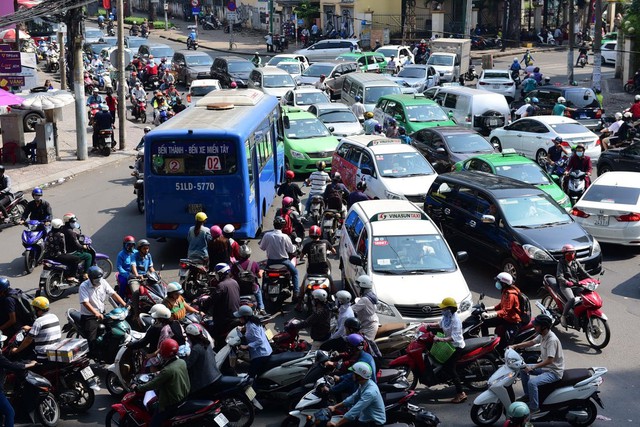
A traffic scene in Ho Chi Minh City. Photo: Quang Dinh / Tuoi Tre
Editor’s note: This commentary by Australian Ray Kuschert offers a personal perspective on traffic behavior in Ho Chi Minh City, particularly the often-misunderstood practice of honking at red lights. While some may interpret it as impatience or disregard for rules, the author argues it reflects a different set of road norms shaped by local conditions, shared responsibility, and informal communication among drivers.
The piece has been edited by Tuoi Tre News for clarity, consistency, and coherence.
Oh, it’s just a few seconds, so why are they honking? This is a common observation from those who know very little about the system of traffic movement in Ho Chi Minh City. And while it looks bizarre to the untrained eye, it actually serves a valuable purpose.
In the recent article “Just 30 seconds at a red light, why the honking and inching forward, Vietnamese drivers?”, the Vietnamese writer speaks of honking as a sign of impatience and a lack of control from drivers. But take a step back and consider the cultural aspects, and it is actually a much different situation.
Every country brings a culture to the road. With a rules-based system, driver behaviors are developed based on the rules they need to follow. Further, we hope there is a consideration for your fellow commuter that allows for actions not necessarily within the law but considered the right thing to do to show respect to other road users.
There is a clear difference between Australia, and dare I say most other Western nations, and Vietnam. Australian road rules are based on “rights”, whereas Vietnamese rules have a foundation of “responsibility”. Those honks at traffic lights can be regarded as a part of the local culture.

With the honks, we need to wake up and understand the culture. A honk of a horn in Vietnam is a communication of respect, care, and safety.
It is the length and style of the sound that tells you so much more, with a long unbroken honk equivalent to a mouthful of abuse if you do something dangerous or the wrong thing.
At the red light, that little honk with a few seconds to go is not impatience but a warning to put your phone away, start your motorbike, and get ready to go. Further, many riders are in a position where they are unable to see the traffic signals, and it has long been known that one or two riders at the back of the queue will honk to let those at the front know the signal has changed. I personally find it supportive and welcoming.
And then there are local rules. Local rules are what is allowed by the community and police at a particular intersection. There are many reasons for this, but it is usually based on logic and efficiency, such that changes to signals won’t or can’t improve the situation.
As an example, consider the road to Cat Lai Ferry in Ho Chi Minh City. Along that road from the main intersection to the ferry are about four sets of traffic lights. At the main intersection, the traffic can get very congested, with large trucks often blocking the road. Police will often wave motorbikes through the red light to go around the trucks that are stuck. Without doing this, motorbikes could be stuck in the intersection for well over 30 minutes.
Further down the road are additional intersections. At some, you have to stop at the red light and can only proceed on green. At others, you are waved through by the traffic marshal when sideroad traffic is not present.
Now apply this concept to every local area across the city where planning and efficient operation intersect, and you see a system that is actually working as well as it can under the conditions it has to endure.
I suppose that after a decade of living in this system, I get a little offended when critics complain that it is “just a few seconds” or “why don’t they follow the traffic laws?” Think of the massive local issues, weather, and generations of development across Ho Chi Minh City, and you see the system in a different way.
Rather than reject the traffic culture in Vietnam, I have stopped trying to arrogantly apply the expectations and culture of the traffic laws in my home country and started to understand that I now live in this country. I understand the people and the way the system works, and I work with it, not against it. That is the best advice for staying safe and enjoying the pandemonium that is traffic in Ho Chi Minh City.

Ray Kuschert / Tuoi Tre News Contributor
Link nội dung: https://news.tuoitre.vn/expat-finds-honking-at-red-lights-in-ho-chi-minh-city-supportive-welcoming-103260402120850081.htm