
Explainer: Why a tourist’s ride onto Ly Son Island’s volcanic arch in central Vietnam sparks concerns
A Chinese tourist riding a motorbike across the natural arch of To Vo Gate on Ly Son Island, Quang Ngai Province, central Vietnam, has sparked public concern over the protection of the nationally recognized scenic sites.
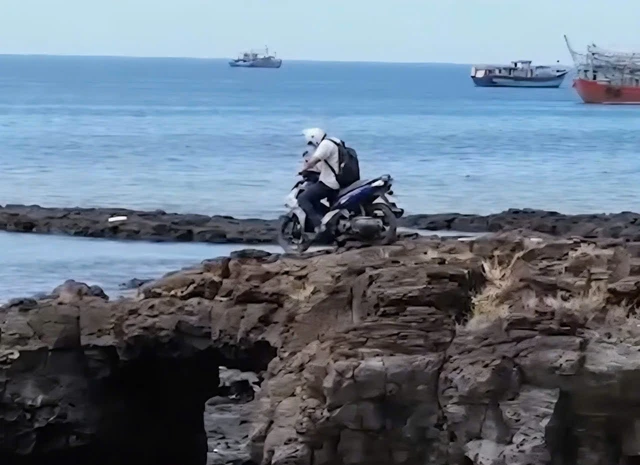
Video footage shows a Chinese tourist riding a motorcycle onto To Vo Gate, an iconic stone arch recognized as a national heritage site in Ly Son Special Zone in Quang Ngai Province, central Vietnam. Photo: Supplied
The incident lasted only a few dozen seconds but drew criticism from local residents and online users, particularly because the tourist rode onto the rock arch despite signs prohibiting visitors from entering, climbing or walking on the formation.
Local authorities identified the tourist as Zhang Xudong, born in 1990 and a Chinese national.
As Zhang rode his motorbike toward the heritage site, local residents repeatedly called on him to stop, citing concerns over his safety and the risk of damaging the rock formation.
He nevertheless continued riding across the arch.
Following a meeting with local authorities this week, Zhang acknowledged the violation, signed a commitment not to repeat it, and was reminded of regulations on protecting the heritage site.
Visitors have a role to play
While the incident was an individual act, it has raised concerns about the behavior of some visitors at popular tourist destinations.
A heritage site shaped and preserved over thousands of years can be vulnerable to damage caused by just a few minutes of careless behavior.
The incident is not just a matter concerning To Vo Gate or Ly Son. It also highlights a broader responsibility for visitors to tourist destinations across Vietnam.
Travel is not only about admiring landscapes or taking photos, but it also means respecting the cultural, historical and natural values of the places people visit.
All visitors, Vietnamese and international alike, are expected to follow signs, site regulations and instructions from site managers.
At a heritage site, visitors are not merely tourists but also have a role to play in preserving the heritage for future generations.
Alongside efforts to raise public awareness, Ly Son authorities said they will strengthen visitor guidance, consider installing multilingual signs and take stricter action against violations that damage heritage sites as a deterrent.
A 4,000-year-old volcanic formation on Ly Son Island
The public reaction was not simply about a tourist riding a motorbike onto a rock.
To Vo (Wasp) Gate is a rare natural formation shaped by volcanic activity thousands of years ago and has long been a must-visit destination for tourists to Ly Son Island.
The natural wonder was formed around 3,000 to 4,000 years ago by lava eruptions from the Gieng Tien volcano.
The cooling lava formed thick layers of basalt, which were later eroded by waves, gradually wearing away the weaker rock in the middle and leaving behind a distinctive natural arch resembling a giant wasp nest.
About 2.5 meters high and nearly 20 meters long, To Vo Gate features a natural arch and layers of rugged rock stacked on top of one another, revealing the remarkable volcanic eruptions and cooling processes that shaped the formation.
The formation is surrounded by smooth black lava rocks of various shapes, some partially submerged in crystal-clear blue water.
Its pristine and distinctive landscape has made To Vo Gate a symbol of tourism in Quang Ngai Province.
To Vo Gate is also part of a rich marine cultural heritage complex that includes a number of tangible heritage sites, such as Gieng Tien Volcano, Duc Pagoda, Cau Cave, Thoi Loi Mountain, Xo La Well, An Hai Communal House, Am Linh Temple, a whale skeleton exhibition house, the Memorial House of the Hoang Sa Flotilla cum the Bac Hai Administration, and Be Island.
Meanwhile, Ly Son is also home to valuable intangible cultural heritage; as well as traces of and cultural interactions among the ancient Sa Huynh, Champa and Dai Viet communities.
In addition, numerous local traditional festivals carry both spiritual significance and memories of the historical efforts to protect Vietnam's sovereignty over its seas and islands.
The area around To Vo Gate also supports a diverse ecosystem, including seagrass beds, coral reefs and abundant seafood resources, contributing to local economic and sustainable tourism development.
With its distinctive beauty, rich history and profound cultural significance, To Vo Gate is not only a source of pride for Ly Son residents but also a nationally significant tourism attraction that draws visitors from Vietnam and abroad.
In September 2025, the Minister of Culture, Sports and Tourism signed a decision recognizing To Vo Gate in Ly Son Special Zone, Quang Ngai Province, as a national scenic heritage site.
In April this year, the Ly Son Special Zone People’s Committee issued a warning urging visitors not to climb on To Vo Gate.
The practice poses safety risks to visitors due to the formation’s rugged surface.
Also, the natural rock structure of To Vo Gate was not designed to withstand direct pressure from people climbing onto or posing for photos on top of the arch.
If such behavior continues, it could gradually affect the stability of the arch and damage this valuable volcanic formation.


Tran Mai - Dong Nguyen / Tuoi Tre News