
Explainer: Why people are talking about reducing working hours in Vietnam
Discussions have emerged in Vietnam following a recent proposal for a roadmap to cut working hours in the private sector.
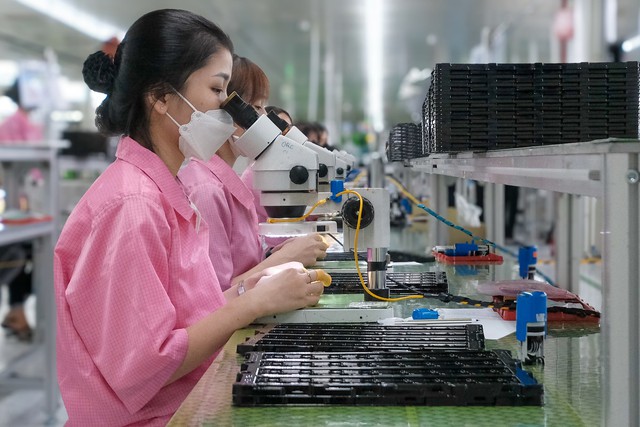
Workers at an electronics factory in Vietnam. Photo: Gia Doan
In the dossier for the draft law amending and supplementing several provisions of the Labor Code, the Law on Archives, the Law on Gender Equality and the Law on Red Cross Activities, the Son La Department of Home Affairs proposed a roadmap to reduce normal working hours for private-sector workers to 40-44 hours per week, bringing them in line with the public sector.
To make the reduction effective, the department said it should be accompanied by measures to improve labor productivity to achieve the goal of double-digit growth.
However, the Ministry of Home Affairs, which is in charge of drafting the legislation, said it would not accept the proposal.
The recommendation, still, continues to attract considerable attention.
Push for shorter working hours
This is not the first time it has been raised, as the Vietnam General Confederation of Labor has also repeatedly called for shorter working hours.
Currently, under Vietnam's 2019 Labor Code, normal working hours must not exceed eight hours per day or 48 hours per week.
Employers may set working hours on a daily or weekly basis, but must notify workers of the arrangement.
If working hours are calculated on a weekly basis, normal working hours must not exceed 10 hours per day or 48 hours per week.
The state also encourages employers to adopt a 40-hour workweek.
Since 1999, the prime minister has introduced regulations providing for a 40-hour workweek for civil servants, public employees, and workers at administrative and public service agencies, as well as political and socio-political organizations.
Speaking to Tuoi Tre (Youth) online newspaper, Dr. Nhac Phan Linh, deputy director of the Institute for Strategy and Policies on the Vietnam Fatherland Front under the Central Committee of the Vietnam Fatherland Front, said reducing working hours would give workers more time to recover, care for their families, reduce stress, and improve their quality of life.
It would also be an important factor in boosting labor productivity.

Dr. Nhac Phan Linh (second from left) and colleagues on a field trip to study workers' living conditions in Bac Ninh Province, northern Vietnam. Photo: Ha Quan / Tuoi Tre
"Reducing working hours does not mean reducing business profits,” Linh stressed.
“On the contrary, it can drive businesses to improve productivity, working conditions, and competitiveness.
“It is also a path for Vietnam to improve the quality of its workforce instead of continuing to rely on a growth model based on cheap labor."
Linh pointed out that experiences from European countries and Japan show that labor productivity can continue to rise even as working hours are shortened, particularly when accompanied by digital transformation and worker training.
In addition, many global brands in international supply chains for materials and goods impose strict labor standards on products sold in high-end markets such as Europe, the U.S., and Japan.
"In such cases, decent work, including working conditions, working hours, rest periods, occupational safety, wages, non-discrimination, and forced labor, are among the factors that are closely scrutinized," Linh said.
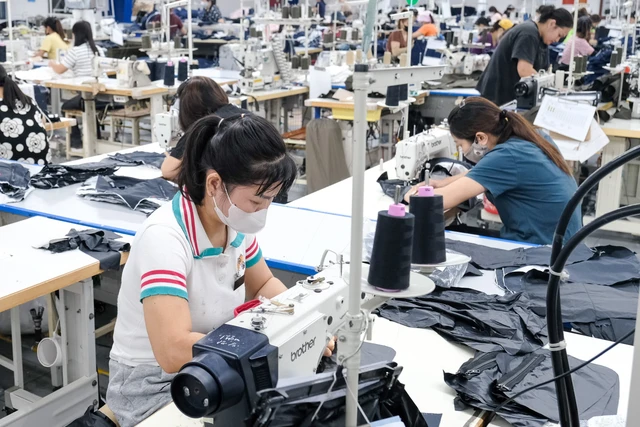
Workers produce garments for export to Europe and the U.S. at a factory in Bac Ninh Province, northern Vietnam. Photo: Ha Quan / Tuoi Tre
Businesses take different approaches
In reality, some businesses have already mapped out plans to reduce working hours, while others want to raise the overtime limit.
Duong Thi Huong Duyen, deputy director of Nam&Co London Co., Ltd. in Ninh Binh Province, said that to retain workers, the company had adjusted its production schedule so that employees could finish work earlier, at around 5:30 pm each day.

Workers use machinery in production to improve labor productivity at Nam&Co London Co., Ltd. in Ninh Binh Province, northern Vietnam. Photo:Ha Quan / Tuoi Tre
As a result, their working day is now around nine hours, giving workers more time to rest, recover, and take care of their families.
"When working hours are reduced, we encourage workers to focus their energy on production,” Duyen said.
“The company has improved working conditions by installing additional ventilation fans and air conditioning, as well as increasing wages and benefits."
Workers' average monthly income now stands at VND12-13 million ($458-496).
Meanwhile, Asada Kyoji, general director of TOTO Vietnam Co., Ltd. in Hanoi, said the company has developed a roadmap to reduce the number of working days and increase days off for employees through 2030.
For example, in 2026, the company has cut four working days, giving employees four additional days off. Employees work one or two Saturdays each month.
"In the coming period, we will continue to improve productivity through production automation,” he said.
“As productivity improves with a stable workforce, the company will be in a better position to consider reducing working hours for employees.”
On the other hand, Canon Vietnam Co., Ltd. has proposed raising the overtime limit to 400 hours per year, and even 500 hours per year for certain sectors.
The company said current regulations are not flexible enough as many industrial parks face shortages of general workers and recruitment has become difficult.
The company noted that many workers voluntarily want to work overtime to improve their living standards.
Under Vietnam's 2019 Labor Code, workers may work no more than four hours of overtime per day, 40 hours per month, and 200 hours per year.
Workers in certain sectors may work up to 300 hours of overtime per year, including textiles and garments, footwear, agricultural, forestry and fisheries processing, electronics, telecommunications, electricity production and supply, and water drainage.
Gradual transition
Lawyer Tran Ngoc Thich, managing partner of Thich and Partners Law Firm in Ho Chi Minh City, said reducing normal working hours to 44 hours per week would be in line with regional and global trends while helping improve workers' health and quality of life.
However, Thich said a roadmap was needed to give businesses time to prepare resources and adjust their production plans, as many labor-intensive sectors, including electronics, garments and footwear, still rely on overtime to fulfill orders.
If working hours are reduced too quickly, businesses may seek to increase overtime to the maximum permitted level or consider relocating production.
According to Thich, reducing working hours will only be effective if businesses improve productivity by stepping up the use of science and technology, automation, and artificial intelligence (AI).
He also said the overtime limit should not be raised, as Vietnam is shifting toward a growth model driven by productivity, technology, and a highly skilled workforce.
"Many workers want to work overtime because their wages are too low,” he explained.
Therefore, alongside the roadmap to reduce working hours, the government should continue adjusting the minimum wage toward a level sufficient to meet workers' basic living needs to reduce their reliance on overtime, he said.
Sharing the same view, National Assembly deputy Trinh Thi Tu Anh said the proposal to reduce working hours is worth considering, but the obligation to 'mandatorily' cut the time should not be legislated immediately.
Instead, it should continue to be encouraged as under current law, accompanied by a long-term transition roadmap.
She said imposing the reduction at this time, when the economy is pushing hard to achieve double-digit growth, could create a 'cost shock' for businesses.
Vietnam still relies heavily on labor-intensive sectors.
If working hours are immediately cut by four to eight hours per week while wages remain unchanged, labor costs per unit of output would rise sharply, undermining Vietnam's international competitiveness compared with Bangladesh, India and Indonesia, while increasing the risk of orders shifting elsewhere and affecting overall economic growth.

Workers at a foreign-invested factory in Ninh Binh Province, northern Vietnam. Photo: Ha Quan / Tuoi Tre
Making shorter hours work
According to Dr. Nhac Phan Linh, when standard working hours are reduced, both workers and businesses will have to make positive changes.
Specifically, workers will need to work more diligently, with greater focus, efficiency, and productivity.
Meanwhile, businesses will be forced to invest in science, technology, automation, and improvements to production processes instead of continuing to rely on cheap labor and simple machinery.
In reality, however, many businesses, particularly those in contract manufacturing and labor-intensive sectors, have little incentive to upgrade their technology, as extending overtime remains an easier and less costly solution than investing in machinery and technology.
"Vietnam's goal should not be to increase overtime, but to raise incomes from regular working hours,” Linh said.
“Currently, with monthly incomes of around VND8-10 million [US$306-382], many workers can barely cover their basic living expenses and have no savings to fall back on in case of illness,” he added.
“Therefore, we need to continue adjusting the minimum wage, raise basic wages across businesses, and gradually incorporate allowances such as transportation, communication, and childcare support provided by many businesses into official wages.”
He also noted that wages earned from normal working hours should ensure workers' basic living standards, accounting for at least 75-80 percent of their income structure.
“Overtime should only serve as additional income when both workers and employers are willing to work more to earn additional profits,” Linh said.
“We need to regularly raise regional minimum wages and basic wages, with the goal of achieving a wage level sufficient to meet workers' basic living needs over the next five to 10 years.”
To ensure that reducing working hours does not place excessive pressure on businesses, the expert proposed that the state introduce support policies such as tax incentives and credit support for investments in science, technology, and AI, while also strengthening links between businesses and training institutions to develop a skilled workforce.
To handle large orders during certain periods, Dr. Linh recommended considering monitoring overtime hours on an annual rather than weekly or monthly basis, allowing businesses to adjust working hours more flexibly with the consent of workers and labor unions to prevent excessive workloads.
"The role of the state is to regulate the economy and promote growth and development, while also ensuring a balance of interests between businesses and workers,” Linh stated.
“Businesses always seek to minimize costs and maximize profits, while workers want job stability, career development, an income sufficient to meet their basic living needs and the ability to save."



Tuoi Tre News
Link nội dung: https://news.tuoitre.vn/explainer-why-people-are-talking-about-reducing-working-hours-in-vietnam-103260818184132178.htm