
FOMO-driven parents in Ho Chi Minh City rush their first-graders into English certificate race
Seeing fifth- and sixth-graders already holding international English certificates, with some even starting to prepare for the IELTS test, many Vietnamese parents are rushing to enroll their first-graders in test preparation classes for fear that their children will fall behind.
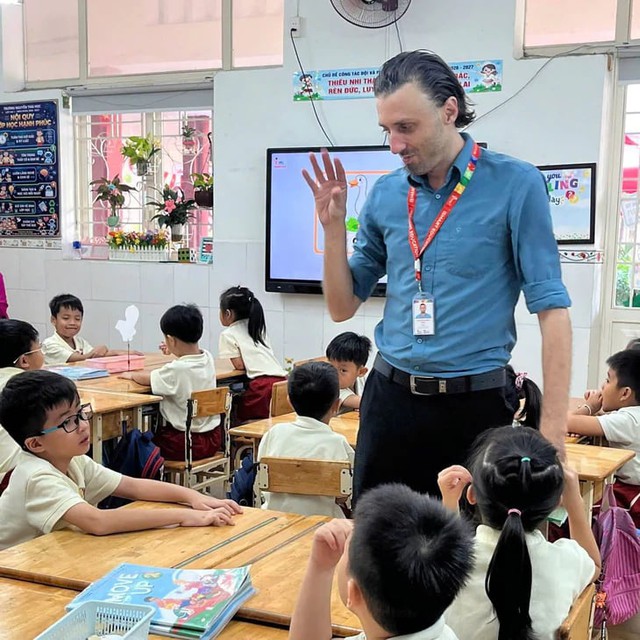
An English lesson at Nguyen Thai Hoc Primary School in Ben Thanh Ward, Ho Chi Minh City. Photo: Thao Thuong / Tuoi Tre
However, psychologists, teachers and education administrators have warned that pushing six-year-olds to chase certificates could undermine their natural enjoyment of learning.
“I don't force my child, but I'm afraid …”
Barely a few months into their children's first school year, one parent in Ho Chi Minh City took to social media to ask other parents for recommendations for language centers and certificate preparation classes for six-year-olds.
"I see that many fifth- and sixth-graders can already speak English and have all kinds of certificates. At what grade do you think children should start learning English?" the parent asked.
Sharing similar concerns, N.H., whose child is in Grade 1 at Nguyen Thai Son Primary School in Xuan Hoa Ward, said she had recently decided to enroll her child in three additional English lessons a week.
She hopes her child will earn an international certificate early to improve their chances of admission to integrated, advanced and high-quality schools.
"After school, I take my child to an English teacher's home in the former Go Vap District. There are six first-graders in the class. Many other parents there also started their children's English lessons early, with some beginning as early as kindergarten,” N.H. said.
“I don't force my child, but I'm afraid they will fall behind right from the starting line, so I want to invest in their education from the beginning.”
How can first-graders learn English without becoming overwhelmed?
On the other hand, many parents oppose having children who have just entered Grade 1 prepare for English certificate exams, arguing that they are too young to face academic and examination pressure.
Anh Thu, an English teacher at a language center on Pasteur Street in Xuan Hoa Ward, said the number of five- and six-year-olds enrolling in English classes at the center had been increasing.
However, based on her teaching experience, she has noticed that many children mainly memorize material to answer multiple-choice questions.
While they can pick the correct answers quickly, they struggle to communicate using simple sentences.
"Parents sign their children up for English test preparation classes, but I find that children enjoy learning through songs, games, storytelling and fun interactions much more than doing practice tests,” Thu said.
From an educational perspective, a lecturer at the Faculty of Primary Education at Ho Chi Minh City University of Education said comparing first-graders with fifth- and sixth-graders based on academic achievements was unfair.
"At the age of six, children are going through a major transition from the free play environment of kindergarten to a more structured school setting,” the lecturer said.
“They are also getting used to Vietnamese letters and learning how to hold a pen.
"If parents make them practice English test papers to obtain certificates too early, children can easily become cognitively overwhelmed.
"When English becomes associated with scores, certificates and adults' expectations, children may become fearful, resistant and lose their natural curiosity about learning," the lecturer added.
From another perspective, Thu Huong, an English teacher at a primary school in Thu Duc Ward, said international certificates earned by fifth- and sixth-graders were the result of sustained learning built on solid listening and speaking skills, combined with individual aptitude, rather than intensive test preparation or starting English lessons as early as Grade 1.
"Parents should only consider introducing children to proficiency assessment tests around Grade 3 or Grade 4, when they have become literate in their mother tongue and developed more stable thinking skills,” Huong said.
"Instead of rushing to pursue certificates, parents should support their children and create an open learning environment where English becomes enjoyable to explore,” she added.
“Children who build a good foundation in Grade 1 will have the confidence and ability to pursue English learning over the long term."
Under the 2018 General Education Curriculum issued by the Ministry of Education and Training, promulgated together with Circular 32, English lessons in Grades 1 and 2 are designed as a gentle introduction to the language, aiming to foster children's interest and develop basic communication skills while avoiding written tests and pressure to achieve high scores.
The education sector has also repeatedly advised parents and schools against forcing early-grade students to take certificate examinations.
- REFERENCE MORE
- REFERENCE MORE
- REFERENCE MORE


Thao Thuong - Dong Nguyen / Tuoi Tre News