
From screens to streets: Online disputes among youths alarm Vietnamese authorities
Disputes that once remained confined to social media are increasingly leading to real-life confrontations among children and teenagers in Vietnam, with recent police investigations in Ho Chi Minh City drawing attention to the risks associated with excessive exposure to online platforms and games.
From online insults to criminal cases
Late on March 3, police in Ho Chi Minh City received reports of two groups of teenagers chasing each other with weapons and causing chaos at a coffee shop on Le Duc Tho Street.
The conflict reportedly began two days earlier, when an 18-year-old named Phong and his friends gave hostile looks to another group after they revved their motorbikes loudly while passing by.
Later, while scrolling through TikTok, the short-form video platform, Phong saw a post by Thanh, 18, containing a provocative message, triggering a heated exchange online that eventually led to an arranged fight.
On the night of March 3, Phong’s group arrived at the café carrying iron pipes, pepper spray, and homemade knives.
During the clash, Thanh fought back with a baton while others threw chairs and glasses from the café.
The incident ended with 23 teenagers facing criminal charges, most of them under or just over 18 years old.
Another case in April also stemmed from social media disputes.
Two young men sparked controversy online after posting about a backpacking trip that others claimed was unrealistic.
A third man later mocked them on his personal page, leading to arguments online.
The dispute escalated into an in-person confrontation at a café in Tan Son Nhi Ward, where a fight broke out after both sides exchanged insults.
Police quickly intervened and later charged eight young people involved in the incident.
“Social media does not automatically turn a child into a criminal,” lawyer Do Ngoc Thanh from the Ho Chi Minh City Association for Protection of Child Rights said.
“But without guidance from adults, technical safeguards, legal education and life skills, it can become a pedal that pushes children from curiosity to deviant behavior, and from deviant behavior to illegal actions.”
Social media a double-edged sword
In early October 2025, K., 19, from Thanh My Tay Ward went online looking for a part-time job and was approached by a stranger.
After a long period of chatting, the person invited K. to Cambodia to work at a hair salon.
Without informing the family, K. left and was picked up at Hang Xanh intersection before being taken to a hotel near Moc Bai border gate in Tay Ninh Province.
After being brought into Cambodia through unofficial crossings, K. was taken to multiple locations under supervision.
At one detention site, K. asked to return home.
The family was then asked to pay ransom money, while K. was allegedly beaten, electrocuted, and photographed so the images could be sent to relatives as pressure.
Following a report from the family, Ho Chi Minh City police launched a special investigation, rescued K., and dismantled a transnational criminal network linked to Nguyen Thanh Hai, 55, proclaimed himself as a “street knight.”
In another case, the Ho Chi Minh City People’s Court in late March sentenced Ong Van Quoc, 20, to nine years in prison and Ly Hai Dang, 21, to seven years in prison for raping a girl under 16 years old.
According to court documents, on September 7, 2024, T. discovered that her daughter, Y., 2011, showed signs of pregnancy.
After medical examinations confirmed that Y. was more than 18 weeks pregnant, the family reported the case to the police.
Investigators from the former local police determined that, besides the two defendants, Y. had sexual relations with several other men.
One of them was Ho Quoc Thinh, 20, whom Y. met through the Litmatch application.
The two became acquainted online, regularly exchanged messages, and later had sexual relations multiple times.
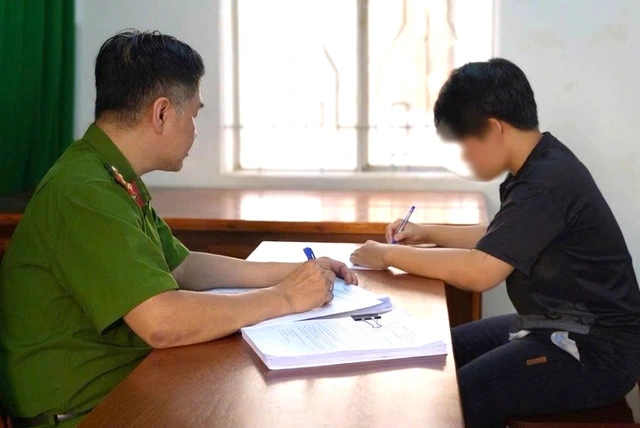
K., 19, provides information to investigators after being rescued and brought back from Cambodia. Photo: Chi Kien / Tuoi Tre
Forensic conclusions later identified Thinh as the biological father of Y.’s child.
Investigators also found that Y. had sexual relations with Nguyen Trong Bang, 29, whom she also met through social media.
Authorities transferred Thinh’s case to Binh Thanh District Police for further investigation, while Bang’s case was separated for later handling.
Readers advocate social media ban for children
Responding to recent articles discussing National Assembly deputy Nguyen Thi Mai Thoa’s proposal to study measures to restrict, or even ban, children from using social media, most readers of Tuoi Tre (Youth) newspaper expressed support for banning children from social media within the current context.
A female reader said she fully agreed with the proposal, arguing that children are not mature enough to filter information on their own and that unrestricted access to social media could seriously affect both their physical and mental health.
“Social media itself is not bad. What is frightening is that children are learning how to live from social media before learning how to live in real life,” another reader named Hoa commented.
A reader identified as Max said social media helps people stay connected with distant friends, but also exposes users to scams and overwhelming amounts of information every day.
“Even adults struggle to tell right from wrong online, so how can children?” the reader wrote, calling for a ban on social media use for children under 16.
Others argued that a complete ban may not be realistic.
A reader named Thong said children should not be left to grow up entirely on social media and questioned whether the fault lies within many adults who intentionally leave their children to phones.
Meanwhile, reader Luan wrote: “A child who does not use social media may be safe for some time, but a child who knows how to use it properly will be safer in the long run.”
3 potential risks from social media to children
Lawyer Thanh said social media is not the only cause of misdoings among children, but its impact should not be underestimated.
Thanh said children aged between 12 and 16 are particularly vulnerable because they have not fully developed legal awareness, emotional control, risk recognition skills, or the ability to protect themselves.
According to Thanh, social media creates three major risks at the same time.
First is the risk of becoming victims, as children can be lured into sexual exploitation, scams, human trafficking, or labor exploitation.
Second is the risk of becoming lawbreakers themselves, ranging from online insults and humiliation to arranging fights, filming and spreading violent clips, or more serious acts such as assault, extortion, and sexual abuse.
Third is the risk of emotional desensitization. Over-exposure to violence, humiliation and dangerous online trends will lead to “normalization of deviance”, making such behavior seem normal to children.
Thanh said criminal behavior must be assessed based on factors including age, awareness, motive, fault, consequences and each individual’s role.
While the law already recognizes cyberspace as an environment that can directly affect public order and safety, responsibility should not be placed entirely on social media platforms.
“The right approach is neither neglect nor extreme prohibition,” Thanh said.
Children should be protected through laws, educated with patience, monitored with technology, and accompanied with love.
What children need is not unlimited phone access, but adults who are knowledgeable, calm, and caring enough to guide them safely through the digital world.

Van Giang - Dan Thuan / Tuoi Tre News
Link nội dung: https://news.tuoitre.vn/from-screens-to-streets-online-disputes-among-youths-alarm-vietnamese-authorities-103260507144940142.htm