
Guangzhou Metro opens representative office in Ho Chi Minh City, deepens urban railway cooperation
Guangzhou Metro Corporation officially inaugurated its representative office in Ho Chi Minh City on Monday evening, a new milestone in urban railway cooperation between the sister cities of Ho Chi Minh City and Guangzhou.
The opening ceremony was attended by Lai Zhihong, vice-mayor of the Guangzhou People's Government, Chinese Consul General in Ho Chi Minh City Tang Li, vice-chairman of the Ho Chi Minh City People's Committee Bui Xuan Cuong, and representatives of government agencies and businesses from both countries.
Speaking at the ceremony, Nguyen Vinh Toan, deputy director of the Ho Chi Minh City Department of Construction, said the establishment of Guangzhou Metro’s representative office holds special significance as the two cities prepare to celebrate the 30th anniversary of their sister-city relationship.
According to Toan, the office represents not only a new achievement in cooperation between Vietnamese and Chinese localities but also a shift from project-based collaboration to a long-term strategic partnership in the field of urban railways.
The decision by Guangzhou Metro Corporation to establish its representative office in Ho Chi Minh City demonstrates the corporation’s strong commitment to cooperation with Ho Chi Minh City and Vietnam as a whole, Toan added.
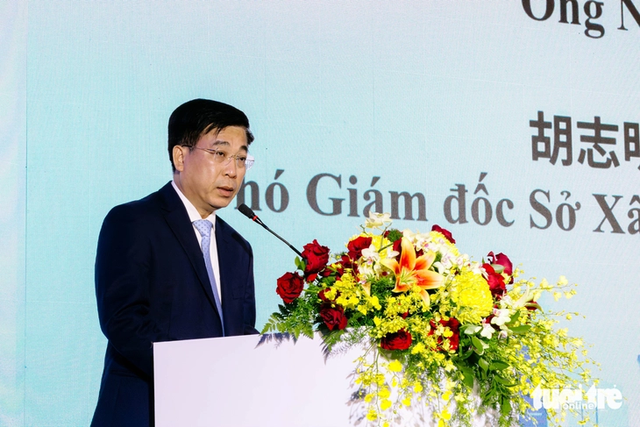
Nguyen Vinh Toan, deputy director of the Ho Chi Minh City Department of Construction, delivers remarks at the inauguration ceremony. Photo: Thanh Hiep / Tuoi Tre
He noted that Guangzhou was among the first international localities to establish a sister-city relationship with Ho Chi Minh City in 1996.
Over nearly three decades, the two cities have built extensive cooperation across various sectors, including urban transport infrastructure development.
In April 2024, the Ho Chi Minh City Management Authority for Urban Railways, the China Association of Metros, and Guangzhou Metro signed a memorandum of understanding on urban railway planning and development.
Since then, a number of cooperative activities have been implemented, including urban railway projects in Ho Chi Minh City in which Guangzhou Metro-affiliated entities have participated in research, consultancy, and project preparation.
Toan said Ho Chi Minh City expects Guangzhou Metro to support the training of high-quality human resources, help local businesses integrate more deeply into the urban railway value chain, and share expertise in metro network planning, transit-oriented development (TOD), and integrated urban transportation systems.
He added that Ho Chi Minh City is entering a crucial phase of urban development following recent administrative restructuring, with plans to build a modern urban railway system and an integrated transport network to support its vision of becoming a green, smart, internationally competitive megacity.
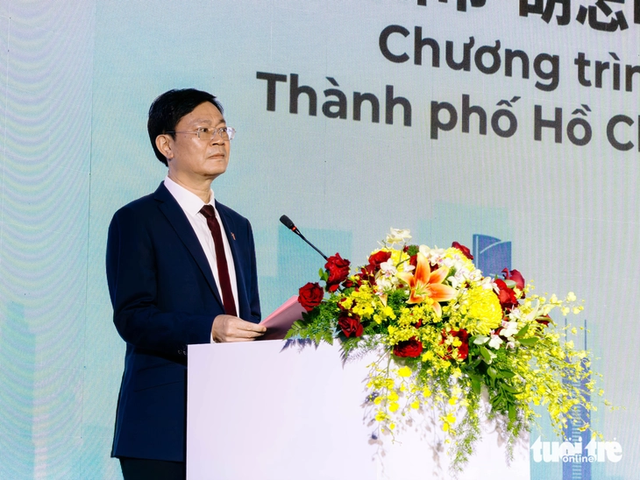
Liu Zhicheng, chairman of Guangzhou Metro Corporation, speaks at the inauguration ceremony for the corporation’s representative office in Ho Chi Minh City. Photo: Thanh Hiep / Tuoi Tre
Liu Zhicheng, chairman of Guangzhou Metro Corporation, said the establishment of the representative office in Ho Chi Minh City marks the transition of railway cooperation between the two cities from technical exchanges and pilot projects to long-term, systematic collaboration.
According to Liu, Guangzhou Metro and the Ho Chi Minh City Management Authority for Urban Railways established a strategic partnership in late 2023.
Over the past two years, the two sides have expanded cooperation across multiple areas and participated in key projects, including the overall design of metro line No. 2, construction management consultancy for metro line No. 2, and feasibility studies for metro line No. 4.
Liu said Guangzhou Metro is ready to share more than 30 years of experience in urban railway development, including technology, investment and construction expertise, and modern operational management systems with Vietnam and Ho Chi Minh City.
The corporation will also support Vietnam in improving technical standards, strengthening urban railway management systems, promoting technology localization, and developing human resources.
“Through our representative office in Vietnam, we will establish a permanent service platform, strengthen connections with local enterprises, and promote deeper integration across the entire urban railway value chain,” Liu said.
Thanh Ha - Thanh Hiep / Tuoi Tre News