
Hanoi hospital uses robot for knee replacement, enabling patients to walk within 24 hours
Doctors at E Hospital in Hanoi have successfully performed their first total knee replacement surgery assisted by the CORI robotic system, enabling patients to stand and walk within 24 hours, marking a breakthrough in orthopedic treatment in Vietnam.
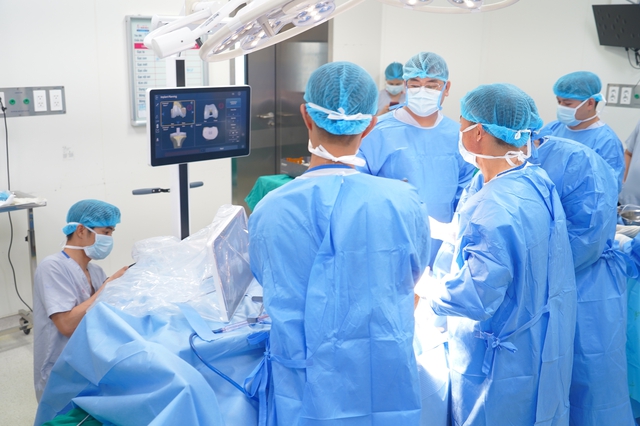
Surgeons at E Hospital in Hanoi perform robot-assisted knee replacement. Photo: Supplied
The first patient, a 60-year-old woman identified as N.T.T., suffered from severe bilateral knee osteoarthritis for nearly a decade.
Despite previous treatments including medication, joint injections, platelet-rich plasma therapy, and arthroscopy, her condition worsened significantly.
Earlier this week, doctors diagnosed her right knee with stage-4 degeneration, with nearly complete cartilage loss, bone spurs, and severe deformity, making mobility extremely difficult.
Kieu Quoc Hien, head of the hospital’s orthopedic trauma surgery department, said the CORI robot represents a major advance in knee surgery.
The system collects and processes anatomical data in real time during the operation, allowing surgeons to plan and execute bone cuts with sub-millimeter precision. This ensures the artificial joint is precisely positioned and tailored to each patient’s anatomy.
Unlike older technologies, CORI does not require preoperative CT or MRI scans.
Instead, it creates a 3D model and calculates biomechanical parameters during the procedure, reducing costs, saving time, and minimizing radiation exposure.

A patient recovers quickly after undergoing robot-assisted knee surgery at the Hanoi-based E Hospital. Photo: Supplied
Hien said the minimally invasive approach results in smaller incisions, less soft tissue damage, reduced postoperative pain, and faster recovery times.
Under favorable conditions, patients can begin standing and walking within 24 hours and resume near-normal daily activities within two to three weeks.
The technology also lowers complication risks such as vascular or ligament injury and joint misalignment.
Surgery time is reduced compared to traditional methods, especially in complex deformities.
Hien added that the cost of robot-assisted knee replacement in Vietnam is currently four to five times lower than in countries like Thailand or Singapore, making advanced treatment more accessible.
Surveys show that 30-40 percent of Vietnamese over 60 suffer from knee osteoarthritis, with higher rates among postmenopausal women.
Among those over 40, the prevalence exceeds 23 percent.
With an aging population, experts said the adoption of robot-assisted surgery will play a vital role in delivering precise, safe, and patient-centered care.
Minh Duy - Duong Lieu / Tuoi Tre News
Link nội dung: https://news.tuoitre.vn/hanoi-hospital-uses-robot-for-knee-replacement-enabling-patients-to-walk-within-24-hours-103260322111245087.htm