
Having dogs likely boosts teens' social skills: study
TOKYO -- Having a dog at home likely helps alter adolescent children's microbiome to make them happier and have better social skills, a study by a Japanese research team showed.
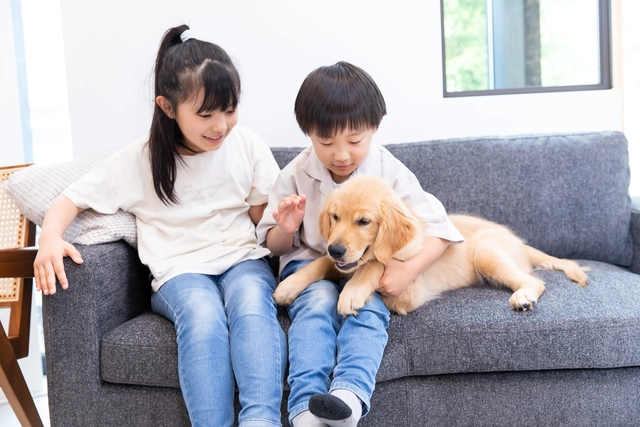
Children playing with a puppy. Photo: Jiji Press
The team's findings, based on surveys of children and experiments involving mice, were published in U.S. journal iScience.
Children's gut microbiota is partially altered either by dogs' resident bacteria entering the children's system or by changes in children's gastrointestinal environment due to changes in children's psychological condition from living with dogs, according to Takefumi Kikusui, a professor at Azabu University and a member of the team.
Children's social skills are believed to be boosted by the vagus nerve, which runs through the intestine, stimulating the release of oxytocin, known as the love hormone, according to the team.

Owning a dog also opens up more opportunities for children of interactions with family members and neighbors through dog-related activities such as feeding, cleaning up and taking a walk.
On the impact of changes in gut bacteria on social skills, Kikusui said, "We hope to identify the species of bacteria and clarify how much they influence (such changes)."
As part of an epidemiological study involving 13- to 14-year-old children in Tokyo, Kikusui, Eiji Miyauchi, an associate professor at Gunma University, and other members of the team collected saliva samples from about 100 children from households with dogs and from about 250 children from households without such pets.
The team then transplanted their oral bacteria into germ-free mice.
Mice with bacteria from dog-owning children exhibited higher social skills than those without such bacteria, more frequently sniffing unfamiliar mice, and approaching and sniffing their buddies trapped in a narrow tube.
The team believe that the bacteria associated with social behavior is part of the genus Streptococcus.

Link nội dung: https://news.tuoitre.vn/having-dogs-likely-boosts-teens-social-skills-study-103251225171837551.htm