
Ho Chi Minh City accelerates plan to make English a second language in schools
Ho Chi Minh City is speeding up its plan to make English a second language across schools in the second half of 2026 as part of efforts to improve education quality and develop a high-quality workforce.
The city is also advancing a scheme to integrate artificial intelligence (AI) into the education system.
The priorities were highlighted during a recent conference on education, science, and social affairs.
City officials said the two strategic projects will support the city's transition toward a knowledge-based economy by strengthening language proficiency and digital skills among students.
Schools prepare for English as a second language
Nguyen Tran Khanh Bao, principal of Marie Curie High School, said his school has been creating an English-speaking environment by using bilingual signs, documents, and forms to familiarize teachers and students with the language.
The school has also strengthened international exchanges, promoted foreign language programs, and assessed the English proficiency of teachers and students.
Bao said the school, which has 80 classes and more than 3,400 students, has developed a strong English club while also promoting second and additional foreign language programs.
The school has been piloting English classes taught entirely in English for students with strong language skills and teaching subjects such as biology entirely in English, with both teachers and students responding positively.
He called on the Ministry of Education and Training to issue official evaluation criteria for the English-as-a-second-language initiative so schools can prepare proactively.

Nguyen Tran Khanh Bao, principal of Marie Curie High School, discusses the school's efforts to create an English-speaking environment through bilingual signs, documents, and forms. Photo: Huu Hanh / Tuoi Tre
Do Ngoc Chi, principal of Nguyen Binh Khiem Elementary School, said her school has benefited from strong support from parents and teachers committed to continuous professional development.
Regarding the plan to make English a second language in schools, Chi said she hopes that mechanisms will soon be introduced to further develop the existing English teaching workforce.
The enhanced English program was launched in Ho Chi Minh City in the 1999-2000 school year, producing a strong pool of English teachers. However, some schools continue to face localized teacher shortages, Chi said, expressing hope that measures would be introduced to better balance teacher allocation.
Nguyen Tan Phat, director of the Ho Chi Minh City Department of Education and Training, said private investment plays an important role in the city's education system, with two-thirds of preschools and more than one-third of high schools being privately operated.
He added that English learning has become a natural demand among residents of the city of more than 10 million people, and schools have developed road maps and practical measures to improve education quality.
City's English education efforts hailed
Former National Assembly Committee for Culture and Education chairman Phan Thanh Binh noted that Ho Chi Minh City began piloting English education 13 years ahead of many other localities and now allocates about 25 percent of its budget to education, above the national benchmark of 20 percent.
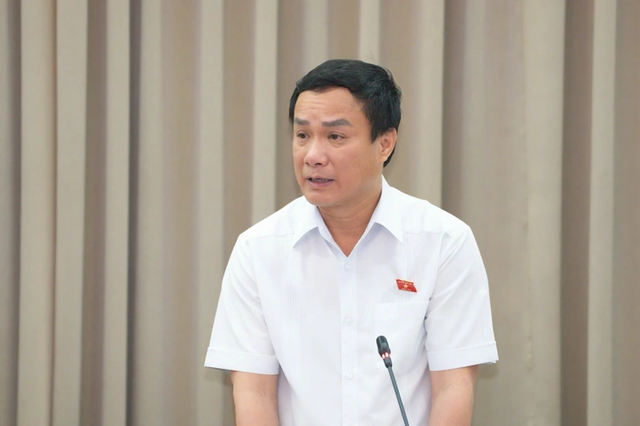
Trieu The Hung, deputy chairman of the National Assembly's Committee for Culture and Social Affairs, praises Ho Chi Minh City's education sector during a working session with the municipal government on July 17, 2026. Photo: Huu Hanh / Tuoi Tre
During a working session with the Ho Chi Minh City People's Committee last week, Trieu The Hung, deputy chairman of the National Assembly's Committee for Culture and Society, praised city schools for proactively creating English-learning environments and encouraging greater language use on campus.
Hung also spotlighted the city's success in mobilizing private investment, noting that about 38 percent of educational institutions are privately operated. As of the end of May 2025, Ho Chi Minh City had 1,325 private educational institutions, the highest number nationwide.
Stronger coordination for education reform
Duong Anh Duc, head of the Ho Chi Minh City Party Committee's Propaganda and Mass Mobilization Commission, said the city's education sector faces significant challenges amid rapid urban development and called for closer coordination among education authorities and local administrations.
He stressed the need for stronger cooperation between the Department of Education and Training and commune-, ward-, and special zone-level authorities to create a better learning and teaching environment.
Duc also urged the city to broaden its education strategy beyond high school, covering all levels from preschool to postgraduate education.
He said Ho Chi Minh City should make full use of its extensive network of junior colleges and universities, which gives it an advantage similar to other major metropolitan areas such as Hanoi.
Drawing on international models, he suggested developing programs that identify and nurture talent from an early age while strengthening links between schools and higher education institutions.
Such cooperation would allow students to gain earlier exposure to professional environments, shorten training periods, and reduce education costs.
School network expands despite capacity pressures
In the first half of the year, Ho Chi Minh City recognized an additional 130 schools as meeting national standards and established five new high schools.
Its '150-day campaign to complete 1,000 classrooms' has so far delivered 213 new classrooms.
To achieve its target of providing 300 classrooms for every 10,000 school-age residents, the city has proposed giving priority to the first phase of 148 school construction projects with an estimated investment of VND42.026 trillion (US$1.6 billion).
The education sector also reported progress in piloting AI education and developing high-quality human resources.
However, officials acknowledged that overcrowding remains a major challenge in rapidly urbanizing areas, where the actual number of classrooms has reached only 50 to more than 70 percent of the target in many localities.
Tuoi Tre News
Link nội dung: https://news.tuoitre.vn/ho-chi-minh-city-accelerates-plan-to-make-english-a-second-language-in-schools-103260720145421252.htm