
Ho Chi Minh City drives nighttime economy from 24-hour supermarkets to midnight markets
As international and domestic travelers remain willing to spend, yet find their options dwindling late at night, Ho Chi Minh City is confronting a familiar challenge that is how to keep the urban experience alive after hours and create distinct nighttime identity.
Experts and representatives from firms discussed obstacles and solutions to unlock the city’s nighttime economy at a thematic seminar titled 'Nighttime Economy: Driving Growth in Ho Chi Minh City,' jointly organized by Tuoi Tre (Youth) newspaper and the Ho Chi Minh City Food Association in the southern metropolis on Wednesday.
Extending ‘consumer lifecycle’
Tran Le Nguyen Khang, deputy head of retail operations at SATRA, said that developing the nighttime economy is fundamentally about prolonging the ‘consumer lifecycle’ for tourists within a single day.
With its large-scale retail chain, SATRA is piloting late-night retail points in key tourist venues.
However, Khang said that expansion should not be confined to the downtown core.
Distributing nighttime shopping zones across multiple areas could help ease congestion while introducing visitors to a broader urban landscape.
He also emphasized the need for the promotion of locally distinctive goods – souvenirs, OCOP-certified products, and culturally rooted items that connect consumption with place.
Among the more unconventional ideas gaining traction is the introduction of nighttime tours of wholesale markets.
Operating from around 10:00 pm until dawn, these markets offer a raw, immersive glimpse into the city’s commercial pulse – an experience largely invisible to typical tourists.
Also, night tours should be combined with seafood dining, convenience store hopping, and supermarket visits.
The goal is to extend both the duration and diversity of visitor spending.
SATRA is also working with travel companies to bundle these elements into integrated packages, merging sightseeing, food, and retail into a seamless itinerary.
Such cross-sector collaboration could create a multiplier effect across tourism and commerce, said the SATRA representative.
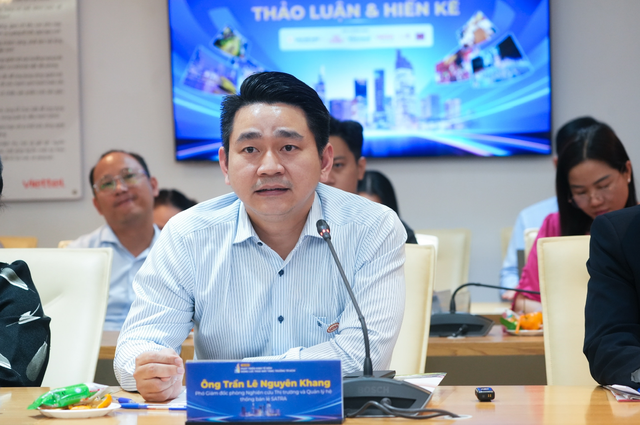
Tran Le Nguyen Khanh from SATRA speaks at a thematic seminar titled 'Nighttime Economy: Driving Growth in Ho Chi Minh City,’ March 25, 2026. Photo: Huu Hanh / Tuoi Tre
Expanding consumer space, creating distinctive products
Beyond physical expansion, SATRA plans to apply technology to the nighttime economy development.
The firm is cooperating with its tech and logistics partners to open ‘digital tourism stations’ that allow international visitors to explore and purchase regional specialties in real time, bridging in-person shopping with e-commerce platforms.
Nighttime offerings should be organized into thematic clusters designed to cater to diverse tastes.
Events and festivals hosted within retail spaces could further transform them into hybrid cultural and entertainment hubs.
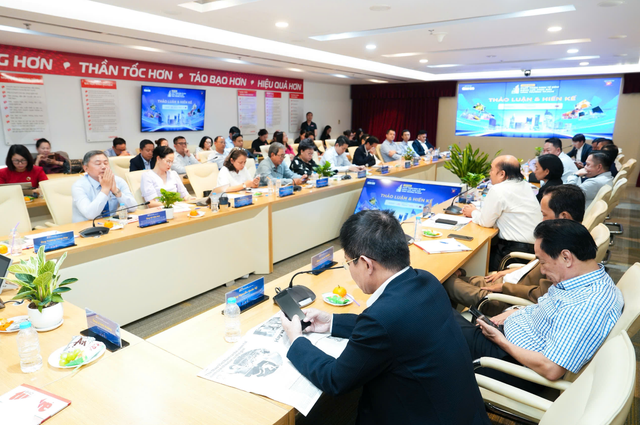
Many firms propose Ho Chi Minh City have a strong intersectoral coordination mechanism to develop the nighttime economy. Photo: Huu Hanh / Tuoi Tre
Need for nighttime complexes
From an industry association perspective, Luu Nhat Tuan, vice-chairman of the Ho Chi Minh City Food Association, said that the core issue is not a lack of ideas, but an absence of coordination.
The city needs a comprehensive master plan and a dedicated body to oversee the nighttime economic growth.
Such sectors as tourism, food, culture, and entertainment should be integrated effectively, he noted.
“Without a strong coordinating mechanism, resources cannot be effectively mobilized,” Tuan said.
Some factors such as infrastructure, policies, and products could be gradually improved, but priority should be given to establishing a strategic framework to guide each step and operation.
Tuan proposed the development of centralized ‘nighttime complexes,’ integrating dining, art performances, shopping, and entertainment into all-in-one destinations.
Such hubs could smooth visitor experience while maximizing spending opportunities.
He also hinted at piloting some areas to adopt a flexible approach – carrying out quickly, reviewing outcomes, and adjusting over time.
Currently, many services in Ho Chi Minh City shut down at around 10:00 pm, meaning the city is missing out on a significant share of nighttime consumer spending.
Extending operating hours, alongside appropriate security measures and effective management, will be key to unlocking the full potential of the evening economy.
Tourism department to map out nighttime spending structure
Nguyen Thi Thanh Thao, head of the planning and tourism resource development division at the Ho Chi Minh City Department of Tourism, said the city has been focusing on developing nighttime tourism for years as part of its broader urban economic strategy.
The demand of both residents and visitors for nighttime shopping, dining, and entertainment is real.
However, it is essential to change the mindset of nighttime economy promotion and management, she said.
The department is currently drafting a tourism development plan for Ho Chi Minh City through 2030, which includes expanding tourism space beyond the central core.
This year, the department will conduct a survey on spending patterns of both domestic and international tourists, particularly in the downtown area and surrounding zones to help firms better understand market demand and develop more suitable products.
Besides, the city plans to build a comprehensive picture of spending structures related to nighttime activities.
Thao noted that developing the night economy cannot rely solely on isolated models or increased investment.
The most important foundation is the local community.
The city must avoid negative impacts on residents’ daily lives while ensuring they benefit from the development process.
Only with active community participation, she asserted, can the nighttime economy achieve long-term sustainability.
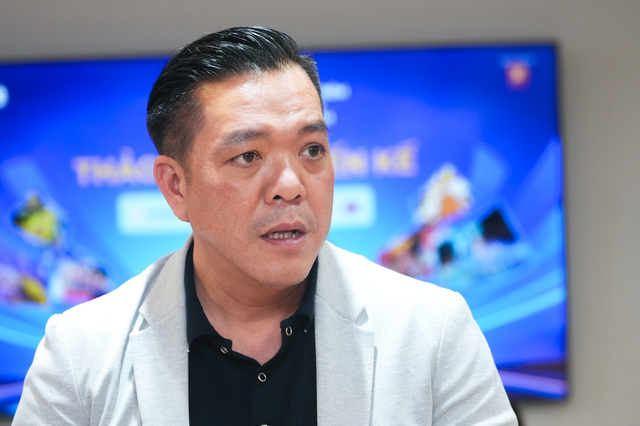
Luu Nhat Tuan, vice-chairman of the Ho Chi Minh City Food Association. Photo: Huu Hanh / Tuoi Tre
Nighttime Economy: Driving growth in Ho Chi Minh City
To identify bottlenecks and unlock resources for the nighttime economy, Tuoi Tre (Youth) newspaper and the Ho Chi Minh City Food Association co-hosted a thematic seminar titled 'Nighttime Economy: Driving Growth in Ho Chi Minh City' on Wednesday in Ho Chi Minh City.
The event was held as the city is drafting a special urban law and a resolution on specific policy mechanisms, creating opportunities for the city to proactively plan, attract investment, and develop its evening economy.
The seminar brought together government officials, policymakers, leading economists, the Ho Chi Minh City Food Association, and representatives of major companies such as Saigontourist Group, Vietravel, Satra, and Viettel.
Discussions focused on spatial planning, diversifying culturally distinctive arts and entertainment products, and gathering direct feedback from businesses on policies for developing the nighttime economy.
The event was expected to showcase successful international models and propose effective pilot roadmaps, helping position the night economy as a new growth engine for the city.

Tieu Bac - Nhat Xuan - Bong Mai - Cong Trung / Tuoi Tre News
Link nội dung: https://news.tuoitre.vn/ho-chi-minh-city-drives-nighttime-economy-from-24-hour-supermarkets-to-midnight-markets-103260326121824703.htm