
Ho Chi Minh City financial center offers zero corporate tax until 2030
Businesses operating in incentivized sectors at the Ho Chi Minh City International Financial Center (VIFC-HCMC) can enjoy a zero corporate income tax rate until 2030, Assoc. Prof. Dr. Nguyen Huu Huan, vice-chairman of the executive board of the center, told an investment promotion conference held on Tuesday.
Under the preferential policy, the corporate income tax rate will rise to 10 percent after 2030.
The rate is significantly lower than Singapore’s current corporate tax rate of 17 percent.
As per Resolution 22 and Decree 323, the Vietnam International Financial Center in the southern metropolis covers 898 hectares, including parts of Ben Thanh Ward and Saigon Ward, as well as most of Thu Thiem Ward, Huan said.
Together, National Assembly Resolution 222 and Government Decree 323 - both issued in 2025 - establish the regulatory and operational framework for the VIFC-HCMC, granting it specialized tax incentives, regulatory sandboxes, and administrative autonomy to attract global financial institutions and investment.
Huan underlined that the legal and regulatory framework for the center has now been completed, marking a shift from the preparation phase to implementation.
The completed legal framework is expected to accelerate the acceptance of membership applications, with the first applications set to be received in August.
To compete with established global financial centers, the center is offering what Huan described as unprecedented incentives.
Ho Chi Minh City is entering a new stage of development, said Pham Quang Nhat, director of the Investment and Trade Promotion Center of Ho Chi Minh City.
The city requires not only rapid expansion but also a higher-quality, more efficient development model anchored in innovation, technology, high-value services, modern finance, and international competitiveness.
Achieving double-digit economic gains in the coming period demands a major restructuring of the city’s key drivers, Nhat said.
The city can no longer rely solely on traditional sources of resources.
Instead, it needs to strengthen its ability to mobilize, direct and allocate capital, develop new markets, promote innovation and connect domestic resources more effectively with international capital.
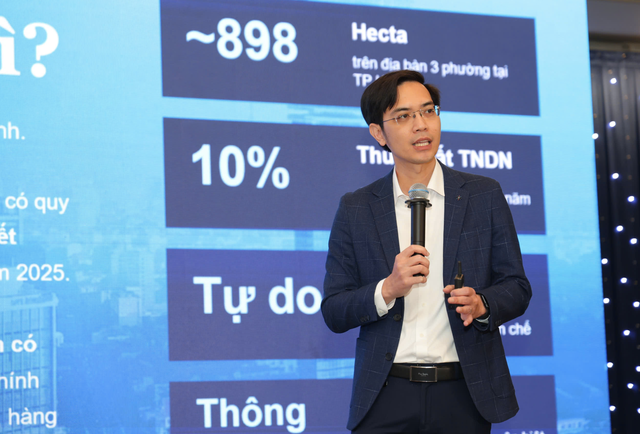
Assoc. Prof. Dr. Nguyen Huu Huan, vice-chairman of the executive board of the Ho Chi Minh City international financial center. Photo: CBRE
Targeting $10-15 billion a year for real economy
Unlike many emerging financial centers, which typically take five to seven years to begin attracting significant capital flows, VIFC-HCMC aims to attract several billion U.S. dollars in its first year and eventually reach annual capital inflows of $10-15 billion, said Huan.
“We are moving on two tracks simultaneously: completing the legal, institutional and regulatory framework for the center while attracting capital flows,” Huan shared.
The center is initially focusing on global investment funds, which are seen as the fastest source of capital to deploy.
It also plans to attract capital through international bond issuance and develop a fintech ecosystem to support capital flows in the coming years.
Huan said investors are particularly interested in having a streamlined mechanism for capital to enter and exit the center.
The mechanism is currently being developed in that direction, with the aim of making the center more attractive to international investors.
Regarding the legal framework, Huan said the center would apply international legal principles and give priority to common-law principles where permitted by Vietnamese law.
The center will also establish specialized regulations governing foreign exchange and cross-border capital flows, as well as a regulatory sandbox for technology-driven financial services.
Specialized courts and international arbitration mechanisms will also be available.
He also said that the framework could allow foreign judges to participate in adjudication, opening a new avenue for dispute resolution and demonstrating Vietnam’s commitment to international legal standards while creating a common playing field for foreign investors.
To ensure a transparent and secure investment environment, the center will apply anti-money laundering and counter-terrorist financing regulations, together with requirements on record-keeping and reconciliation.
It will also conduct controlled tests with limited scope and duration and subject to appropriate safeguards.
Ho Chi Minh City financial hub climbs 11 places
According to the 2026 Global Financial Centres Index, the international financial center in Ho Chi Minh City climbed 11 spots to rank 84th out of 120 financial hubs worldwide, making it the third-ranked center in Southeast Asia.
Vietnam is estimated to need $1.5-1.6 trillion in capital between 2026 and 2050 to support its double-digit growth ambitions.
Meanwhile, the country’s credit-to-GDP ratio has already exceeded 150 percent.
“The demand for capital to support the growth target is now enormous, while the banking system is under excessive pressure,” Huan said.
“Therefore, an important mission of the center is to attract international capital to support economic growth and ease pressure on the domestic capital market.”
The conference, themed ‘Creating a Gateway Connecting Vietnam with Global Capital Flows,’ was jointly organized by the Investment and Trade Promotion Center of Ho Chi Minh City, the executive board of the financial center and CBRE Vietnam.
Tieu Bac - Cong Trieu / Tuoi Tre News
Link nội dung: https://news.tuoitre.vn/ho-chi-minh-city-financial-center-offers-zero-corporate-tax-until-2030-103260811201114862.htm