
Ho Chi Minh City maps out plan to enter top 50 smart cities globally by 2030
Ho Chi Minh City has laid out a smart-city development plan and key solutions to become a leading smart city and rank among the world’s top 50 by 2030, Nguyen Manh Cuong, an alternate member of the Party Central Committee and deputy chairman of the municipal administration, said on Thursday.
The remarks were made at a conference on solutions for building and developing a smart city in Ho Chi Minh City, jointly organized by the municipal Department of Construction and the city's Association of Construction Science and Technology.
Cuong said the city's administration on July 29 issued a smart-city development plan for 2026-30, with a vision to 2045, charting the city's development path in the digital era.
Under the plan, Ho Chi Minh City aims to reach the highest level of smart-city maturity under Vietnam's national criteria for sustainable smart cities and become one of the Asia-Pacific's leading cities and centers for science, technology and innovation by 2045.
The plan aims to make the city a smart and sustainable city based on green growth, with urban governance relying on data and digital technologies.
To put the plan into action, the city has identified six key groups of tasks, six implementation solutions and a three-phase roadmap, Cuong said.
The plan is guided by nine core principles, including compliance with the law and unified management; putting residents and businesses at the center; using data as the foundation; and ensuring interoperability, integration and data sharing.
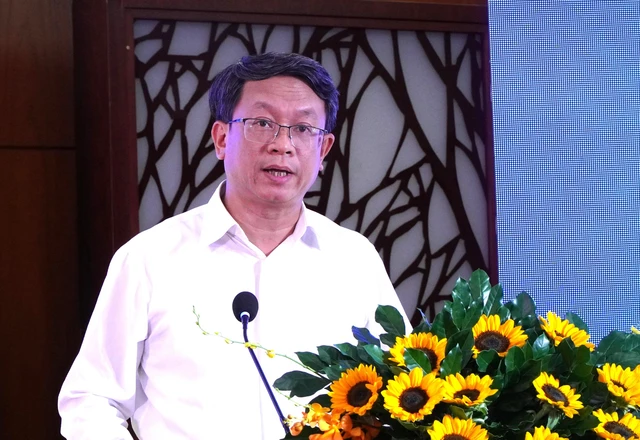
Dr. Tran Quoc Thai, director of the Department of Urban Development under the Ministry of Construction, speaks at a conference on solutions for building and developing a smart city in Ho Chi Minh City, August 20, 2026. Photo: Ai Nhan / Tuoi Tre
The remaining principles are to protect information and privacy, clearly define the roles and responsibilities of agency heads, ensure safety through controlled implementation, follow a roadmap suited to available resources, and maintain an open and flexible approach to technology to avoid technological lock-in.
To facilitate the application of new technologies, services and ideas to smart-city development, the city will create a transparent business environment and introduce breakthrough mechanisms, Cuong said.
The city’s smart-city development efforts must also serve as a model for other localities in Vietnam and help turn its goal of entering the world’s top 50 smart cities into reality, Tran Quoc Thai, director of the Department of Urban Development under the Ministry of Construction, told the conference.
To turn the vision into reality, Thai urged Ho Chi Minh City to quickly identify a short list of high-impact priorities.
These should include transportation and logistics; flooding, drainage and the environment; urban planning, construction and management of urban assets; and healthcare, social welfare and urban safety, he said.
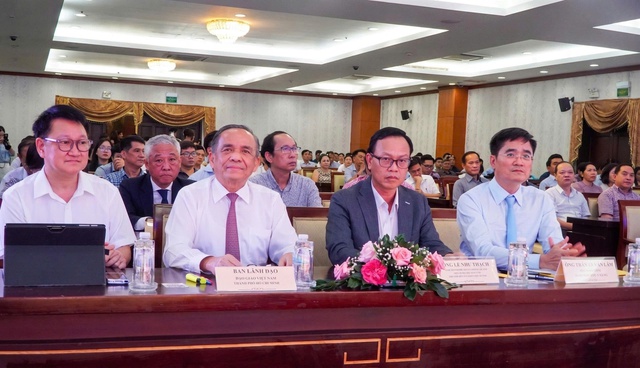
Director of the Ho Chi Minh City Department of Construction Tran Quang Lam (R, 1st, front row) and other delegates attend a conference on solutions for building and developing a smart city in Ho Chi Minh City, August 20, 2026. Photo: Ai Nhan / Tuoi Tre
The city should also establish sandbox mechanisms for controlled pilot projects, allowing new solutions to be tested before being scaled up and potentially serving as models for other localities, Thai said.
He also called for a unified urban data platform, with priority given to data for urban planning, construction management, urban infrastructure and public investment management.
The Ministry of Construction and its Department of Urban Development will support the city in improving institutions and standards, providing technical guidance, connecting smart-city networks and sharing implementation experience, Thai said.
Duong Thao Hien, deputy director of the Ho Chi Minh City Department of Planning and Architecture, said the city's smart-city vision is centered on developing the ability to sense, understand and act.
A smart city should be able to see the overall picture, identify problems early and coordinate responses, with data serving as essential infrastructure for urban governance, Hien said.
To develop these capabilities by 2045, Ho Chi Minh City needs to accurately sense conditions through reliable data collection, correctly understand situations through data analysis, scenario simulation and impact and risk forecasting, and take appropriate action, she said.
Hien also proposed four pillars of action with a three-phase roadmap for developing the city's smart-city model.
Technology should become a driver of urban development, while data should be treated as a public asset and responsibly managed, with residents at the center and actively participating in the smart city, she advised.
Vinh Tho - Ai Nhan / Tuoi Tre News
Link nội dung: https://news.tuoitre.vn/ho-chi-minh-city-maps-out-plan-to-enter-top-50-smart-cities-globally-by-2030-103260820221118195.htm