
Ho Chi Minh City markets turn to tourism to revive business
Traditional markets in Ho Chi Minh City, including Ben Thanh, Tan Dinh and Binh Tay, are turning to tourism, new products and better business practices to boost sales as prolonged sluggish trading drives some vendors out.
Market managers said tourist arrivals have become a bright spot as fewer shoppers visit traditional markets, but they need greater support from authorities in areas including urban planning, tourism, culture and transport to turn the markets into stronger shopping and cultural destinations.
Tourists visit markets for more than shopping
With its distinctive architecture, Binh Tay Market in Binh Tay Ward has attracted visitors interested in exploring the market, with tour groups becoming increasingly common at the market.
Trinh Thi Bich, who has sold confectionery at the market for more than 20 years, said about two out of every 10 customers are now tourists on average, with those traveling in tour groups tending to spend more.
“Tourists favor cashews, coffee, confectionery and assorted candied fruits because they are easy to store and make convenient gifts. Some have even placed repeat orders after discovering the products,” Bich said, adding that she prepares products in appropriately sized packages with attractive designs.
Meanwhile, Tan Dinh Market, built in 1926 and known for its historical features, has also attracted growing interest from tourists.
Visitors from Malaysia, Indonesia, India and China are among those who come to the market for fabrics, fashion and tailoring services. The traditional wooden-clog service has also become a draw.
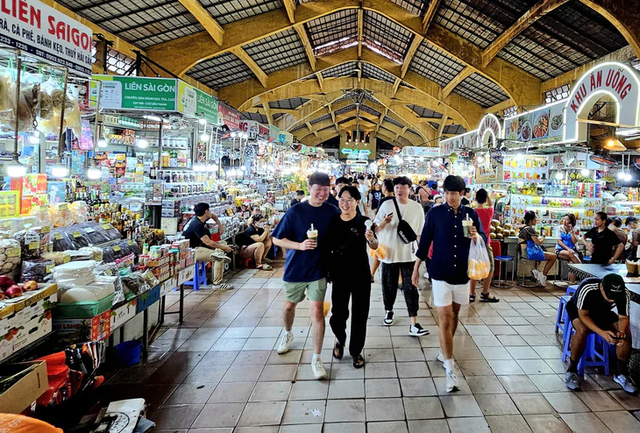
More than 80 percent of visitors to Ben Thanh Market in Ho Chi Minh City are international tourists, but their numbers have been declining, prompting the market management to draw up plans to attract more visitors. Photo: N. Tri / Tuoi Tre
At a wooden-clog stall near the market entrance, business is brisk. A representative of the stall said that the clogs generally sell for VND100,000-350,000 (US$3.8-13.3) a pair, with the stall serving 50-60 customers a day during peak periods. Many customers buy several pairs at once.
“Tourists come to the market not just to shop, but mainly to experience it and learn more about its architecture and Vietnamese culture,” said Ma Hong Ha, owner of the Hong Ha stall.
“The market space and products therefore need to be carefully developed and accompanied by stories.”
While many fashion stalls have closed, some tailoring shops around Pham Van Hai Market in Tan Son Hoa Ward are doing better thanks to tourists and younger customers.
A representative of Tuyet Phuong tailoring said the shop offers a range of made-to-measure products, including dresses, skirts, suits and ao dai, with tourists particularly fond of ao dai despite the garments’ high prices.
Similarly, vendors at Tan Dinh and Ben Thanh markets are expanding on-site tailoring services, particularly for ao dai and ao ba ba (a long-sleeved buttoned shirt paired with loose trousers typically worn by the people of southern Vietnam), in a range of styles.
Foreign tourists, especially those from Malaysia, Indonesia and India, account for 70-80 percent of customers using these services, according to market vendors.

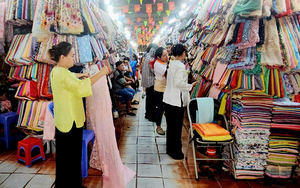
Foreign tourists visit Tan Dinh Market in Ho Chi Minh City to buy fabrics and have clothes tailored. Photo: N. Tri / Tuoi Tre
Markets draw up plans but need support
Market managers said the growing number of tourists is a bright spot, providing a boost for vendors amid a sharp decline in visits to traditional markets.
Nguyen Ngoc Que Phuong, director of the public service supply center of Binh Tay Ward, which manages Binh Tay Market, told Tuoi Tre (Youth) online newspaper that the market management has introduced several initiatives to attract tourists.

These include international payment services that allow visitors to pay without exchanging currency, as well as free cultural and hands-on activities such as lantern-making and making mooncakes.
Binh Tay Market also plans to launch a digital guide to the market, allowing them to scan a QR code to access information about the venue.
“Besides developing our own services and products, we are trying to connect with more travel companies to bring visitors to the market,” Phuong said.
“With a focus on developing the market as a shopping and tourism destination, we aim to significantly increase tourist arrivals over the next three to five years.”
Le Quang Thien, deputy director of the public service supply center of Tan Dinh Ward, told Tuoi Tre that the number of tourists visiting Tan Dinh Market has risen by an average of 10-15 percent annually in recent years following various initiatives, and could increase by 20 percent this year.
The market plans to improve the roads around the venue, develop a food area and strengthen links with Tan Dinh Church to offer visitors a wider range of stories and products.
“We are trying to diversify the products sold at the market, develop more souvenirs, promote more civilized business practices, ensure quality and fair prices, and offer more promotions,” Thien said.
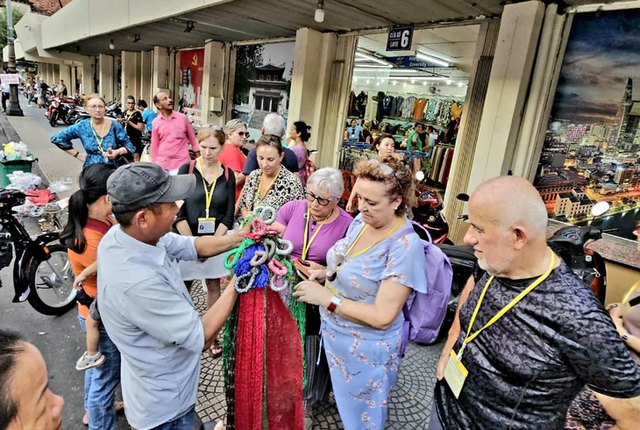
A group of foreign tourists visits Ben Thanh Market in Ho Chi Minh City. Photo: N. Tri / Tuoi Tre
At Ben Thanh Market, where more than 80 percent of visitors are international tourists, the management unit said visitor numbers have gradually declined, prompting the management to consider various measures to reverse the trend.
One plan is to develop a nighttime food area at the market. Besides food vendors operating during designated hours, the area would feature cultural and artistic performances to attract visitors.
Despite these plans, market managers said that improvements, construction and the development of new products involve areas such as transport, urban planning and tourism, making coordination and support from relevant sectors essential.
Duong Duc Minh, deputy director of the Ho Chi Minh City Institute for Economic and Tourism Development Research, said authorities should accelerate the development of cultural and historical experiences, shopping activities and distinctive culinary offerings at traditional markets, in addition to promoting better business practices.
“Markets with limited products that lack appeal and clear standards will constrain promotional and commercial activities, making it particularly difficult to work with travel companies to develop tours that bring visitors to the markets,” Minh said.
Thanh Ha - Nguyen Tri / Tuoi Tre News
Link nội dung: https://news.tuoitre.vn/ho-chi-minh-city-markets-turn-to-tourism-to-revive-business-103260930115113811.htm