
Ho Chi Minh City outlines new urban development vision to foreign partners
The Ho Chi Minh City People’s Committee held a conference on Thursday to introduce the Urban Development Law and outline the city’s development vision to members of the consular corps, international organizations and foreign partners, highlighting new opportunities for investment and cooperation.
Speaking at the event, vice-chairman of the municipal administration Tran Van Bay said the conference followed Monday's announcement of the city’s master plan for the 2025-50 period, with a 100-year vision.
The conference provided an opportunity for the city to share its institutional breakthroughs aimed at realizing its long-term vision and development objectives, while presenting potential opportunities for international cooperation and investment in the years ahead.
Vice-chairman Bay said Ho Chi Minh City aims to become a special, civilized, modern, dynamic and innovative metropolis by 2030, with a prominent position in Southeast Asia.
By 2045, the city aspires to establish itself as an international economic and financial hub, as well as a center for culture, science, technology and innovation in Asia.
It aims to become a global, smart and modern metropolis on a par with the world’s leading cities by 2050.
“To realize this vision and achieve these objectives, the city needs an institutional framework commensurate with its ambitions,” he underlined.
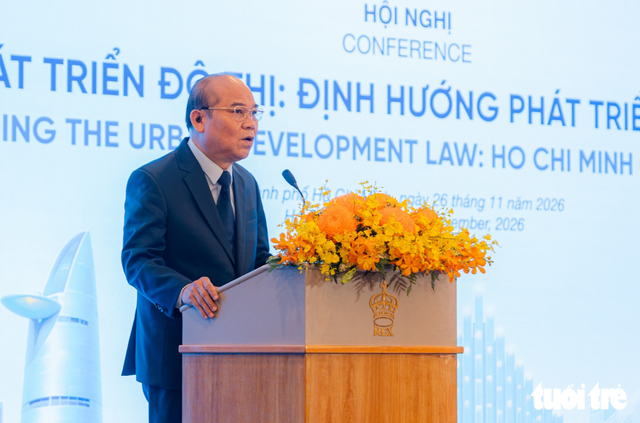
Ho Chi Minh City vice-chairman Tran Van Bay speaks at the conference to introduce the Urban Development Law, November 26, 2026. Photo: Ngoc Duc / Tuoi Tre
“The Urban Development Law represents an important institutional breakthrough in this regard.”
Following the law’s adoption, the city moved swiftly to develop and issue implementing resolutions and decisions within its authority, with a focus on ensuring consistency, feasibility and effectiveness.
Through the conference, Ho Chi Minh City expected international partners to gain a clearer understanding of changes to its legal framework, development orientations and emerging investment and cooperation opportunities.
The event also provided a platform for the city to listen to and address questions from foreign stakeholders, he said.
He called on diplomatic missions and international organizations to use their positions and networks to communicate the information to governments, local authorities, organizations, associations and business communities in their respective countries.
He also encouraged them to actively facilitate connections and introduce capable partners with relevant experience and technologies to explore investment and cooperation opportunities in the city.
During the conference, international delegates heard presentations from representatives of the municipal Departments of Justice, Industry and Trade, Planning and Architecture, and Science and Technology on key provisions of the Urban Development Law.
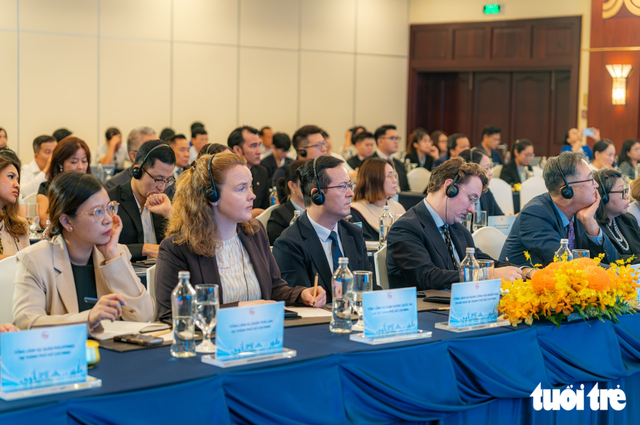
Consuls general of several countries attend the conference in Ho Chi Minh City. Photo: Ngoc Duc / Tuoi Tre
International partners show interest in free trade zone, regulatory sandbox
Addressing a question from British Deputy Consul General William Lawrenson about Ho Chi Minh City’s sandbox policy, deputy director of the municipal Department of Science and Technology Tran Trong Tuyen said the mechanism had been more clearly defined under the Urban Development Law.
However, sandbox provisions are also included in several other pieces of legislation, particularly the Law on Science, Technology and Innovation, the Law on Artificial Intelligence and the Law on Digital Transformation.
Under the Urban Development Law, Ho Chi Minh City has been granted broader and more specific authority to implement controlled testing mechanisms.
The department is currently advising on a citywide regulatory sandbox framework, he said.
The proposal will first be submitted to the municipal People’s Committee, which is expected to present it to the municipal People’s Council in December.
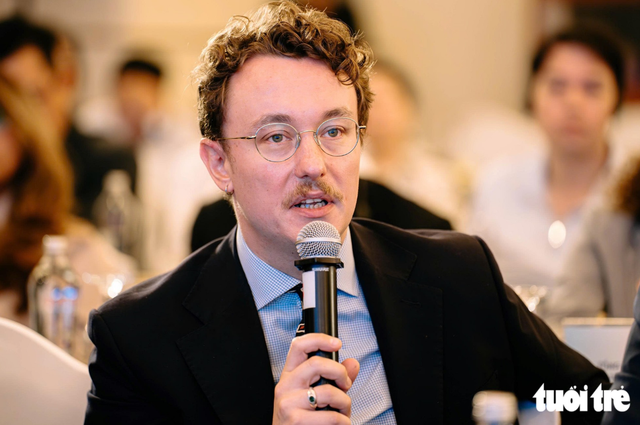
British Deputy Consul General William Lawrenson raises a question at the conference. Photo: Thanh Hiep / Tuoi Tre
Meanwhile, German Consul General Sühl raised questions about policies supporting infrastructure development in response to climate change and the need to strengthen urban resilience.
In response, deputy directot of the municipal Department of Construction Huynh Thanh Khiet explained that, unlike other localities where spatial planning and socio-economic planning are conducted separately, Ho Chi Minh City has adopted an integrated master plan incorporating both.
As a result, the development orientations for the city’s entire technical infrastructure system through to 2050 have been incorporated into the plan.
The city will develop five central areas based on the transit-oriented development (TOD) model.
These areas will be connected through ring roads and an extensive urban railway network, comprising 18 metro lines with a combined length of over 900 kilometers, alongside light rail transit lines totalling around 450 kilometers.
The city is also expected to break ground on five additional metro lines by the end of this year.
A representative of the Netherlands Consulate General in Ho Chi Minh City asked whether businesses should prioritize investment in free trade zones or hi-tech parks.
Deputy director of the municipal Department of Industry and Trade Le Van Danh said the department was working with relevant units to organize an investment promotion conference for the free trade zone.
Details of the zone’s policy mechanisms and incentives will be widely communicated to both domestic and international investors.
Parts of the zone are already operational, with existing projects underway.
He said that Ho Chi Minh City had drawn on experiences from China, South Korea, Dubai, Malaysia and Singapore to develop the zone.
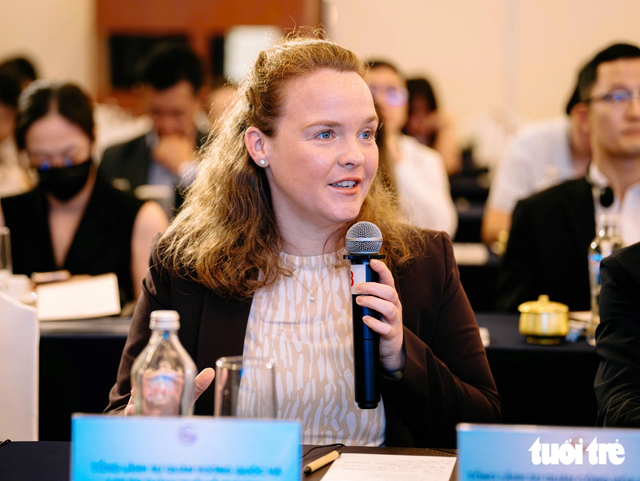
A representative from the Netherlands Consulate General speaks at the conference. Photo: Thanh Hiep / Tuoi Tre
It is envisioned as a multifunctional development incorporating ports, logistics facilities, industrial parks, urban areas, commercial centers and service facilities.
The model is designed to enable experts, investors and their families to live and study within the zone.
The city hopes diplomatic missions and international representative agencies will help promote the zone and connect it with potential investors.
Beyond boosting exports, the initiative is intended to create opportunities for Vietnamese small- and medium-sized enterprises to become part of the ecosystems and supply chains of major international corporations.
Tieu Bac - Ngoc Duc - Thanh Hiep / Tuoi Tre News
Link nội dung: https://news.tuoitre.vn/ho-chi-minh-city-outlines-new-urban-development-vision-to-foreign-partners-10326112714480166.htm