
Ho Chi Minh City pushes ‘dual transition’ for growth, global integration
Ho Chi Minh City is accelerating a ‘dual transition’ focused on digital transformation and green economic development as it enters a new phase of expansion and global integration following an administrative merger earlier this year, officials said at the 2025 Intelligent Community Forum (ICF) Global Summit on Wednesday.
The city is entering a period of deep restructuring guided by the belief that a modern megacity must be built on knowledge, innovation, science, and sustainable development, deputy chairman of the municipal administration Nguyen Loc Ha said at the two-day event that opened on Tuesday.
To this end, Ho Chi Minh City is developing a shared data system and modern digital infrastructure, while upgrading transport and logistics networks to strengthen regional connectivity, integrate into global value chains, and support cross-border trade and investment.
At the same time, the city is building an innovation ecosystem to promote green economic development, based on a ‘triple-helix’ model of cooperation among the state, universities, research institutes, and the business community.
Following the merger of Binh Duong and Ba Ria – Vung Tau under the national administrative restructuring effective July 1, the expanded metropolis now spans over 6,700 square kilometers and is home to more than 14 million people.
As Vietnam’s largest economic hub, the city contributes nearly a quarter of national GDP and carries growing responsibility in leading a shift toward a modern, sustainable, knowledge-based development model aligned with its dual transition strategy and ambition for deeper regional and global integration.
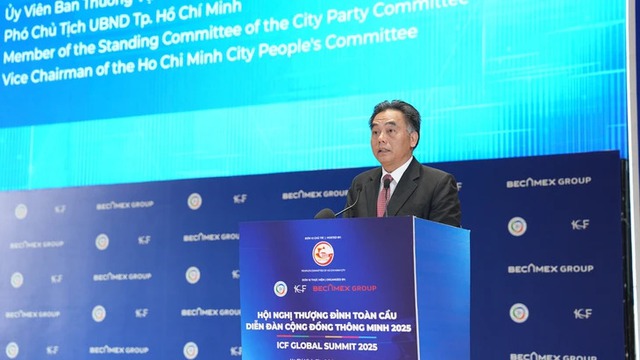
Chairman of the Ho Chi Minh City administration Nguyen Loc Ha speaks at the 2025 Intelligent Community Forum Global Summit in Ho Chi Minh City, December 3, 2025. Photo: T. T. / Tuoi Tre
Ha noted that the ICF previously supported the former Binh Duong Province in becoming a pioneering smart community, and that repeated international recognition of Binh Duong’s strategy shows that a locality with clear vision and persistent determination can meet high global standards, even within a developing economy.
Looking ahead, one of the city’s priorities is to expand the smart community model across the entire metropolis, improving quality of life, public services, digital infrastructure and fostering an innovation ecosystem and green economy capable of attracting high-quality investment.
Lou Zacharilla, co-founder of the ICF, said that the transfer of hosting rights for the ICF Global Summit from the former Binh Duong to the merged Ho Chi Minh City represents a rare example of successful continuity in the organization’s history.
“This transition has not only maintained momentum but also enhanced Vietnam’s standing within a global network of more than 200 member cities, duly recognizing Ho Chi Minh City’s serious, persistent and determined efforts,” Zacharilla said.
Over the two-day summit, delegates discussed strategies to enhance urban competitiveness through innovation, digital solutions and sustainable growth, while exploring Ho Chi Minh City’s vision as a post-merger megacity and its potential to become a leading economic and technological hub in the region.
The organizing committee also announced and honored the 2025 ICF Top 7 communities: Assai (Brazil), Bursa (Turkey), Durham (Canada), Fairfield (U.S.), Hilliard (U.S.), Kingston (Canada), and Las Rozas de Madrid (Spain).
Previously, Binh Duong was named among ICF’s Smart 21 communities for five consecutive years, ranked in the Top 7 in 2021 and 2022, and crowned the world’s leading smart community in 2023.
Vinh Tho - Ba Son / Tuoi Tre News
Link nội dung: https://news.tuoitre.vn/ho-chi-minh-city-pushes-dual-transition-for-growth-global-integration-10325120415324072.htm