
Ho Chi Minh City seeks to attract cargo now transshipped via Singapore, Malaysia, Thailand
Ho Chi Minh City, Vietnam's southern economic hub, is seeking to attract international cargo currently transshipped through regional hubs such as Singapore, Malaysia's Port Klang, and Thailand, as it aims to become an international logistics services hub.
The goal was discussed at a seminar organized by the municipal Department of Industry and Trade on Wednesday.
City seeks to capture international cargo flows
Dang Minh Phuong, chairwoman of the Ho Chi Minh City Logistics and Seaport Association, said the city needed to move beyond serving as a gateway for goods and become a hub for transshipment, distribution and supply chain coordination.
Rather than competing with Hanoi and Hai Phong for existing cargo flows, the city aims to attract shipments currently routed through major regional hubs, including Singapore, Port Klang in Malaysia, and Thailand.
This requires an integrated logistics ecosystem covering multimodal transport, finance, marine insurance, arbitration, legal services, technology and data to attract cargo owners, shipping lines and logistics service providers, Phuong said.
Le Van Danh, deputy director of the municipal Department of Industry and Trade, said the city aimed to achieve average annual growth of 13-16 percent in its logistics sector while reducing logistics costs to 11-14 percent of its GRDP.
Its action plan comprises nine groups of solutions covering infrastructure, cargo sources, human resources, value-added services, digital transformation, green transition and international cooperation.
However, domestic logistics businesses remain concentrated in transportation, freight forwarding and warehousing, which generate relatively low added value.
"Vietnam's logistics sector is almost entirely based on making money through labor-intensive services. High-value services such as finance, order management and international freight forwarding remain underdeveloped," Danh said.
Assoc. Prof. Dr. Trinh Tu Anh, director of the Institute of Smart Cities and Management at the University of Economics Ho Chi Minh City, said the large volume of goods handled by the city had yet to translate into commensurate economic value.
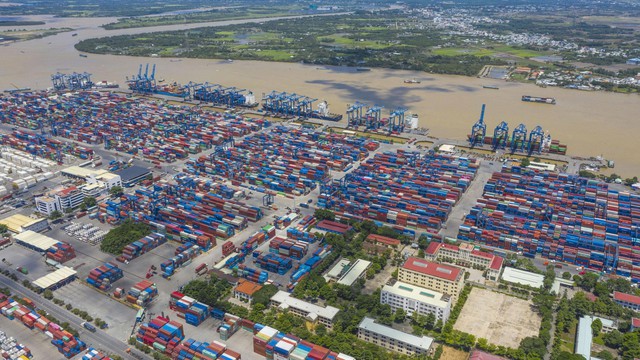
An aerial view of Cat Lai Port in Ho Chi Minh City. Photo: Quang Dinh / Tuoi Tre
More than 80 percent of cargo is transported by road. At the Cat Lai-Phu Huu port complex, road transport accounts for around 92 percent of container traffic, putting considerable pressure on transport infrastructure.
This reliance on road transport drives up logistics costs, while inland waterways and railways have yet to significantly ease pressure on major transport gateways, she said.
Anh added that the city remains primarily a regional logistics hub and needs to play a greater role in coordinating supply chains, directing cargo flows and providing higher-value services to become an international center.
City plans 38 logistics centers, proposes land allocation
Tran Ngoc Thanh, an expert with a consortium comprising the National Institute of Urban and Rural Planning and U.S.-based Boston Consulting Group, said logistics development was being incorporated into Ho Chi Minh City's proposed master plan for 2025-50, with a 100-year vision.
Under the plan, which is subject to approval, Ho Chi Minh City aims to establish 38 logistics centers.
The consortium has proposed allocating 4,500-6,000 hectares for these centers and more than 7,000 hectares for supporting facilities by 2035.
It also recommends limiting the development of inland container depots (ICDs) and warehouses in inner-city areas and gradually relocating them to integrated logistics zones.
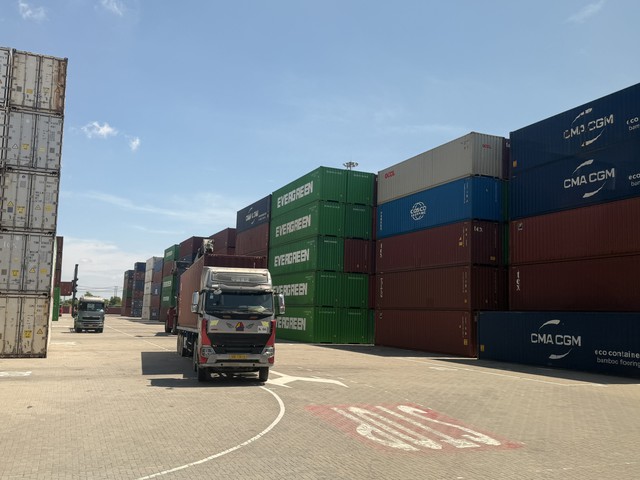
Trucks move through a container yard at a port in Ho Chi Minh City to receive cargo. Photo: Cong Trung / Tuoi Tre
Existing facilities, including the Truong Tho ICD and warehouses along the Saigon River, are proposed for conversion to other uses.
Thanh said the 38-center logistics network would only operate effectively with coordinated infrastructure, data systems and management.
5 priorities for attracting international cargo
Phuong proposed five groups of measures to attract international cargo and develop the city's logistics sector.
The first is to improve the institutional framework by incorporating the international logistics hub model into the city's master plan and the national seaport development plan, while establishing special mechanisms for an international maritime center, the Cai Mep Ha Free Trade Zone and the Can Gio International Transshipment Port.
The second is to develop multimodal transport infrastructure, prioritizing rail links to seaports, inland waterways, ring roads and expressways, as well as connections between ports, industrial parks, production areas and logistics facilities to reduce reliance on road transport.
The third is to promote green finance through credit and tax incentives for businesses investing in low-emission ports, clean transport vehicles and green fuels.
The city should also develop a carbon credit market linked to its international financial center.
The fourth is to develop a skilled workforce through cooperation among government agencies, educational institutions, associations and businesses to train personnel in digital logistics, maritime services and finance in line with practical needs and international standards.
The fifth is to expand international cooperation by leveraging the city's partnerships with 88 localities and promoting sister-port arrangements with Osaka in Japan, Shanghai in China and Los Angeles in the U.S., as well as with major American and European gateway ports.
Vinh Tho - Cong Trung / Tuoi Tre News
Link nội dung: https://news.tuoitre.vn/ho-chi-minh-city-seeks-to-attract-cargo-now-transshipped-via-singapore-malaysia-thailand-103261125201919232.htm