
Ho Chi Minh City steps up environmental protection efforts toward 2030
Ho Chi Minh City has approved a comprehensive environmental protection program for 2026-30, setting 22 targets to control pollution, improve environmental quality, and enhance climate resilience, while outlining key tasks to achieve these goals.
Approved by the Ho Chi Minh City Party Committee on July 6, the program marks a major step in the southern metropolis' efforts to tackle growing environmental pressures from rapid urbanization, increasing waste volumes, air pollution, and climate risks as it moves toward a greener and more sustainable future.
Mounting environmental challenges
As Vietnam's largest economic hub and one of the country's most densely populated urban areas, Ho Chi Minh City faces growing pressure to balance rapid development with environmental protection and climate resilience.
Rapid urbanization has brought a range of environmental challenges, including deteriorating air quality, rising household waste volumes, increasing pressure on water resources, and greater climate-related risks.
Air pollution remains one of the city's most pressing concerns.
Under the city's 2026-30 air quality management plan, road traffic, construction, industrial production, and other urban activities have been identified as major sources of emissions, prompting efforts to strengthen air quality monitoring and pollution control.
The plan calls for tighter emissions controls, expanded environmental monitoring, and measures to reduce pollution from key sources.
Recent data show that fine particulate matter (PM2.5) remains a challenge.
According to IQAir data cited by the Vietnam News Agency, Ho Chi Minh City's PM2.5 concentration reached about 13 micrograms per cubic meter on June 18, around 2.6 times higher than the World Health Organization's recommended annual guideline.
While seasonal rains have helped improve air quality, prolonged exposure to polluted air may still pose health risks, especially for children, older adults, and people with respiratory conditions.
Waste management is another major challenge for the rapidly growing metropolis.
The Ho Chi Minh City Department of Agriculture and Environment said the city generates around 14,000 metric tons of household waste daily, putting a strain on collection, treatment, and disposal systems.
The growing waste volume has strained landfills, water resources, and urban ecosystems, highlighting the need to accelerate waste separation at source, recycling, and waste-to-energy development.
Climate change adds further pressure.
According to the environmental protection program, Ho Chi Minh City is increasingly vulnerable to flooding, sea-level rise, and extreme weather events, which threaten infrastructure, economic activities and residents' daily lives.
These challenges have pushed the city to move beyond a reactive approach to pollution control toward a broader environmental strategy focused on prevention, sustainable infrastructure, modern environmental management, and climate resilience.
22 targets for greener, more climate-resilient city
Under the program, the city has set 22 targets for 2026-30 to strengthen pollution control, improve environmental quality, and enhance climate resilience.
The initiative marks a shift from responding to environmental problems after they occur toward preventing pollution, promoting sustainable resource management, and building a greener, healthier, and more climate-resilient metropolis.
The 22 targets are grouped into three categories: pollution prevention and control; tackling major environmental challenges; and climate change adaptation.
The first category focuses on preventing pollution through cleaner production, stronger environmental monitoring, and tighter emissions controls.
By 2030, organic farming is expected to account for 2.5-3 percent of agricultural land.
All industrial parks, export processing zones, high-tech parks, and industrial clusters are expected to have centralized wastewater treatment systems that meet environmental standards.
Facilities subject to mandatory monitoring requirements will be required to install automatic wastewater and emissions monitoring systems connected to environmental authorities.
The second category addresses the city's most pressing environmental issues, particularly air pollution, wastewater and solid waste management.
Key targets include collecting and centrally treating 80 percent of urban wastewater by 2030.
The city also aims to ensure all household solid waste is properly collected and treated, with more than 90 percent recycled or processed using modern technologies.
Waste separation at source will be implemented across all wards, communes, and special zones.
All medical and hazardous waste will be collected and treated in line with environmental regulations.
Other targets include transitioning all public buses and taxis to clean energy by 2030, strengthening control over major emission sources, and ending the illegal open burning of waste and agricultural by-products.
Shopping malls, supermarkets, hotels, and tourist sites are also expected to replace single-use plastics and non-biodegradable plastic packaging with environmentally friendly alternatives.
The third category focuses on strengthening climate resilience and promoting greener development.
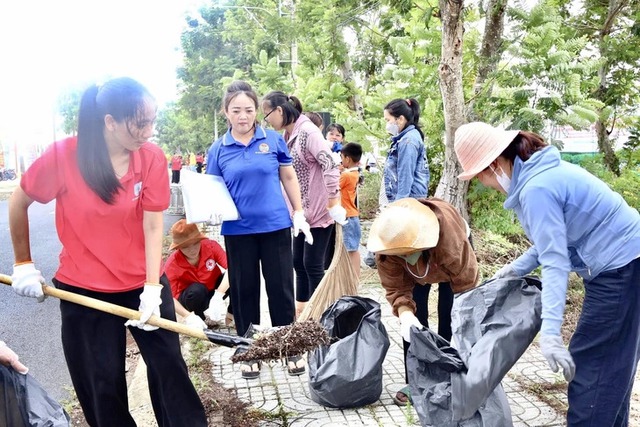
Residents of Binh Khanh Commune in Ho Chi Minh City clean local streets during a community campaign promoting environmental protection in June 2026. Photo: Minh Chau
By 2030, Ho Chi Minh City aims to maintain forest coverage at around 11 percent.
The city also plans to increase the share of renewable energy in electricity supply and consumption to 15-18 percent, with a long-term goal of reaching 25 percent.
Another target is to improve public awareness of environmental protection, climate adaptation, and biodiversity conservation.
Together, the 22 targets provide a comprehensive framework for Ho Chi Minh City to strengthen pollution control, improve environmental quality, and enhance climate resilience through 2030.
From targets to action
To achieve its 22 targets by 2030, the environmental protection program outlines three major groups of tasks.
The first focuses on minimizing the environmental impacts of socio-economic development through integrated environmental protection measures, environmental zoning, upgrading waste treatment technologies, relocating production and business facilities that fail to meet environmental standards, and expanding environmental monitoring.
The second centers on preventing pollution and improving environmental quality.
Key priorities include managing water, air, soil and marine environments; addressing pollution hotspots; expanding wastewater collection and treatment systems; rehabilitating polluted rivers, canals and streams; and accelerating digital transformation through environmental databases and digital technologies.
The third group focuses on improving the management of household, industrial, agricultural and hazardous waste.
It prioritizes investment in modern waste treatment infrastructure, reducing dependence on landfills, expanding waste collection networks, promoting recycling and reuse, and advancing the circular economy and eco-industrial development.
The program also identifies 26 priority schemes and projects to support implementation.
These include expanding automatic environmental monitoring networks, investing in wastewater collection and treatment systems, developing waste-to-resource and waste-to-energy facilities, upgrading landfill sites, and rehabilitating rivers, canals, drainage systems and reservoirs.
It also outlines five key solutions: improving policies and regulatory frameworks, raising public awareness, mobilizing investment resources, promoting scientific research and technological innovation, and strengthening regional and international cooperation on environmental protection.
According to city officials, the program's success will depend not only on effective governance and sustained investment but also on the active participation of businesses, communities, and residents.
Vinh Tho - Tien Long - Chau Tuan / Tuoi Tre News
Link nội dung: https://news.tuoitre.vn/ho-chi-minh-city-steps-up-environmental-protection-efforts-toward-2030-103260713115643878.htm