
Ho Chi Minh City struggles with disposal of 17.2m cubic meters of canal sludge
Ho Chi Minh City is facing a major bottleneck in its canal restoration efforts as the southern Vietnamese city lacks designated dumping sites for an estimated 17.2 million cubic meters of dredged soil and sludge.
The massive volume of material originates from various urban dredging and drainage projects, according to the municipal Urban Infrastructure Construction Investment Project Management Board.
Nguyen Hoang Anh Dung, deputy director of the board, highlighted the issue at a municipal economic and social press briefing on Thursday, noting that the board is responsible for only some of the city's canal and drainage projects.
During the 2026-30 period, the board has been assigned to act as the developer for 55 projects in the technical infrastructure, environmental and irrigation sectors.
Four major projects are currently being expedited by the board, but the lack of designated disposal sites for dredged soil and sludge has significantly affected their progress.
The projects include the construction of infrastructure and environmental improvements along the Tham Luong-Ben Cat-Nuoc Len Canal system, which is expected to generate 4.7 million cubic meters of material.
Another project involves dredging Xom Cui Canal's drainage system, which is expected to generate 350,000 cubic meters of material.
The third involves dredging, infrastructure construction and environmental improvements along the northern bank of Doi Canal in the former District 8, generating 260,000 cubic meters of material.
The last project involves dredging, environmental improvement and infrastructure construction along Xuyen Tam Canal, from Nhieu Loc-Thi Nghe Canal to Vam Thuat River.
Across the city's dredging projects, the total volume of soil and sludge generated is estimated at around 17.2 million cubic meters, including 8.8 million cubic meters of excavated soil and 8.4 million cubic meters of dredged sludge.
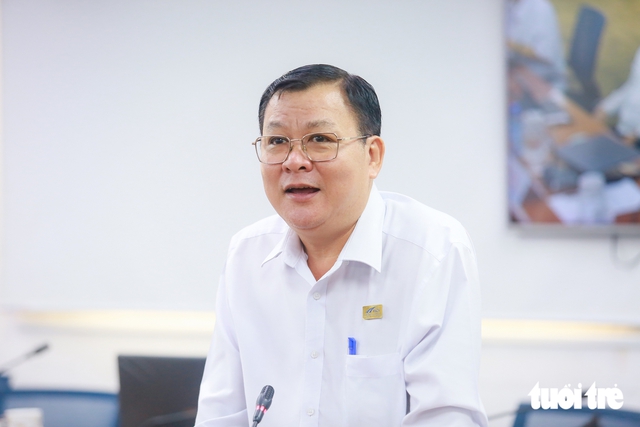
Nguyen Hoang Anh Dung, deputy director of the Ho Chi Minh City Urban Infrastructure Construction Investment Project Management Board, speaks at a municipal economic and social press briefing, August 13, 2026. Photo: Chau Tuan / Tuoi Tre
Among these projects, the Tham Luong-Ben Cat-Nuoc Len Canal project is particularly affected by the lack of a disposal site.
The nearly 32-kilometer project is expected to generate nearly 4.7 million cubic meters of excavated soil and dredged sludge, including nearly 3.3 million cubic meters of sludge from the canal bed, news site VnExpress reported.
Nguyen Van Cuong, chief supervisor of construction package No. 10 for the project, told VnExpress that contractors have been able to handle soil excavated along the canal banks but have been unable to dredge sludge from the canal bed because there is no site available to receive it.
The package, covering more than eight kilometers from Truong Dai Bridge to the Saigon River, has reached more than 65 percent completion, with work mainly focused on embankments, roads and other infrastructure along the canal, he said.
However, the city currently has no specific list of sites designated for disposing of non-contaminated dredged material.
As a result, each project that needs to dispose of dredged material must work directly with local authorities in areas where suitable land is available and obtain approval from the Ho Chi Minh City Department of Agriculture and Environment before it can proceed.
It is this process that has affected the progress of some projects, Dung said.
The Urban Infrastructure Construction Investment Project Management Board has called on the city to soon publish a list of sites where dredged material can be used for land filling.
Dung stressed that the list should be available not only for projects managed by the board but also for other local authorities and agencies across the city.
"These sites could be shared by multiple projects, helping avoid the need to transport dredged material long distances or use separate dumping sites for individual projects," he said.
Phan Viet Thuan, director of the Ho Chi Minh City Institute of Natural Resources and Environment Economics, said dredging rivers and canals is essential for urban areas but must be accompanied by suitable sites for receiving and treating the dredged material, according to VnExpress.
He urged the city to soon plan centralized sites for receiving and treating dredged sludge, particularly as it prepares to carry out numerous canal improvement projects.
Such a system would help control the origin and volume of dredged material, ensure environmental requirements are met, and facilitate the classification and reuse of suitable material for infrastructure projects, he added.
Vinh Tho – Chau Tuan – Ky Phong / Tuoi Tre News
Link nội dung: https://news.tuoitre.vn/ho-chi-minh-city-struggles-with-disposal-of-172m-cubic-meters-of-canal-sludge-103260813214225719.htm