
Ho Chi Minh City’s 100-year master plan puts quality of life at center
Ho Chi Minh City’s proposed master plan for the 2025-50 period, with a 100-year vision, aims to transform the southern Vietnamese metropolis into a globally competitive megacity while prioritizing residents’ quality of life, sustainability, climate resilience, and equitable development opportunities for tens of millions of inhabitants in the years to come.
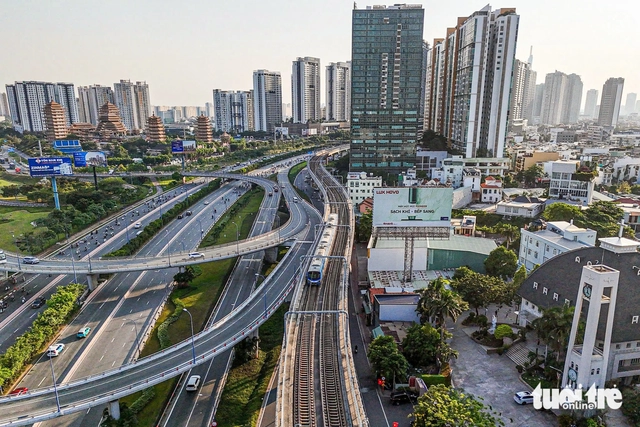
A drone view of Ho Chi Minh City’s metro line No. 1, which began commercial operations from late 2024 and has helped boost the city’s development. Photo: Quang Dinh / Tuoi Tre
The vision was discussed at a conference held on June 2 by the municipal People’s Council in coordination with the Ho Chi Minh City Institute for Development Studies, the Department of Planning and Architecture, and the Department of Finance.
According to the master plan’s summary report presented by Sam Minh Tuan, deputy head of the Vietnam Institute for Urban and Rural Planning, Ho Chi Minh City is entering a critical phase of development following its administrative merger with Binh Duong and Ba Ria-Vung Tau last July.
He said the expanded city’s greatest challenge is not the lack of development potential but its ability to reorganize resources and urban space into a unified, efficient, and multi-centered structure.
A SWOT analysis conducted for the master plan highlighted the city’s strengths, including its position as Vietnam’s economic engine, a combination of service industries, manufacturing, and international seaport infrastructure, a large labor force, and a multimodal transportation network spanning roads, waterways, and aviation, with future potential for expanded regional rail systems.
A SWOT analysis is a strategic planning technique which seeks to identify the strengths, weaknesses, opportunities, and threats involved in a project or an organization.
However, significant challenges remain, such as the city’s incomplete infrastructure connectivity, fragmented economy, uneven living standards, and rising environmental pressures.
To address these issues, planners identified four key priorities, including enhancing economic competitiveness, reorganizing the city’s spatial structure, improving regional connectivity, and upgrading urban quality with residents at the center of planning decisions.
“The 100-year vision positions Ho Chi Minh City as a global megacity with strong competitiveness, innovation capacity, exceptional quality of life, and long-term adaptability,” Tuan said.
Under the proposal, new development hubs would not only generate jobs but also provide housing, schools, hospitals, cultural and sports facilities, public spaces, and essential urban services to ease pressure on the city center.
The consulting team also recommended organizing healthcare, education, vocational training, cultural institutions, social housing, elderly care services, and community facilities according to population distribution and living zones rather than concentrating them in inner-city areas.
The city should also prepare for long-term demographic changes, including population growth, migrant workers, highly skilled professionals, young families, and an aging population.
This would require the increasing supply of affordable homes, worker accommodations, the establishment of age-friendly communities, and strengthening public healthcare capacity.
“Equal access to urban services and welfare should be measured through clear indicators such as travel distance, transportation costs, housing quality, access to healthcare and education, public spaces, and digital infrastructure,” Tuan said.
Speaking at the event, economist Tran Du Lich suggested Ho Chi Minh City change its planning mindset.
As the city increasingly resembles major metropolitan regions such as Shanghai, Tokyo, Seoul, and New York, future planning must shift from urban expansion to building a globally competitive economic and innovation hub, he said.
Urban planners need to determine what role Ho Chi Minh City will play within Asia’s and the world’s network of global cities over the next 25, 50, and 100 years, Lich added.
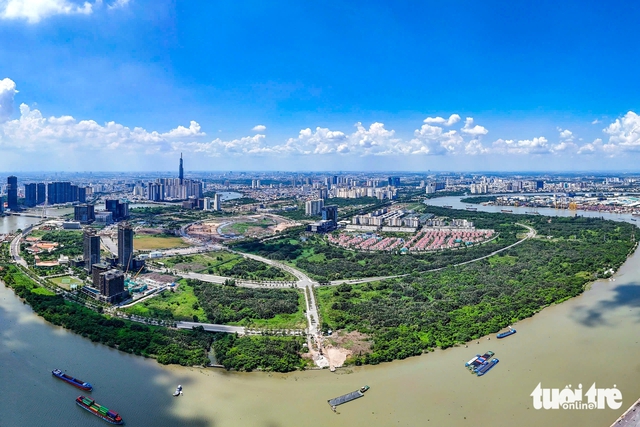
An aerial view of the Thu Thiem New Urban Area in Ho Chi Minh City. Photo: Quang Dinh / Tuoi Tre
Chau Vu, deputy chief of staff of the Ho Chi Minh City People’s Council, said metro lines and mass public transportation should become the backbone for restructuring urban development.
Under the transit-oriented development (TOD) model, housing, workplaces, schools, and essential services would be concentrated around public transit networks, reducing reliance on private vehicles and improving accessibility.
According to economist Pham Viet Thuan, people’s quality of life must be put at the center of the century-long vision.
“A developed city should not be measured solely by GDP growth or economic output,” Thuan said.
“It should also be evaluated by travel time, air quality, green space, access to public services, and housing affordability.”
He also warned that environmental protection and climate adaptation are essential to the city’s future success.
The city should preserve waterways, protect natural lowlands, expand water-absorbing urban infrastructure such as retention lakes and floodable parks, and conserve mangrove ecosystems, particularly in Can Gio.
According to Associate Professor Tran Hoang Ngan from Saigon University, the 100-year master plan should avoid past planning flaws such as delayed plans, fragmented local planning, and mismatched population forecasts.
Ngan recommended several solutions including phased planning, TOD land auctions, smart infrastructure, and regional digital mapping.
Vo Van Minh, deputy secretary of the Ho Chi Minh City Party Committee and chairman of the municipal People’s Council, said the expanded city now covers more than 6,700 square kilometers and has a population exceeding 14 million, making it one of Southeast Asia’s largest megacities.
He said the master plan would serve as a strategic framework to optimize development resources, improve living standards, strengthen climate resilience, and reinforce Ho Chi Minh City’s position within Vietnam and the region.
Minh Duy - Tien Long - Ai Nhan / Tuoi Tre News
Link nội dung: https://news.tuoitre.vn/ho-chi-minh-citys-100-year-master-plan-puts-quality-of-life-at-center-103260623154027959.htm