
Ho Chi Minh City’s 100-year master plan: Where should affordable housing be located?
As Ho Chi Minh City maps out its development over the next 100 years, planners are weighing how to place social, rental, and affordable housing closer to jobs, public transport, and essential services instead of pushing lower-income residents to the urban fringe.
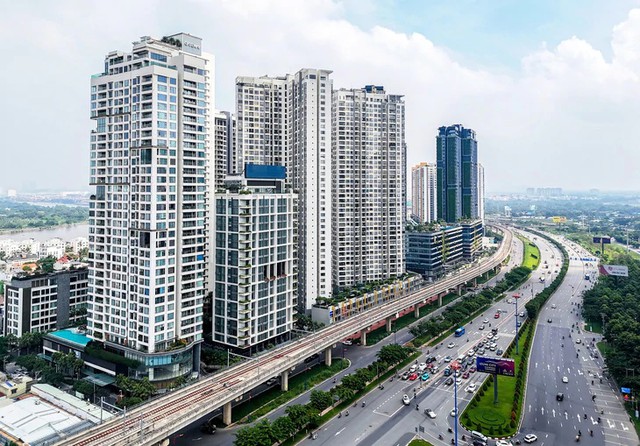
The development of social housing, rental housing, and affordable commercial housing linked to metro lines and transit-oriented development (TOD) is among the key directions in Ho Chi Minh City’s comprehensive master plan. Photo: Chau Tuan / Tuoi Tre
The issue was among the topics discussed at a workshop on solutions for building and developing a smart city in Ho Chi Minh City, as the city is preparing its comprehensive master plan with a 100-year vision.
Architect Sam Minh Tuan of the Vietnam Institute for Urban and Rural Planning (VIUP), a consultant to the master plan, said affordable housing should be integrated into the city’s urban fabric and social infrastructure rather than developed as stand-alone projects wherever land is available.
Ho Chi Minh City aims to add nearly 200,000 social housing units between 2026 and 2030, making it necessary for the master plan to first establish a clear spatial framework for their distribution.
That framework would later be translated into lower-level planning, housing development programs, and specific investment projects.
Put housing near jobs and growth poles
Housing development should be based first on actual demand and the capacity of technical infrastructure, Tuan said.
Priority should be given to major employment centers, including new urban growth poles, industrial parks, high-tech zones, logistics centers, seaports, universities, hospitals, and other major employment clusters.
Key areas include the Thu Duc-Di An-Thuan An corridor; industrial centers such as Thu Dau Mot, Ben Cat, Tan Uyen, and Bau Bang; Nha Be-Hiep Phuoc; and Phu My-Cai Mep-Thi Vai-Long Son.
The principle, Tuan said, is to shorten the distance between homes and workplaces, reduce commuting costs, and provide a stable labor supply for major development centers.
Affordable housing should also be closely linked to public transport and transit-oriented development, or TOD.
Areas around metro and urban railway stations, major transport hubs, and interchange points should reserve an appropriate share of land for social, rental, and affordable housing.
Such projects should have reasonable density, mixed-use functions, and convenient pedestrian access to public transport.
Tuan also suggested that part of the increase in land value generated by transport infrastructure investment be reinvested in affordable housing.
This could help prevent lower-income residents from being pushed farther away from public transport corridors.
“Social housing should not be concentrated only on the outskirts,” he said.

Architect Sam Minh Tuan, M.Arch., of the Vietnam Institute for Urban and Rural Planning (VIUP), a consultant for Ho Chi Minh City’s 100-year master plan. Photo: Ky Phong / Tuoi Tre
In the urban core and established neighborhoods, affordable housing could be expanded through the redevelopment of old apartment buildings, the upgrading of canal-side areas, the use of public land and underused resettlement housing, and the redevelopment of land vacated after unsuitable facilities are relocated.
Priority should also be given to resettling residents on-site or near their former homes so they can maintain access to jobs, schools, and existing community networks.
“Social housing should be integrated into mixed-use urban areas rather than form isolated housing enclaves,” Tuan said.
Housing must come with essential services
Affordable housing should only be developed where social and technical infrastructure can meet residents’ needs.
Each housing cluster should have access to schools, kindergartens, healthcare facilities, markets, green spaces, sports facilities, fire prevention and fighting systems, water supply and drainage, and public transport.
Site selection should also take into account infrastructure capacity and environmental conditions.
Large concentrations of housing should be limited in areas prone to severe flooding, environmentally sensitive zones, or locations that lack adequate access to essential services.
Housing products should also be tailored to the needs of different groups.
Industrial and logistics areas should prioritize worker accommodation, family rental apartments, and rent-to-own housing.
University, healthcare, and innovation centers should give priority to urban dormitories and small rental apartments for students, young workers, lecturers, doctors, and nurses.
New urban growth poles, meanwhile, should provide a mix of social housing for sale, rent-to-own units, and rental housing.
Tuan said rental housing should become a long-term pillar of the city’s housing system, given Ho Chi Minh City’s large migrant workforce and the flexibility of its labor market.
Citywide land bank proposed
To expand affordable housing supply, Tuan proposed establishing a citywide land bank.
The comprehensive master plan should identify and classify potential land sources, including public land, land reserved for social housing in commercial housing projects, TOD land, resettlement land, surplus public properties, land freed up after facility relocations, and land in industrial-urban-service complexes.
The master plan should set out principles, criteria, and priority areas, while the precise location of individual projects would be determined through lower-level planning and housing development programs.
Such an approach, he said, would preserve flexibility without losing sight of social welfare objectives.
Rental housing should be a strategic pillar through 2030
Ho Chi Minh City should accurately assess demand for rental housing and make it a strategic pillar of housing development through 2030, Deputy Minister of Construction Nguyen Van Sinh said.
He called for a shift away from a housing model focused mainly on commercial projects toward one that develops rental housing in parallel.
Rental housing, he said, should be treated as a long-term segment serving a broad section of the population, helping improve social welfare and labor productivity while contributing to a more stable real estate market.
Its development should also be closely integrated with urban and land-use planning, industrial park development, public transport, the labor market, and population management.
Ngoc Nguyen - Ai Nhan / Tuoi Tre News
Link nội dung: https://news.tuoitre.vn/ho-chi-minh-citys-100-year-master-plan-where-should-affordable-housing-be-located-103260903103635986.htm