
Ho Chi Minh City’s largest canal project to displace over 6,100 households
More than 6,100 households along the southern bank of Doi Canal in Ho Chi Minh City are set to make way for a VND49 trillion (US$1.92 billion) urban renewal project, the city’s largest-ever canal-side relocation initiative, aimed at transforming the waterfront landscape and improving living conditions for local residents.
The project is part of the city’s 2025-30 urban renewal plan.
The municipal People’s Council on September 22 approved investment policies for four Doi Canal revamp subprojects, funded by the municipal budget.
Stretching some 8.8 kilometers along Pham The Hien Street and passing through Chanh Hung and Binh Dong Wards, the project is expected to affect 6,161 households and properties.
Of these, 5,807 will be subject to full clearance, while 354 will face partial clearance.
Notably, compensation, assistance and resettlement costs are estimated at approximately VND39.8 trillion ($1.56 billion), accounting for more than 80 percent of the total investment.
To facilitate implementation, the entire project has been divided into four independent subprojects.
Two sections in Chanh Hung Ward, running from Rach Ong Bridge to Mat Bridge and from Mat Bridge to Hiep An Bridge, will affect 3,004 cases.
The other two sections in Binh Dong Ward, extending from Hiep An Bridge to Ba Tang Bridge and from Ba Tang Bridge to the end of the southern bank of Doi Canal, will affect 3,157 cases.
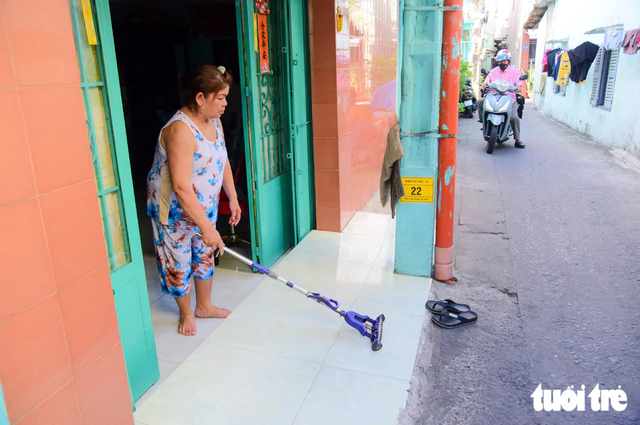
Le Thi Chau, 64, who lives in Chanh Hung Ward, Ho Chi Minh City, hopes compensation and resettlement policies will be appropriate. Photo: Tri Duc / Tuoi Tre
Compared with previous canal and waterway improvement projects in Ho Chi Minh City, the southern bank of Doi Canal project stands out as the largest in terms of investment.
For comparison, the Nhieu Loc-Thi Nghe Canal renovation project, whose first phase was inaugurated in 2012, had a total investment of more than VND8.6 trillion ($337 million).
More recently, the nearly nine-kilometer Xuyen Tam Canal renovation project was approved with an investment of more than VND17.2 trillion ($674 million).
Meanwhile, the 32.7-kilometer Tham Luong-Ben Cat-Nuoc Len Canal project had a revised total investment of VND9.03 trillion ($354 million).
In terms of relocation, the Nhieu Loc-Thi Nghe Canal project previously required the clearance of more than 7,000 households.
Nevertheless, with over 6,000 affected cases along just 8.8 kilometers, the Doi Canal project also involves a massive land clearance effort.
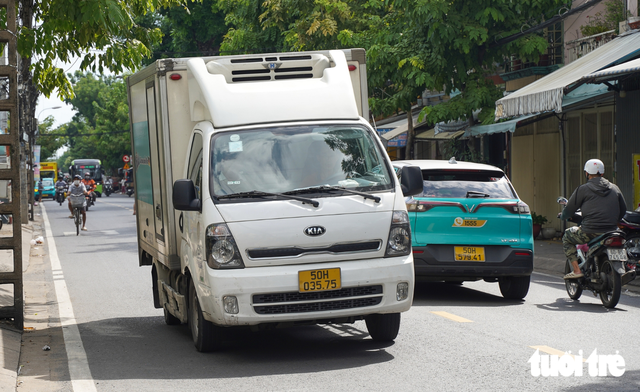
Pham The Hien Street will be widened to 30 meters following the project. Photo: Thuan Van / Tuoi Tre
Affected wards step up land clearance efforts
Thousands of houses still stand close together along the southern bank of Doi Canal, with many built right at the water’s edge.
Numerous homes featuring corrugated metal roofs, wooden pillars and plank walls have deteriorated after decades of use.
Le Thi Chau, 64, who lives in an alley off Pham The Hien Street in Chanh Hung Ward, said she had lived in the area for more than 20 years and supported the policy of relocating canal-side households to facilitate urban renewal and improve living conditions.
However, she hopes local authorities will provide clear information about compensation and resettlement policies, as well as support measures to help residents rebuild their lives after relocation.
Chau is among the more than 6,100 cases affected by the project.
Land clearance efforts are currently being accelerated by authorities in Chanh Hung and Binh Dong Wards.
Regarding compensation progress, a representative of the Chanh Hung Ward construction investment project management board said that, as of early November, officials had completed record preparation, document collection and data entry into the management software for 880 of the 944 affected cases along the section from Rach Ong Bridge to Mat Bridge.
For the section from Mat Bridge to Hiep An Bridge, authorities had prepared records and collected documents for 1,650 of the 2,060 affected cases, with information on 1,100 cases already entered into the software system.
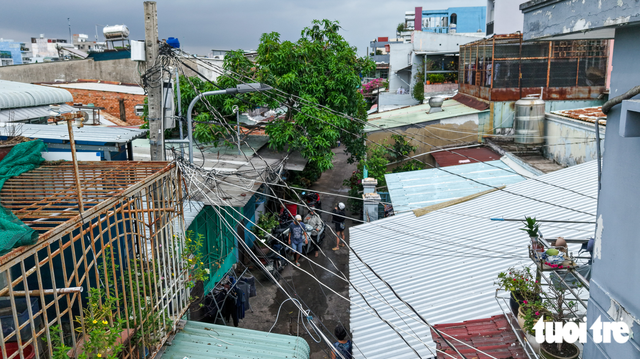
Houses lie along alleys of Pham The Hien Street on the southern bank of Doi Canal. Photo: Tri Duc / Tuoi Tre
In the coming period, the ward will focus on finalizing its land acquisition plan, coordinating the establishment of a compensation, assistance and resettlement council, and selecting a consultancy firm to conduct land price appraisals.
“Local authorities will draw on experience gained from the northern bank of Doi Canal project, where 800 affected cases were resolved with total compensation payments exceeding VND2.466 trillion ($96.6 million).
According to the ward authorities, canal-side projects typically involve a high proportion of households with small residential land areas, many of which are subject to complete clearance.
This creates an urgent demand for resettlement housing.
Therefore, the ward is urging the city to promptly increase its resettlement housing supply and introduce appropriate compensation and assistance mechanisms to ensure that affected residents can stabilize their lives after relocation.
Meanwhile, Binh Dong Ward is conducting surveys, land measurements, and the collection and verification of housing and land documents in preparation for developing compensation, assistance and resettlement plans.
On November 2, the Ho Chi Minh City People’s Committee issued a plan for compensation, assistance, resettlement and land acquisition for the section stretching from Hiep An Bridge to Ba Tang Bridge in Binh Dong Ward.
Under the plan, the city aims to complete the handover of the entire site before March 31, 2027.
Tieu Bac - Tri Duc / Tuoi Tre News
Link nội dung: https://news.tuoitre.vn/ho-chi-minh-citys-largest-canal-project-to-displace-over-6100-households-103261109155620267.htm