
Ho Chi Minh City’s Tan Son Nhat airport stays smooth despite sharp rise in National Day holiday travel
Passenger traffic is surging during Vietnam’s National Day holiday, but airport procedures and airfares have remained relatively manageable at Ho Chi Minh City’s Tan Son Nhat International Airport in the first days of the period.
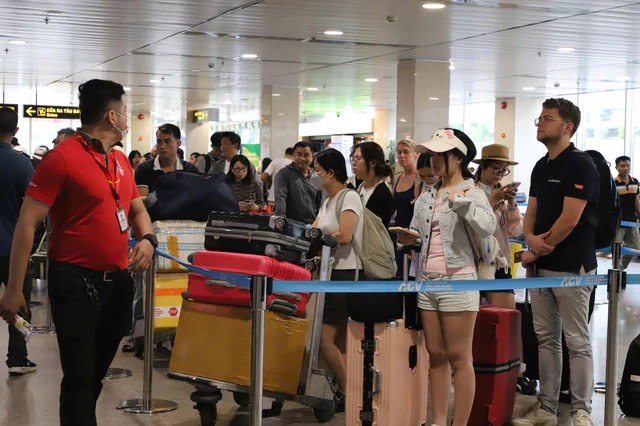
Passengers queue to check in at Terminal 1 of Tan Son Nhat International Airport in Ho Chi Minh City during the National Day holiday 2026. Photo: C. Trung / Tuoi Tre
Vietnamese civil servants and public employees are enjoying a five-day National Day break this year following a workday swap.
The two official public holidays fall on Tuesday, September 1 and Wednesday, September 2.
As Monday, August 31 falls between the weekend and the two holidays, it is swapped with a working Saturday, creating a five-day break from Saturday, August 29 through Wednesday, September 2.
According to Tuoi Tre (Youth) online newspaper observations during the first days of the holiday, operations at Tan Son Nhat International Airport have remained relatively smooth.
Passenger Thuy Trang and her family drove from Thu Dau Mot City in former Binh Duong Province, now part of Ho Chi Minh City, to the airport two hours early for their flight to Da Nang City, fearing traffic jams, long queues and a missed flight.
However, check-in counters were not particularly crowded, while security screening areas did not see the long lines that had been common during previous holiday periods.
The smooth flow of passengers inside the terminal does not mean fewer people are traveling. Statistics, however, show the opposite.
During the six-day peak period from August 28 to September 2, Tan Son Nhat is expected to handle an average of around 130,000 passengers and 780 flights per day, up 16 percent and 12 percent, respectively, year on year.
On the busiest days, the airport could handle around 135,000 passengers and more than 800 flights.
So, what is making the difference?
More capacity, smarter procedures
The biggest change is the involvement of Domestic Terminal 3, which began operations on April 19 last year, and has helped ease pressure on Terminal 1.
On August 30 alone, Terminal 3 is estimated to handle 273 domestic flights carrying around 37,500 arriving and departing passengers, while Terminal 1 is set to operate 155 flights serving more than 26,500 passengers.
The total number of passengers has increased, but they are no longer concentrated at a single terminal, helping reduce passenger density at each facility.
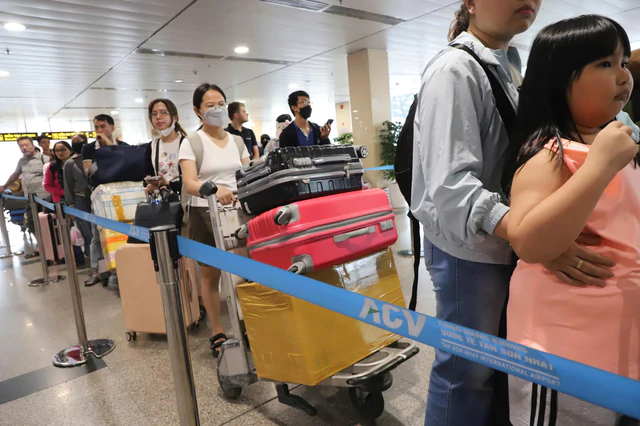
Passengers queue to check in at Terminal 1 of Tan Son Nhat International Airport in Ho Chi Minh City during the National Day holiday 2026. Photo: C. Trung / Tuoi Tre
The airport’s capacity has increased not only because of the additional terminal but also because the time required to process each passenger has been reduced.
With online check-in and electronic boarding passes, passengers without checked baggage can go directly to the security screening area instead of queuing at check-in counters.
The use of VNeID, Vietnam’s digital identification app, and biometric identification has further simplified the process.
Vietnam Airlines and Vietjet Air have stepped up recommendations for domestic passengers to check in through VNeID, complete verification before their flights and use facial recognition at security checkpoints and boarding gates.
As a result, each counter can serve more passengers, passenger flows through security checkpoints move faster, and travelers have to present documents fewer times.
More flights help ease pressure on fares
Travel demand has increased, but airfares have not risen sharply across the board.
Some routes remain tight, including Ho Chi Minh City-Tuy Hoa, where the booking rate has reached 99 percent, Ho Chi Minh City-Con Dao at 98 percent, and Hanoi-Chu Lai at 100 percent.
However, booking rates were only around 55 percent on the Hanoi-Da Nang route and 69 percent on the Hanoi-Phu Quoc route at the time of Tuoi Tre’s reporting.
Airlines said they had proactively increased capacity ahead of the peak period.
Nearly one million seats have been made available on key domestic tourist routes, up around 10 percent year on year.
Vietnam Airlines added around 60,000 seats, bringing its total capacity to nearly 725,000 seats across more than 3,600 flights, while Vietjet added around 82,000 seats, equivalent to about 400 flights.
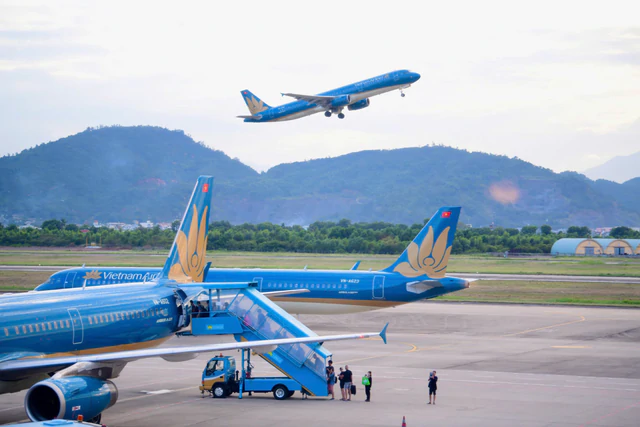
Nearly one million seats have been made available on key domestic tourist routes during the 2026 National Day holiday, Photo: Quang Dinh / Tuoi Tre
The increased supply has spread demand across more flights while giving passengers more choices in terms of airlines, departure times and fares.
As a result, a peak travel period no longer necessarily means every route will sell out or fares will skyrocket.


Cong Trung - Dong Nguyen / Tuoi Tre News